

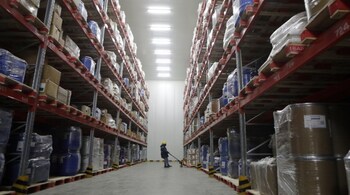
The chain breaks here, in a tiny medical clinic in Burkina Faso that went nearly a year without a working refrigerator.
From factory to syringe, the world’s most promising coronavirus vaccine candidates need non-stop sterile refrigeration to stay potent and safe.
But despite enormous strides in equipping developing countries to maintain the vaccine “cold chain,” nearly 3 billion of the world’s 7.8 billion people live where temperature-controlled storage is insufficient for an immunization campaign to bring COVID-19 under control.
The result: Poor people around the world who were among the hardest hit by the virus pandemic are also likely to be the last to recover from it.
The vaccine cold chain hurdle is just the latest disparity of the pandemic weighted against the poor, who more often live and work in crowded conditions that allow the virus to spread, have little access to medical oxygen that is vital to COVID-19 treatment, and whose health systems lack labs, supplies or technicians to carry out large-scale testing.
Maintaining the cold chain for coronavirus vaccines won’t be easy even in the richest of countries, especially when it comes to those that require ultracold temperatures of around minus 70 degrees Celsius (minus 94 F). Investment in infrastructure and cooling technology lags behind the high-speed leap that vaccine development has taken this year due to the virus.
With the pandemic now in its eighth month, logistics experts warn that vast parts of the world lack the refrigeration to administer an effective vaccination program. This includes most of Central Asia, much of India and southeast Asia, Latin America except for the largest countries, and all but a tiny corner of Africa.
The medical clinic outside Burkina Faso’s capital, a dirt-streaked building that serves a population of 11,000, is a microcosm of the obstacles.
After its refrigerator broke last fall, the clinic could no longer keep vaccines against tetanus, yellow fever, tuberculosis and other common diseases on site, nurse Julienne Zoungrana said.
Staff instead used motorbikes to fetch vials in insulated carriers from a hospital in Ouagadougou, making a 40-minute round-trip drive on a narrow road that varies between dirt, gravel and pavement.
A mother of two who visits the Gampela clinic says she thinks a coronavirus inoculation program will be challenging in her part of the world. Adama Tapsoba, 24, walks four hours under scorching sun to get her baby his routine immunizations and often waits hours more to see a doctor. A week earlier, her 5-month-old son had missed a scheduled shot because Tapsoba’s daughter was sick and she could only bring one child on foot.
“It will be hard to get a (COIVD-19) vaccine,” Tapsoba said, bouncing her 5-month-old son on her lap outside the clinic. “People will have to wait at the hospital, and they might leave without getting it.”
To uphold the cold chain in developing nations, international organizations have overseen the installation of tens of thousands of solar-powered vaccine refrigerators.
Keeping vaccines at stable temperatures from the time they are made until they are given to patients also requires mobile refrigeration, reliable electricity, sound roads and, above all, advance planning.
For poor countries like Burkina Faso, the best chance of receiving a coronavirus vaccine is through the Covax initiative, led by the World Health Organization and the Gavi vaccine alliance. The goal of Covax is to place orders for multiple promising vaccine candidates and to allocate the successful ones equitably.
The United Nations’ children’s agency, UNICEF, began laying the global distribution groundwork months ago, in Copenhagen.
At the world’s largest humanitarian aid warehouse, logistics staff are trying to foresee shortages by learning from the past, especially the spring chaos surrounding global shortages of masks and other protective gear that were commandeered off airport tarmacs or stolen and traded on the black market.
Currently, 42 coronavirus vaccine candidates are in clinical trials and another 151 are in pre-clinical evaluation, according to WHO. The ones most likely to end up in the Covax mix must be stored at 2 to 8 degrees Celsius (25-46 F).
A Pfizer candidate is among the ones in advanced testing requiring storage at ultracold temperatures. The company, which has designed a special carrying case for its vaccine, has expressed interest in Covax and signed contracts with the United States, Europe and Japan.
Medical freezers that go down to minus 70 degrees Celsius are rare even in U.S. and European hospitals. Many experts believe the West African countries that suffered through a 2014-16 Ebola outbreak may be the best positioned, because a vaccine against that virus also requires ultracold storage.
For more than two-thirds of the world, however, the advanced technology is nowhere on the horizon, according to a study by German logistics company DHL. Meanwhile, billions of people are in countries that don’t have the necessary infrastructure to maintain the cold chain for either existing vaccines or more conventional coronavirus candidates, the study said.
Opportunities for vaccines to be lost expand the farther a vaccine travels. DHL estimated that 15,000 cargo flights would be required to vaccinate the entire planet against COVID-19, stretching global capacity for aircraft and potentially supplies of materials such as dry ice.
“We need to find a bridge” for every gap in the cold chain, DHL chief commercial officer Katja Busch said.
“We’re talking about investments ... as a society, this is something we have to do.”
Gavi and UNICEF worked before the pandemic to supply much of Africa and Asia with refrigeration for vaccines, fitting out 40,000 facilities since 2017. UNICEF is now offering governments a checklist of what they will need to maintain a vaccine supply chain and asking them to develop a plan.
“The governments are in charge of what needs to happen in the end,” said Benjamin Schreiber, who is among the directors of UNICEF’s vaccination program.
Cracks in the global cold chain start once vaccines leave the factory. Container ships are not equipped to refrigerate pharmaceutical products with a limited shelf life. Shipping vaccines by air costs a lot more, and air cargo traffic is only now rebounding from pandemic-related border closures.
Even when flights are cold and frequent enough, air freight carries other potential hazards. WHO estimates that as much as half of vaccines globally are lost to wastage, sometimes due to heat exposure or vials breaking while in transit. With coronavirus vaccines, which will be one of the world’s most sought-after products, theft is also a danger.
“They can’t be left on a tarmac and fought over because they would actually be spoiled and they would have no value — or worse still, people would still be trying to distribute them,” said Glyn Hughes, the global head of cargo for the International Air Transport Association.
Tinglong Dai, a Johns Hopkins University researcher who specializes in health care logistics, said creativity will be needed to keep the cold chain intact while coronavirus vaccines are distributed on a global scale.
Gavi and UNICEF have experimented with delivering vaccines by drone. Indian officials have floated the idea of setting aside part of the country’s vast food storage network for the coronavirus vaccines.
“If people can figure out how to transport ice cream, they can transport vaccines,” Dai said.
Temperature-sensitive labels that change color when a vaccine is exposed to heat too long and no longer safe to use, and live delivery tracking to ensure vaccines reach their destinations as intended also have allowed for progress in delivering safe shots.
Yet chances for something to go wrong multiply on the ground as vaccines are prepped to leave national depots. Since the cold chain is so fragile, logistics planning is crucial; syringes and disposal boxes must be available as soon as vaccine shipments arrive.
By the end of the year, UNICEF expects to have 520 million syringes pre-positioned for coronavirus vaccines in the developing world and maps of where the refrigeration needs are greatest “to ensure that these supplies arrive in countries by the time the vaccines do,” Executive Director Henrietta Fore said.
The last vaccine requiring cold storage that India’s national program adopted was for rotavirus, a stomach bug that typically affects babies and young children. Dr. Gagandeep Kang, who led the research for that vaccine, estimated that India has about 30 percent less storage capacity than it would need for a coronavirus vaccine.
In countries such as India and Burkina Faso, a lack of public transportation presents another obstacle to getting citizens inoculated before vaccines go bad.
Dr. Aquinas Edassery, who runs two clinics in one of India’s poorest and least developed regions, said patients must walk for hours to receive health care. The trip on a single road that winds 86 kilometers (53 miles) over steep hills and washes out for months at a time will pose an insurmountable barrier for many residents of the eastern district of Rayagada, Edassery said.
As with most logistics, the last kilometer (mile) is the hardest part of delivering a coronavirus vaccine to the people who need it. In Latin America, perhaps nowhere more than Venezuela provides a glimpse into how the vaccine cold chain could go dramatically off course.
When a blackout last year left much of the nation in the dark for a week, doctors in several parts of Venezuela reported losing stocks of vaccines. The country’s largest children’s hospital had to discard thousands of doses of vaccines for illnesses like diphtheria, according to Dr. Huníades Urbina, head of the Venezuelan Society of Childcare and Pediatrics.
“We won’t be able to halt either the coronavirus or measles,” Urbina said.
Preserving the cold chain has only grown more difficult since then. Gas shortages limit the ability to move vaccines quickly from one part of Venezuela to another. Dry ice to keep vaccines cool during transport is harder to find. And after years of economic decline, there also are fewer doctors and other professionals trained to keep the chain intact.
“I’m not optimistic on how the vaccine would be distributed in the inner states because there is no infrastructure of any kind to guarantee delivery — or if it gets delivered, guarantees the adequate preservation under cold conditions,” Dr. Alberto Paniz-Mondolfi, a Venezuelan pathologist, said.
Venezuela presents an extreme example, but a coronavirus vaccine also is likely to test parts of Latin America with more robust health care systems. In Peru, private businesses that typically transport fish and beef have offered their trucks, though it remains unclear whether the Health Ministry will accept.
Back in Burkina Faso, vaccination days became an ordeal at the Gampela clinic when the refrigerator went out, said Zoungrana, the nurse. Staff members on hospital courier runs must buy fuel they often can’t afford and make a second trip to and from the capital to return any unused doses.
“We’re suffering,” said Zoungrana, who was run off the road on her motorbike just a few weeks ago.
Days after journalists from The Associated Press visited the clinic this month, a long-awaited solar refrigerator arrived. With technicians in short supply, the clinic was waiting to be sure the appliance would function properly before stocking it with vaccines.
Nationwide, Burkina Faso is about 1,000 clinical refrigerators short, and less than 40 percent of the health facilities that conduct vaccinations have reliable fridges, national vaccination director Issa Ouedraogo said.
Multi-dose vials — the equivalent of bulk storage for vaccines — can drastically reduce global transportation costs. But once a vial is opened, its shelf life counts down even faster; if too few people show up for their jabs in time, whatever remains in the larger vials must be discarded.
“It’s really upsetting to have wastage like that. It’ll result in loss of lives and pain and suffering. It’s a waste of resources,” said University of Massachusetts at Amherst professor Anna Nagurny, who studies supply chain logistics.
For now, UNICEF is betting on 20-dose vials of coronavirus vaccine and hoping that the amount wasted will stay below 3 percent for closed vials and 15 percent for open multi-dose vials that do not get used up, according to Michelle Siedel, one of the UN agency’s cold chain experts.
If Burkina Faso were given 1 million doses of a coronavirus vaccine today, the country wouldn’t be able to handle it, Jean-Claude Mubalama, UNICEF’s head of health and nutrition for the African nation.
“If we had to vaccinate against the coronavirus now, at this moment, it would be impossible,” he said.
Follow our full coverage of the coronavirus pandemic here.
Discover the latest Business News, Sensex, and Nifty updates. Obtain Personal Finance insights, tax queries, and expert opinions on Moneycontrol or download the Moneycontrol App to stay updated!





