

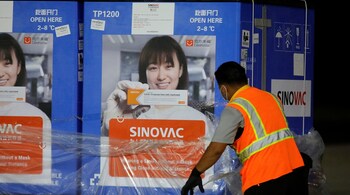
Several countries that administered doses of COVID-19 vaccines developed by Chinese companies have reported a surge in novel coronavirus infections.
At a time when the United States and the West moved slowly to donate doses to other countries, the Chinese government prioritised sending vaccines to developing nations. The aim behind the People’s Republic of China’s ‘vaccine diplomacy’ was to have greater influence over developing nations and possibly to secure commercial deals.
As recently as June 20, 1.5 million doses of the China’s Sinovac vaccine reached Pakistan amid shortage of jabs in the South Asian country. Bangladesh also recently signed a deal with China to buy the Sinopharm COVID-19 vaccine.
However, China’s ambitious plans may have taken a beating after many of these beneficiary countries reported a spike in coronavirus infections.
On June 20, China’s National Health Commission (NHC) announced that over one billion doses of COVID-19 vaccines had been administered across the mainland. The country had accelerated the pace of free inoculations drive in late March. However, authorities did not reveal how many people had been fully vaccinated.
A total of 21 COVID-19 vaccines have entered clinical trials in China so far. Seven of these have been granted conditional marketing authorisation or emergency use authorisation (EUA).
The main Chinese-made COVID-19 vaccines being delivered on a large scale are CoronaVac, developed by Sinovac; Convidecia, developed by CanSino Biologics; and Sinopharm’s BBIBP-CorV.
However, the World Health Organization (WHO) has granted emergency approval to just two of these vaccines, Sinopharm and Sinovac, which China has supplied and exported to several countries.
CoronaVac has been granted EUA in Azerbaijan, Bangladesh, Brazil, Indonesia, Malaysia, Mexico, Pakistan, Turkey and Ukraine, among others. Convidecia has received emergency use nods from authorities in Argentina, Chile and Moldova, among others.
Sinopharm’s BBIBP-CorV has received full use approval in Bahrain, Seychelles and United Arab Emirates (UAE), and emergency use authorisation in 72 other countries including Afghanistan, Maldives, Mauritius, Morocco, Sri Lanka, Thailand and Vietnam.
Additionally, a many low- and middle-income countries are eligible to receive doses of vaccines like CoronaVac under the COVAX programme.
COVID-19 Vaccine Tracker: All you need to know about manufacturing and pricing
The Contrast
According to Our World in Data, a platform compiling vaccination numbers from around the globe, 50 to 68 percent of the population in the Seychelles, Chile, Bahrain and Mongolia have been fully inoculated. That number is higher than that of the United States.
All four countries largely used Chinese vaccines. Yet, they rank among the top 15 nations (Seychelles and Mongolia are ranked no. 1 and 2, respectively) with the worst COVID-19 outbreaks over the past week, according to data from The New York Times. This assessment is based on cases per one lakh population.
Seychelles, where a sizeable chunk of the population received a Chinese-made vaccine, reported 145 COVID-19 cases per one lakh population over the last seven days. The number was 66 for Mongolia. In comparison, India's COVID-19 infections per one lakh people stood at four, despite a large section of the population not having received even the first dose.
In comparison, Israel which has given at least one dose to a lesser number of people than Seychelles, but used American pharmaceutical giant Pfizer’s vaccine has recorded less than one case per one lakh people over the past seven days.
While scientists still do not know why some countries with high vaccination rates are witnessing outbreaks, new coronavirus variants and easing of restrictions too early may have also contributed to spike in cases. Plus, most Chinese pharma firm have not released much of the clinical trial data prove how well their shots work.
The contrast in infection rates and questions over jab efficacy may push developing countries turning to the West for more doses instead of China.
Follow Moneycontrol’s full coverage of the coronavirus pandemic here
Discover the latest Business News, Sensex, and Nifty updates. Obtain Personal Finance insights, tax queries, and expert opinions on Moneycontrol or download the Moneycontrol App to stay updated!





