

On a recent Sunday night at Le Bilboquet, a see-and-be-seen restaurant in the Hamptons on Long Island, well-heeled diners nibbled on $475 tins of Osetra caviar. A handsome man showed off his gold Audemars Piguet watch to his sparkly female companion. A party of 10 in polo shirts and striped rompers danced to a tropical house remix of Tina Turner’s “What’s Love Got to Do With It.”
They were all unmasked, while the wait staff, bartenders and other servers kept their mouths and noses covered.
A similar scene unfolded at the Gucci store in East Hampton, where shoppers removed their masks upon reading the door sign stating that vaccinated customers could enter without face coverings. Inside, they were attended to by store clerks in blue-and-white surgical masks, per company policy.
In the weeks since the Centers for Disease Control and Prevention revised its mask guidelines to allow fully vaccinated people to take their masks off in most indoor settings, a stark divide has emerged, particularly in wealthier enclaves where services are at a premium.
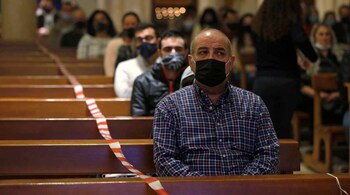
Those who are still wearing masks tend to be members of the service class — store clerks, waiters, janitors, manicurists, security guards, receptionists, hair stylists and drivers — while those without face coverings are often the well-to-do customers being wined and dined.
Employers are hesitant to discuss their mask policies, but there are sensible reasons for requiring staffers to keep their masks on.
Just under 50% of people in the United States are fully vaccinated. And coronavirus variants, some of which are highly infectious and may be more resistant to vaccines, are on the rise, said Dr. Lisa Maragakis, an public health researcher and associate professor at Johns Hopkins University.
Food servers, retail clerks, grocery cashiers and other public-facing workers interact all day with customers, which can put their health (and the health of their customers) at risk. This not only creates potential liability issues for employers, but also could hamstring a business at a time of worker shortages.
Even at establishments that give vaccinated employees the choice to take their masks off, many are keeping them on. “Who knows who has had their shot and who hasn’t,” said Michelle Booker, a store clerk from the Bronx who works at a Verizon store in midtown Manhattan. She was wearing her mask on a recent Tuesday, although the company permits vaccinated employees to go without masks. “I don’t believe half of the people who come in,” she said. “I’m still terrified.”
And from a public-relations standpoint, seeing employees with masks sends a message about how management regards the health of its customers and staff. “Their workers are serious professionals who take safety seriously,” said Erin Vearncombe, a professor at the University of Toronto who studies the sociology of dress codes.
The resulting class divide may not always be intentional, but it still can be jarring to see how masks have emerged as another symbol of inequality from the pandemic.
At an Apple store in midtown on a recent Friday, mask-free customers could be seen buying $1,500 iPhones from masked salespeople who may not make that much in a week. At a nearby Sweetgreen, food workers in black masks and matching aprons, and who were mostly people of color, prepared $14 berry and burrata salads for a largely white clientele.
“It sends a message — one that’s been internalized on both sides — that the body of the mask wearer is ‘riskier’ than the body of the consumer,” Vearncombe said. “It shows that certain groups have, and even deserve, more civil liberties than others.”
Some workers argue that the mask double standard — one rule for customers; another for staff — is not just discriminatory, but defies logic.
“Customers have to be vaccinated to go maskless, but we can’t ask for proof,” said Jose de la Rosa, 26, who works behind the counter at Juice Generation in Times Square. “And we have workers who are fully vaccinated, can prove it and still have to wear them. It’s odd.”
As more Americans get vaccinated, some establishments have adopted a single policy for both staff and customers, allowing anyone who has been fully vaccinated to ditch the mask.
A diverse array of stores — including Louis Vuitton, Verizon, Dior, Target and Home Depot — have this policy at all their stores in the United States. Starbucks recently announced that vaccinated workers would be able to remove their masks starting Monday.
But for now, a mask divide remains at many places. On a recent afternoon in Hudson Yards, Mark Pasektsky, 49, a public-relations strategist, was shopping for shirts at Theory. The clerks helping him wore masks. He did not.
“It’s weird, right?” he said. “On one level, you can’t completely blame employers. How do you comfortably institute a policy that protects everyone? You can’t answer it because there is no answer. But the psychology behind the other approach is very curious. Why are they making employees wear masks while the customers do not? Everyone is just confused.”
(Author: Jacob Bernstein )/(c.2021 The New York Times Company)
Discover the latest Business News, Sensex, and Nifty updates. Obtain Personal Finance insights, tax queries, and expert opinions on Moneycontrol or download the Moneycontrol App to stay updated!





