

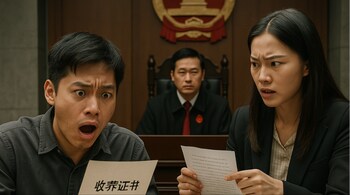
A bitter inheritance battle between a brother and sister in northern China took an unexpected turn when both discovered they were not the biological children of the parents whose estate they were contesting.
The dispute began after the death of Sun, a Tianjin resident, in March 2025. Before his death, Sun transferred ownership of a property worth three million yuan (approximately Rs 3.6 crore) solely to his son, while leaving a note requesting that his daughter—adopted in 1966—be “reasonably compensated," South China Morning Post (SCMP) reported.
The daughter challenged the transfer, arguing that the contract bore only her father’s signature and that her late mother’s share should be included in the estate. “Since the contract was signed only by him, my mother’s share should be treated as part of the inheritance. This house was given to me by my parents, no one is taking it from me,” she said.
But the legal battle escalated when she presented evidence in court showing that her brother’s household registration listed him as “adopted,” revealing that neither sibling was biologically related to the deceased couple.
The revelation resulted in the brother breaking down in court. He argued that his sister had severed ties with the family in the 1990s over a property dispute and that he alone had cared for their parents until their deaths.
The Nankai District People’s Court clarified that under China’s Civil Code, adopted children have equal inheritance rights. But, since the property had been legally transferred and notarised in 2007, it no longer formed part of the estate.
After three hours of mediation, the siblings reached a settlement: the brother would retain the property and pay his sister 550,000 yuan (Rs 67 lakh) in compensation.
Discover the latest Business News, Sensex, and Nifty updates. Obtain Personal Finance insights, tax queries, and expert opinions on Moneycontrol or download the Moneycontrol App to stay updated!





