

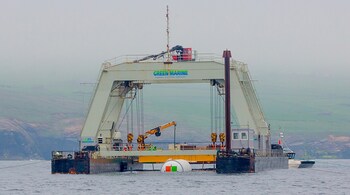
Data servers require exceptional performance per dollar for general purpose and memory-optimised workloads, which in turn require intense cooling to handle multi-threaded workloads.
While liquid cooling addresses the heating issue for personal computers, it doesn’t quite do the job for datacentres.
So, Microsoft is leveraging technology from submarines and working with marine energy experts to dump their datacentres in water-tight pods under the ocean.
Even if liquid cooling was used on each CPU in a datacentre, like Lenovo’s water-cooled server technology, there’s still the issue of dealing with hot air coming out of the radiators.
Water can store significant amounts of heat energy without changing its temperature making it far more efficient to take the entire datacentre and drop it into the ocean.
Once you reach a depth of 150 to 200 metres, you’ll find out that the sea is quite cold, thus providing excellent cooling; even in warm tropical regions.
On the other hand, traditional data farms not only consume massive amounts of energy, but they are also located relatively far from populated areas on account of the physical size and lower land cost.
While this does reduce cost, it means that the data would have to travel a relatively long way before getting to you, leading to increased latency and lower speed.
In the ocean, data centres can be placed close to coastal lines, and when you consider the fact that 40% of the world’s population resides within 100 kilometres of the coasts, you could very well be looking at better and faster connections.
Building a server warehouse would require huge acres of land. And you’d also have to consider typography and the workforce in the region. These issues will keep popping up every time a company needs to increase capacity.
It would also be much faster to build water-tight pods that house data servers and ship them to the desired location in an assembly line. A water-tight pod would only need to be connected to data lines and a power source.
Underwater server-pods will have to provide excellent access for technicians to quickly solve hardware issues. Another issue is barnacles. Pods will require special barnacle-repellent coating, as they can interfere with heat transfer.
As with everything, a big leap forward doesn’t come without its fair share of challenges and hurdles.
Discover the latest Business News, Sensex, and Nifty updates. Obtain Personal Finance insights, tax queries, and expert opinions on Moneycontrol or download the Moneycontrol App to stay updated!





