

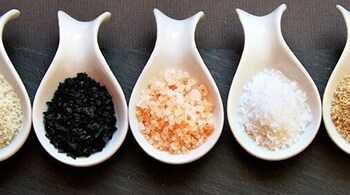
How to make a bland dish taste good? If you, like yours truly, had thought the solution is to ‘spice it up’, then it would literally be a ‘burning’ dish. The answer, like all good cooks may suggest, is to add salt. It is the single most important ingredient to a dish, a transformative one at that. In the hands of someone who knows how to use it, salt will elevate all dishes. It can minimise bitterness, intensify flavour (of chocolate even), and offer the right ‘savoury’ yin to the sweetness ‘yang’ of sugar.
Nowadays, salt comes from all over the world, in different textures, hues and taste. So much so, there are experts aka slemeliers who specialize in salt textures and flavours. The array of salts stacked on the shelves of a gourmet store can be perplexing to the uninitiated. Varieties like Himalayan Pink salt, kosher salt, a range of exotic sea salts, smoked salts (yup!) and more will boggle the mind. You may wonder about the hyperbole around artisanal salts and the exorbitant price tags.
More than a decade back, scientists from North Carolina State University in Raleigh published a study on 38 salts from all over the world. They discovered that different salts do taste different even if the concentration of sodium chloride is the same. Trace minerals can actually accentuate or suppress the saltiness. While some salts tasted barely different, the study showed that one could distinguish between the taste of different salts.
Culinary salts either come from sea or from underground deposits. Most have some trace of minerals. India’s own kala namak or sulemani namak is actually dark red in colour because of the mineral called greigite that’s rich in iron sulphide salt. It is prepared from heating halite – a volcanic rock salt mined in the Himalayan regions – for several hours with amla and haritaki.
For many Indians, this is only other salt they use apart from the common table salt. Chef Meherwan Irani, winner of the James Beard Foundation Award for his US-based restaurant Chai Pani, opines that even though kala namak has a sulphuric smell, it is a fantastic flavour enhancer. Since Chai Pani specialises in Indian street food, kala namak is used in most of the preparations. “We go through 50 kilos of kala namak in a year,” he said. “Westerners may find the smell of the salt in itself off-putting but in chaat masala, it’s much more balanced and adds just the tiniest amount of funk. Kala namak is perfect for okra fries, paani puri, and so many of our chaat dishes. Much like fish sauce, when used sparingly, it adds an incredible umami to a dish.”
In his book Salt, Fat, Acid and Heat, Samin Nosrat writes on the three basic decisions involving salt. ‘When? How much? In what form?’ Adding salt to a dish is not a one-time thing. In general, chefs like to add salt at every stage of cooking. Marinating meat with salt before cooking helps the salt seep in when cooked. Specialty salt flakes or crystals are great as garnish because of their texture, appearance and taste. Bengaluru-based Vikas Seth, chef and culinary director of Embassy Leisure, uses smoked sea salt as a finishing for grilled meats, local and imported sea salts for covering whole fish before baking it, and Himalayan Pink salt slabs for presentation. “There’s wisdom in using salt,” he said. “It has the ability to intensify the flavours and bring out the natural flavours as well. The right amount of salt, sometimes it could be just a pinch, can transform a dish from bland to deliciousness. Anything excess can ruin the dish so moderation is the key.”
The science of salt is perfected in Japanese culinary. The country produces around 4000 kinds of salt, based on the place they come from and the size of the crystals. All Japanese salts, shio, are sea salts and often extracted from seaweed. There are unique salts such as Shio no Moto which is traditionally made using slow evaporation process. Moshio is extracted from hondawara, brown algae rich in minerals that grows close to the Japanese coastline. In order to extract the salt, the seaweed is harvested and left to dry for a day, then soaked in pots filled with seawater. This water is boiled in order to obtain a concentrate that eventually turns into salt crystals. The very big salt crystals, shio no hana, are considered very rare and exquisite. Moshio salt is popular and used on simple food or sprinkled on sashimi that’s Japanese raw fish. The holy trinity of shio, seaweed and fish form the backbone of Japanese cuisine. In fact, it is the shio which imparts the umami or the ‘essence of deliciousness’ into the cuisine.
While Japan has its varieties, India is among the top three producers of salt. The Rann of Kutch produces about 75 percent of salt in the country. Though all salt crystals are produced from evaporating water from brine – the crystals formed under the brine are compact and dense while those formed at the surface are flaky and hollow – the pace of evaporation determines the shape of the crystals formed. This can make a big difference in their flavour. The salts we commonly encounter are: table salt that’s compact, dense and contains anticaking agents to prevent clumps from forming, the pure kosher salt, and sea salts which could be either natural or refined. With the rising popularity of gourmet salts, people have learnt to treat these salts as flavourful ingredients for cooking or garnishing. To paraphrase James Beard, considered the Father of American cooking, where would we be without salt? Probably adrift in the sea of blandness.
Meet the Salts
Table salt: Harvested from underground salt deposits, the finely ground table salt is probably the most familiar. Most table salt brands have iodised versions with any trace minerals removed in the refining process. These are fortified with anticaking agents, so it won’t clump in humid environments.
Kosher salt: Kosher salt has a light but coarse texture and quick-dissolving versatility.
Sea salt: Though coarser than regular table salt, sea salt is considerably softer to the touch than kosher salt.
Rock salt: Rock salt or halite is salt’s natural form.
Fleur de sel: This is carefully hand-raked from the surface of tidal pools in Brittany, France, using special wooden rakes and under perfect weather conditions.
Flake salt: The crunchy crystals of flake salt are best used as a finishing garnish.
Himalayan pink salt: Hand-harvested from the Khewra Salt Mine deep in the Himalayan mountains in Pakistan, this salt is notable for its colour which can be light to vivid pink. Himalayan salt contains all 84 natural minerals found in the human body and due to its rich mineral content, the flavor can be more intense or complex than the average kitchen salt. Slabs of this salt can hold heat for hours, making it a popular cooking stone for delicate proteins like fish.
Hawaiian salt: It comes in both red and black colours. Black Hawaiian salt is a combination of volcanic sea salt and activated charcoal while red Hawaiian salt is unrefined sea salt combined with red volcanic clay, making it rich in iron.
Celtic sea salt: Also known as “sel gris”, Celtic gray salt is harvested from tidal eddies along the French coast. Unlike fleur de sel, which is combed from the surface of the salt water, sel gris is raked from the tidal floor. Its crystals are large and moist.
Smoked salt: Smoked salt is salt that has spent slow heating for two weeks over burning wood. It takes on the aromatic intensity of whichever wood that might be.
Peruvian Pink Salt: Harvested from ancient sea salt deposits in Peru, this salt has a pink color and a mild flavor.
Murray River Pink Salt: Harvested in Australia, this salt has a delicate peach hue due to the presence of minerals. It's often used as a finishing salt and adds a subtle flavor to dishes.
Bamboo Salt: Originating in Korea, bamboo salt is made by packing sea salt into bamboo tubes and then roasting it multiple times in a pine wood furnace. This process imparts a unique flavor to the salt.
Persian Blue Salt: Mined in Iran, this salt is known for its blue crystals, which comes from the presence of the mineral sylvinite. It has a mild taste and is often used as a finishing salt.
Discover the latest Business News, Sensex, and Nifty updates. Obtain Personal Finance insights, tax queries, and expert opinions on Moneycontrol or download the Moneycontrol App to stay updated!





