

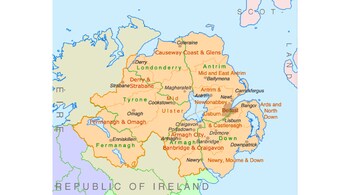
Reviews in the UK press have called The Colony an allegory of the Troubles, a period of great sectarian conflict in Northern Ireland, a country that is part of the United Kingdom and was once part of Ireland.
Audrey Magee’s second novel, after her first, The Undertaking, follows an English painter named Mr Lloyd, and Jean-Pierre Masson, a Frenchman of Algerian descent, to a remote island off the west coast of Ireland, where they both spar even as the local Irish-speaking family of Gillans watch.
To these characters, the native islanders are a passive bunch, watching the conflict unfold but never actively seeking change. The period of the novel’s setting is deeply telling. The year 1979 saw the Irish Republican Army (IRA) assassinate Lord Mountbatten in Sligo, and 18 British soldiers at County Down.
During this peak year of the Troubles, the novel explores issues of identity, language and colonialism that are at once universal, and relevant for any region of conflict anywhere in the world. In the end, it leaves us with questions to reflect on: To what extent can language divide or unite people or shape identities? To what extent can it engineer protests?
Moneycontrol spoke with Audrey Magee to learn more:
There is a dispassionate writer and observer in your novels. One gets a sense of you essentially looking from a distance, and richly recording the lives of your characters. To what extent do you think your journey as a journalist has shaped your writing style, your treatment of your subjects, and the plots of your books?
That's difficult to tell, isn't it? The writer is an amalgam of his, her or their life. Was I attracted to journalism because I was always an observer, always slightly on the outside, looking in? In my 20s, journalism seemed a natural fit as it allowed me to travel the world listening, observing, recording. But it wasn't enough. I needed to step back even further than journalism allowed to see the patterns in human behaviour, to analyse and understand the frameworks behind power and control; for that is what interests me as a writer, the impact of power and politics on the ordinary person. Writing novels is an exploration of these issues, and each reader comes to my books with their own experiences of power and politics, their own understanding of their impact on everyday lives. I respect those experiences and understanding very much and I am not going to tell the reader what to think, how to feel. I ask only that the reader comes on a trip, enters a space where we might - or might not - unpick a few things. To create that space, I write in a style more closely aligned with theatre than journalism, all the time imagining the reader as a member of the audience, an active participant in what is unfolding in front of them.
Do you think objectivity, which is valued in journalism, is needed in fiction as well, especially when dealing with complex political issues?
I think fiction requires tolerance rather than objectivity, tolerance of characters, ideas, situations, opinions, outlooks, ideologies. Without tolerance, there is no understanding; without understanding, there is no good fiction.
There are intensely political conversations in your novels. For instance, the rivalry between the painter and the linguist in 'The Colony' is simmering from the start. To their story, the lives of the native people on the island seem to be serving a peripheral role. Was this intentional? Would you say The Island is more a take on how foreigners or visitors see Ireland, and its inner divisions than the Irish themselves?
I think it's both. You're absolutely right, in the beginning it is all about the two visiting men and their conflicting interpretations of how the islanders should live their lives. But that conflict inevitably spreads to the islanders themselves who feel compelled to define themselves in the midst of these conflicting men. And that is a distillation of colonisation, what it is and what it does. It is a method of control and governance that pitches people against each other, compelling them to chose sides, chose language, chose religion. It is a paradigm built on conflict; the island in The Colony ends up immersed in that conflict.
How much of the novel draws from your own life as an Irish person? Where did the inspiration for the book come from?
It came from being an Irish woman who grew up in Ireland but then travelled to Australia, Pakistan, Bangladesh, Sri Lanka, Thailand, Central Asia, Israel, only to find that the issues we faced in Ireland over language and identity are replicated around the world. I am drawn to the commonality of our experiences, and it is that commonality of experience that I explore in The Colony.
In politically sensitive works, do you find your journalistic voice easier to tell your story, or your personal? We have seen in your novel a detached voice, but at the same time, we know you are from Ireland and are writing a novel that is rooted in your home country.
It's actually neither of those voices. My writing has its own voice, the voice that only turns up when I am writing.
In terms of journalists who have written fiction, wWho would you count as your literary influences?
I very much come from a literary rather than journalistic tradition. Before I went into journalism, I studied French and German literature. Those writers remain my enduring influences: Marguerite Duras, Albert Camus, Christa Wolf, and, of course, Samuel Beckett.
English is the most spoken language around the world and much of this can be explained by colonialism. To what extent can language then reflect our assimilation as people into different cultures or identities, and to what extent can it become a tool to protest? Is it possible to do both?
Language is a living thing that is constantly changing, growing, adapting; it flexes and shifts as the speakers and writers wish it to, making it a very exciting medium to work with as a writer, to study as a linguist, or to analyse as an anthropologist. That adaptability allows language to be anything we want it to be - at its most positive, it becomes a tool of communication that allows us to find our commonality. But it can become a negative space when a language, whether spoken by millions or only hundreds, shifts from being a tool to being a weapon. We know that language adapts, but harder to discern is how it is adapted by people in power to further their political and social agendas.
While India’s diversity unites its people, linguistic divides have led to movements, protests and political formations. What message does your novel have for Indians reading your book? What can they expect to take away from your book?
I don't have a message for anybody. My only intention is to create a space for consideration and exploration. What happens after that is up to each individual reader.
'The Colony' by Audrey Magee is published by Faber & Faber (₹599 paperback)
Discover the latest Business News, Sensex, and Nifty updates. Obtain Personal Finance insights, tax queries, and expert opinions on Moneycontrol or download the Moneycontrol App to stay updated!





