

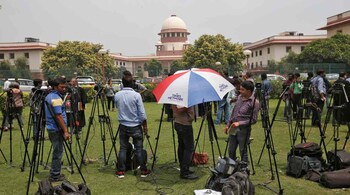
Supreme Court’s Justice Sanjay Kishan Kaul, in his judgment upholding the government’s decision to scrap Article 370, on December 11 suggested setting up of a “truth and reconciliation” commission in Jammu and Kashmir.
The commission should look into the acts of violation of human rights by state and also non-state actors since 1980s, the Supreme Court’s senior most judge after the Chief Justice of India said.
"The commission must be set up before memory escapes. The exercise must be time-bound. There is an entire generation of youth that has grown up with a feeling of distrust and it is to them that we owe the greatest day of liberation," Justice Kaul, who hails from Kashmir, said in his concurring judgment.
Leaving the operational modalities of the commission to the government, Justice Kaul said it should not be turned into a criminal court but must be a platform offering dialogue like in South Africa after the apartheid era came to an end.
Justice Kaul also urged a “reparative” approach so that the commission could enable “achieving forgiveness for the purpose of shared national identity”.
"Much will be achieved when people of Kashmir open their hearts to embracing the past and facilitating the people who were compelled to migrate to come back with dignity. Whatever has been has been, but the future is ours to see,” he said.
The South African government in 1995 set up a truth and reconciliation commission to help heal the country and bring about reconciliation by uncovering the truth about human rights violation during the apartheid period, reports said.
In neighbouring Sri Lanka, the government recently set the ball rolling for a Commission for Truth, Unity and Reconciliation after an earlier plan ran into rough weather.
In a unanimous ruling, a five-judge bench of the Supreme Court upheld the government’s decision to abrogate Article 370, which granted special status to Jammu and Kashmir.
The court said the bifurcation of the state into union territories of Jammu and Kashmir and Ladakh was valid but ordered restoration of J&K’s statehood at the earliest. It also directed the Election Commission to hold election in J&K by September 30.
Led by CJI DY Chandrachud, the bench comprised Justices SK Kaul, Sanjiv Khanna, BR Gavai and Surya Kant.
The court said that Article 370 was a temporary provision, upholding the government’s contention to scrap the provision. The Jammu and Kashmir constituent assembly was never intended to be a permanent and its recommendations were not binding on the President.
Article 370?
Article 370 of the Constitution accorded special status to Jammu and Kashmir, including a separate flag and a constitution. The provision, which was enacted after the instrument of accession was signed by the Indian government and the Maharaja of Kashmir, restricted the powers of Parliament.
The article accorded autonomy to the state and limited the power of Parliament.
Why did the government abrogate Article 370?
In June 2018, Jammu and Kashmir came under governor’s rule after the state government collapsed. In November 2018, the governor dissolved the legislative assembly and paved the way for the president’s rule in December 2018.
In August 2019, the President passed an order to amend Article 370, replacing the words ‘Constituent Assembly’ of the state with ‘Legislative Assembly.’
As per Article 370, the Central government had to take the consent of the constituent assembly to make provisions of the Constitution applicable to the state. With Jammu and Kashmir under President’s rule, the power of the legislative assembly was with the parliament of India.
It was in these circumstances that the Union government removed the special status granted to Jammu and Kashmir, and bifurcated it into the Union Territory of Jammu and Kashmir and the Union Territory of Ladakh. As a result, Article 370 stood abrogated.
Discover the latest Business News, Sensex, and Nifty updates. Obtain Personal Finance insights, tax queries, and expert opinions on Moneycontrol or download the Moneycontrol App to stay updated!





