

Much has been written about the future of fiction. Some, however, are considering whether fiction can foretell the future. According to a recent report in the Guardian, a group of academics at Germany’s University of Tübingen collaborated with the military a few years ago to discover if novels could pinpoint the world’s next wars and disasters.
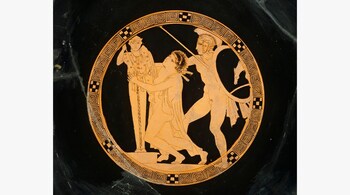
The undertaking was called Project Cassandra, after the Trojan priestess of Greek myth who had the gift of foresight. Legend has it that no-one believed her prophecies, which must have made her unpopular at dinner parties.
The Tübingen team of literary scholars was led by Jürgen Wertheimer, Professor of Modern German Literature and Comparative Literature. They didn’t sit in cosy libraries all day long, reading books and jumping up to announce discoveries. It was initially an exercise in “text mining”: scanning books for words and phrases to create maps of feelings associated with issues, people, and geographical regions.
Lack of digitisation, as well as nuance, led them to consider “literary infrastructure” next. As Philip Oltermann’s report explains, the scholars created a matrix with nine indicators: thematic reach, censorship of the text, censorship of the author, media response, scandals around the text, scandals around the author, literary awards for the author, literary awards for the text, and narrative strategy.
It sounds dreadfully dry, not to mention subjective, but it did produce some results. The team identified Algeria as a potential hotspot, for example – and two years later, there was unrest in Algiers and other cities, which led to the resignation of President Abdelaziz Bouteflika in 2019. Late last year, the project was discontinued. The pandemic, budget cuts, government reshuffles: no one is quite sure of the reasons.
It’s almost fitting that this project of using novels as a crystal ball was itself anticipated by an earlier novel. In 1974, a thriller called Six Days of the Condor by James Grady appeared on the shelves, which was about a CIA functionary whose job it was to analyse spy novels for clues about real-life events. It proved to be immensely popular, and was turned into an Oscar-nominated film by Sidney Pollack starring Robert Redford and Faye Dunaway titled Three Days of the Condor. Perhaps the budget wasn’t enough for the entire six days.
Thrillers apart, it’s the genre of science fiction that has long been used as a seismograph for future trends. The work of H.G. Wells, for example, has foreshadowed the aeroplane, the tank, space travel, the atomic bomb, satellite television and, some say, even Wikipedia. He also wrote about time travel and alien invasions, so who knows what’s in store after the pandemic.
Speaking of the coronavirus, there have been several breathless articles about novels that supposedly predicted it. Nigel Watts’s Twenty Twenty, which appeared in 1995, envisioned a virus-ravaged year of empty streets and virtual technology. Ling Ma’s Severance, published in 2018, tells the story of people fleeing cities because of “Shen fever”, a fungus from Shenzen. And in 1981, there was Dean Koontz’s The Eyes of Darkness, about a virus called Wuhan-400, created as a bio-weapon in a laboratory. More fodder for conspiracy theorists, should they need it.
When it comes to politics, there was much talk of the prescience of work such as Sinclair Lewis’s It Can’t Happen Here and Philip Roth’s The Plot Against America, novels that dealt with proto-fascist tendencies in America. Then again, in the 1980s and 90s, Octavia Butler’s work explored ideas of race and gender that are so much in the air nowadays. Ironically enough, it’s almost always in hindsight that the clairvoyance of such work has been taken seriously.
Novelist Karen Bender has written that among the traits that writers require are extreme sensitivity and imaginative openness. This, one supposes, can work like an in-built trend detector, consciously or not. In the same vein, the Guardian report quotes Wertheimer as saying that great writers have a “sensory talent”. This, he continues, is how literature can bring subterranean social tendencies and conflicts to light.
Having said that, it would be stretching things to assume that specific writers somehow possess gifts of divination. A varied body of work in context over time would be a better indicator than individual work in isolation – precisely the approach taken by the researchers in Tübingen.
In India, for example, bookstore shelves have been filled for some years now with fiction based on retelling and reinventing epics and mythological tales. It’s tipped over from being far-sighted to becoming a trend to cash in on. The implications are only too evident.
Discover the latest Business News, Sensex, and Nifty updates. Obtain Personal Finance insights, tax queries, and expert opinions on Moneycontrol or download the Moneycontrol App to stay updated!





