

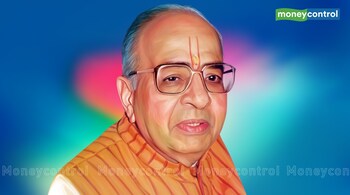
A hundred years ago this month was born a man who earned the right to be included in the pantheon of Indian business leaders whose efforts kept the flame of entrepreneurship burning in the country through the decades of the failed mixed economic model. Arvind Mafatlal was part of the third generation of Mafatlals, but under him the group rose rapidly to become India’s third largest conglomerate, after Tata and Birla.
A brilliant student who finished his schooling at St Xavier’s School in Mumbai, where his family had shifted from Ahmedabad in 1928 to expand its business interests, Arvind’s favourite subject was mathematics. At 16, after ranking 17th in the University of Bombay’s State examination merit list, he joined Sydenham College. But an incident involving a British professor who wanted him to squeal on some of his classmates, so incensed him against the educational system that he dropped out of college.
Education’s loss was the business world’s gain as he joined the family enterprise which was largely textiles, as envisaged by its founder Mafatlal Gagalbhai who set up a partnership firm Mafatlal Chandulal & Co. and in 1905 took over the management of a small defunct mill. Over the next decade, he had acquired a number of mills and with the war in Europe sending prices soaring, the business flourished.
Young Arvind spent his first couple of years as an apprentice in Ahmedabad, turning around the fortunes of three sick mills that had been lately acquired. Following the death of his grandfather, the mantle of leadership had now passed on to his father Navinchandra who grew the business rapidly, and by 1955, the Mafatlal group had become one of the largest mill owners in India. Sadly, before he could scale even bigger heights, Navinchandra Mafatlal passed away after a sudden heart attack. He was only 49 while his eldest son Arvind, on whose shoulders the family fortunes now rested, was just 30.
But belying his years, the young man quickly showed that he had learnt the skills needed to nurture and grow a business from his grandfather and father. Displaying an intuitive understanding of the coming needs of a newly independent nation, he looked to diversify the business into newer areas like dyeing and chemicals. But it was the move into petrochemicals and plastics that set him up as a true visionary. He set up National Organic Chemical Industries (NOCIL) and Polyolefins Industries besides signing prestigious joint ventures with multinationals like Shell and Hoechst on the way to climbing the ladder of corporate success in the country. Soon Mafatlal was spoken about in the same breath as the country’s top conglomerates. By now his reputation was such that he was believed to have the ear of the country’s top political leaders.
But destiny had bigger plans for him. In 1967, as Bihar suffered from a terrible famine, Arvindbhai, as he was popularly called, came to one small district, Ranka, in response to the call for help. What he saw there along with the relief work of a spiritual leader Ranchoddasji Maharaj had a profound, life-altering impact on him. He realized there were sterner tasks ahead. The Shri Sadhguru Seva Sangh Trust was his initial platform for helping the poor and the downtrodden.
Later he started working closely with the Gandhian social activist and pioneer of rural development, Manibhai Desai, with whom he set up the Bharatiya Agro and Industrial Foundation (BAIF) to help create opportunities of gainful self-employment for rural families, especially those from disadvantaged sections of society. BAIF’s work reflected Arvindbhai’s scientific temper and his belief in technology. Thus, among other things, it started an artificial insemination program in the districts of Maharashtra to improve productivity levels of cattle. It also promoted the cultivation of hybrid cotton by marginal farmers in Sholapur district besides setting up a Foot and Mouth Disease Plant as well as a vaccine-making plant.
Despite all his success, life wasn’t easy for him. There were serious setbacks in his personal life. His elder son Padmanabh Mafatlal died in an unfortunate incident while a family separation in 1979 estranged him from his siblings. The business too suffered a series of shocks including labour unrest and mismanagement. But a strong belief in the will of god saw him handle all the trials of life with a rare equanimity.
Also read: Indian business held out great promise at the time of Independence
Discover the latest Business News, Sensex, and Nifty updates. Obtain Personal Finance insights, tax queries, and expert opinions on Moneycontrol or download the Moneycontrol App to stay updated!





