

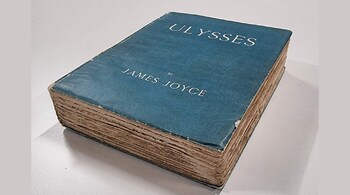
One hundred years ago on February 2, a book was published that, according to its author, contained so many enigmas and puzzles that “it will keep the professors busy for centuries arguing over what I meant”. So far, James Joyce has been proved right about Ulysses. It’s surrounded by a thicket of guides, essays, and treatises that have shored up the modernist masterpiece’s reputation for obscurity.
It’s certainly no beach read. However, as critic John Mullan has pointed out, unravelling Joyce’s enigmas and puzzles with the help of a guide is part of the pleasure of going through the stately, plump volume. Even Judge Woolsey, as part of his 1933 verdict which held that Ulysses was not obscene and could be admitted into the United States, said that to understand Joyce’s work, “it is advisable to read a number of other books which have now become its satellites”.
Among the first of these satellites was Stuart Gilbert’s formidable James Joyce’s Ulysses: A Study. Originally published in 1930, it has the distinction of being written after several discussions with Joyce himself. As Gilbert wrote in his introduction, he consulted Joyce on every doubtful point, “ascertaining from him the exact associations he had in mind when using proper names, truncated phrases or peculiar words”.
Much of the way Ulysses is understood nowadays owes a lot to Gilbert’s book: the Homeric parallels and the patterning of sections after colours and body parts, for example. For the lay reader, however, Gilbert can be dense. Nabokov, too, was not a fan. In a lecture to students at Cornell, he called him a “pseudo-scholarly bore” who was “misled by a tongue-in-cheek list compiled by Joyce himself”.
Since then, portals into the lives of Leopold Bloom, Stephen Dedalus, and Molly Bloom have arrived in various forms. Scholarly interpretations apart, there are several guides and annotated editions, notably the one by Declan Kiberd. To varying degrees, most of them emphasise the structure and symbols of the book, the voices of the narrator and characters, and the prose styles and wordplay. That is how Joyce linked the epic to the everyday, to “celebrate the reality of ordinary people’s daily rounds,” as Kiberd put it.
A good starting point is Harry Blamires’s The New Bloomsday Book, with readable chapter-by-chapter summaries. For Blamires, Ulysses is not forbidding in its experimentation. “Indeed,” he writes, “the devices of style and technique which startle new readers most, emerge, when studied, as logical extensions of traditional poetic practices”.
Terence Killeen’s Ulysses Unbound, first published in 2005 and recently re-issued for the centenary, is another clear companion, containing summaries, styles, and glossaries for each section. For Killeen, Ulysses is “a marvellously democratic book”. In particular, he highlights its many tonal shifts as “a liberation into style”. In a foreword to the new edition, Colm Toibin writes that it’s the ideal bridge between the scholar and the ordinary reader who “comes innocently to the book”.
Another guide published to mark the centenary is Daniel Mulhall’s Ulysses: A Reader's Odyssey. This began as a series of blog posts that Mulhall, currently Ireland’s Ambassador to the United States, wrote about the book’s 18 episodes. He says that after decades of talking about Joyce around the world (including at a conference in New Delhi) he’s come to feel that the book’s reputation for being impenetrable isn’t quite true.
As such, his guide is more accessible than most. “Allow me to whisper it,” he writes of the famous ‘Oxen of the Sun’ episode, for example, “if the going gets too tough, don’t be afraid to hit the skip button or skim through these pages and move on to the remainder of the novel which confronts the reader with somewhat less formidable obstacles”.
Of late, guides to Ulysses haven’t always taken the shape of printed books. Mulhall’s initial blog apart, online resources include The Joyce Project, a digital version with links to detailed notes, visual aids, and further references. Then, there was Re: Joyce, an entertaining and enlightening podcast by author and broadcaster Frank Delaney, with hundreds of brief episodes. “Every sentence in Ulysses has more than one meaning and sometimes many meanings,” says Delaney. His sentence-by-sentence analysis aims to explain Joyce’s “multitasking in prose”.
There’s yet another way to read Ulysses, and it may well be the most satisfying of all. Don’t look for meaning, don’t try to understand all of it, but simply dive in. Expect to be bewitched, baffled, and bored in equal measure. You can always return to notable passages armed with one or more of the guides mentioned here. Don’t worry about getting it right or wrong.
Then, there’s the Marilyn Monroe Method. Eve Arnold, who took the famous 1955 photograph of the star reading Ulysses, later recalled that Monroe told her she loved the sound of the sentences, kept a copy in her car, and occasionally read chunks out loud to make sense of it all. There’s a lot to be said for that, too.
Discover the latest Business News, Sensex, and Nifty updates. Obtain Personal Finance insights, tax queries, and expert opinions on Moneycontrol or download the Moneycontrol App to stay updated!





