

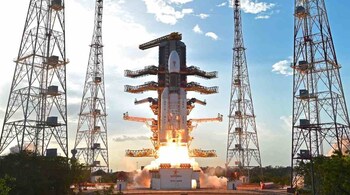
Geosynchronous Satellite Launch Vehicle (GSLV)-MkIII rocket is the heaviest rocket made by Indian Space Research Organisation (ISRO) till date.
Since the 1990s, when it was nothing but a blueprint of a launch pad, it has been rechristened several times. Recently it was named “Bahubali” after an all-mighty character from a fantasy period film; earlier it had been dubbed the Launch Vehicle Mark-3 (LMV-3), and “Fat Boy”, too.
Weighing 640 tonnes, GSLV-MkIII is our space organisation’s first indigenously built, medium-lift rocket. It is specially designed to carry heavy loads, unlike the Polar Satellite Launch Vehicle (PSLV) rocket. The latter has a carrying capacity of 1,750-kilogramme, as against GSLV-MkIII’s 4,000-8,000 kilogramme, which varies as per the orbital altitude where the payload has to be launched.
The idea of GSLV took birth in the 1990s. The dream was to build a launch vehicle indigenously, which would be able to send satellites high-up in the Earth's orbit – at least 35,000 kilometre above the equator.
A decade later, sometime in the early 2000s, the groundwork on GSLV-III commenced. It was supposed to launch its first rocket between the years 2009–2010. However, a major developmental test of the rocket's indigenous cryogenic engine conducted in the middle of 2010 saw not only a lost rocket but also pushed back the project by a couple of more years.
GSLV rockets used several components that had already been tested by the PSLV launcher, including the liquid-fuelled Vikas rocket engine. However, since immense thrust is needed to push the satellite into a higher orbit, it was decided that the third stage in GSLV would be powered by a cryogenic engine; the Vikas engine wasn’t equipped to do this.
Notably, GSLV-MKIII might borrow its name and several features from but are markedly different vis-à-vis design and components. For instance, the shape of the nose cones of both launchers are strikingly different. While the cones of the newer model’s booster rockets are more rounded, the ones on GSLV have relatively conical ends. This feature was changed to lessen vibrations inside the rocket, rendering them more suited to take astronauts to space someday.
The first orbital test launch of the GSAT-19 mission was eventually conducted by ISRO on June 5, 2017. It turned out to be a success. The GSLV-MkIII-D2 or GSAT-29 mission conducted in November last year was the second developmental flight. This time it launched one of ISRO’s most advanced communication satellites into geotransfer orbit.
All in all, it took our space scientists close to 25 years and 11 test flights along with more than 200 tests of its components to finally fully operationalise the GSLV-MkIII. The work hasn’t ended though. Scientists are constantly working on developing the rockets further aiming for a human spaceflight this time.
GSLV-MkIII's potential would be put to test right before ISRO's first manned mission - Gaganyaan - which will be held after two years.
Discover the latest Business News, Sensex, and Nifty updates. Obtain Personal Finance insights, tax queries, and expert opinions on Moneycontrol or download the Moneycontrol App to stay updated!





