

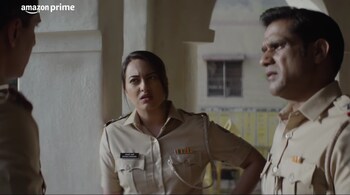
In a scene from Amazon Prime Video’s Dahaad, Devilal (Gulshan Devaiah) the SHO of a police station in Mandawa, Rajasthan, confronts his school-going son about the explicit content he was caught watching on a cell phone. “It’s okay to be curious about these things but there is a right age to have sex, and it happens with the consent of two people,” he says. It’s a little sermon that though operatic, kind of fits into a languidly paced show that deters from adopting templates. Dahaad is adjacent to true-crime, for it deals with a cat and mouse chase between the local police and a psychopathic serial killer. But what possibly sets the show apart is its desire to resist tracing true crime’s most obvious tropes. Instead, it wants to portray a world where both the law and the ones it chases, reveal themselves, with the contemplative pace of a tale interested in dissecting the surface of human nature as opposed to eroticizing its deepest wounds.
Created by Zoya Akhtar and Reema Kagti, Dahaad is set in Mandawa, Rajasthan, a small township teeming with decrepit but operational heritage structures and vast swatches of unmanned land that serve as a backdrop for some of the quiet eeriness. Houses, hotels and even police stations function out of traditionally evocative structures, echoing a landscape’s reluctance to divorce its past. The story begins with a woman committing suicide by poisoning herself. What first seems like routine, however, turns into the complicated pursuit of a single man, serially murdering women of the region. The chief suspect, played with typical creepy fragility by Vijay Varma is Anand Swarnakar, a teacher of Hindi literature.
Dahaad’s biggest strength isn’t what it does, but what it avoids doing in the name of genre instincts. There aren’t twists, or that stubborn pull of the rug from under the feet of a cautiously paced narrative. We get to see both sides of the story equally and instead of prophesizing about the future of each, the many ways it could thwart or reward expectations, we are asked to dive deeper, marry ourselves to the characters before we fantasize about what might become of them. Supporting Devilal in his quest to find this serial killer are Sonakshi Sinha as the rather exuberant Anjali Bhaati, and Sohum Shah as the schemer Kailash Parghi. Both are at odds with each other, owing to the worldviews they have reared, and yet both fear the implications of a world where women are victims of a man’s whims, in their own imprecise ways.
The backdrop of the desert, its arid limitlessness, obviously acts as a character. It’s easier to disappear in this landscape, or at least populate it with the mirage of a soft exterior. It’s what Anand, and quite possibly other men like him do for a sense of both vengeance and self-preservation. While Devilal must contest the challenges to his woke outlook on life, Anjali must confront, on a regular basis, the condescension of her defensive instincts. She is boisterous, at times, ludicrously loud, because it’s maybe the only way she’d be heard. Kailash, on the other hand, is an observant manipulator, a man essentially carved by biases which also eventually become the shrapnel that cuts through his paper-thin image of manhood.
Dahaad’s slow-burn pace is an acquired taste, for it refuses to deliver in thrills, trained tropes, what true crime delivers these days with glorious abandon. Violence is curtailed, the men exact their creepiness through complex methods, rather than brute, thoughtless force. And there is this unhurried quality about the narrative that believes it is better off uncovering a world, layer by layer, exposing the strangeness of what could also so easily pass for the normal. Everything in Dahaad feels a bit subdued, or maybe even bland to an extent, because there is this welcome restraint to not fetishize the maniacs among men. Instead, the series unwraps the composure with which evil can manufacture for itself a world that can as easily be blinded as it believes it has a sense of control.
There are obviously flaws to the crawling pace of the show that shows its cards from the outset. Most people trained on the grungy, mythical tropes of true crime operating in the shadows of speculation and violence, might find the show far too slow for its own good. Sinha’s performance isn’t always convincing, but her inability to convey a complex interior only adds to the metaphor of women having to firm up to be noticed and respected. It doesn’t always work, but what other choice do women like her have? Toughen up, shout your piece or forever go unheard. Not everyone might appreciate the soft touch of elasticity here. As opposed to screwing tension into the story, populating it with gnarly twists, ultra-violence and dizzy cliff-hangers, Dahaad wants you to explore the depths of its voice. Search through its whispery narrative for that shapeless scream of revelation. Yes, it’s about crime and cops, but through them, should you choose to see it, Dahaad becomes so much more.
Discover the latest Business News, Sensex, and Nifty updates. Obtain Personal Finance insights, tax queries, and expert opinions on Moneycontrol or download the Moneycontrol App to stay updated!





