

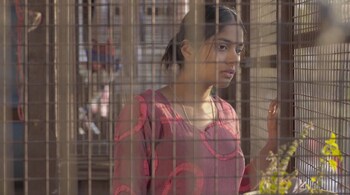
This Amar Colony is not the famed antique wooden furniture market in Delhi, though, wood, antique, furniture become metaphors here, in the film, too. In an old, British-era colonial building, with its bay windows and ageing, wooden staircases, in a hill town, live three women, from three generations, their lives marked by the entries and exits of each other, connecting them are the building corridors, as desolate as them.
Sounds Mumbai chawl-like. It is quite so, though such buildings are quite upscale in Shimla, inhabited by doctors and government officials. The eponymous building Amar Colony (or immortal colony) gives the title to Siddharth Chauhan’s 75-minute debut feature, which had its world premiere at Estonia’s Tallinn Black Nights Film Festival, winning the Special Jury Prize, and has just won its director the FFSI KR Mohanan Award for Best Debut Director in the Indian Cinema Now category at the 27th International Film Festival of Kerala (IFFK).
Delusion helps each woman navigate her desire and disappointment. The youngest, Meera (Nimisha Nair), is a new tenant here. She’s pregnant. With her husband's love absent, younger men in the building indulge her. The middle-aged Devki (Sangeeta Agarwal) is a wheelchair-bound widow with a pigeon for company and a cycle of emotional abuse with her homebound son Mohit. The elderly Durga (Usha Chauhan), a Hanuman devotee, wants to arrest time and remain young for eternity. The space between Durga and her husband Shankar’s bed is occupied by Hindu gods, primarily Hanuman. The void in each of their lives is juxtaposed with the teeming crowds on Shimla’s mall road. Their worlds limited to the said building, a wooden cage in itself, and they united by isolation and desolation.
The little escape, from their ennui-riddled lives, the director provides to the three characters is through the chimeric stories, illusions or dreamlike sequences he builds around them. Durga wears a janeyu (sacred thread) and prays to the Hindu celibate god, in the hope of arresting time and becoming immortal. Meera is almost always out of tomatoes. In this repressed world, each has an object to hold on to (Devki’s pigeon), seek satiety in (Shankar’s mannequin; he sells lingerie), signal the absent/forbidden (Meera’s tomato), or wield — with her umbrella-turned-imaginary mace, Durga adds comic, lighter moments to a conceptually heavy film.
In all this, French composer Marc Marder’s music is a gentle presence. “I had first heard his work in Gurvinder Singh’s Chauthi Koot (2015), it played in my ears long after. I wanted music to be just another layer, like a river flowing in the background, not disturbing the story, not attracting attention to it, not enhancing the emotions,” says director Siddharth Chauhan.
The last time, perhaps, Shimla saw a woman’s sexual expression on screen was in Ketan Mehta’s Maya Memsaab (1993), an adaptation of Gustave Flaubert’s Madame Bovary (1856). Chauhan’s Meera and her risqué moments could parallel Mme Bovary's or Geoffrey Chaucer’s 14th century Wife of Bath. Enough films have been made, by directors across genders, from Bengali to Hindi, on unhappy women seeking sex outside of marriage, her sexual expression seen as transgressive, and, thus, deserving of guilt, self-loathing, self-harm, or punishment. Chauhan debunks the show of desire through a gendered or moral lens. While the women seek a release from the claustrophobia of their lives and the building, the men operate by concealing.
In repressive societies and small-town/rural narratives, sexuality is often shown as a means of oppression, a glimpse of which was seen in Ajitpal Singh's Sundance-screened Fire in the Mountains (2021). For women to seek expression in and liberation through sexuality, they need a separate zenana, the building in Chauhan's film, then, operates like one for Meera, who's at a remove from the outside world. For Durga, the building is a refuge. For Sangeeta, it's a cage.
Women are instantly desexualised, the minute they age, become widows, physically invalid or pregnant — all seen as teleological endpoints of female desire. Patriarchy accords a woman identity and validation through her relation to a man — husband, brother, son, grandson. “Shameless” is a cross desirous women have to bear, labelled nymphomaniacs, for promiscuity is an entitlement exclusive to men or so the society would have you believe. What are women but the woe men dump on the second sex. To quote philosopher Iris Marion Young, known for her important work Pregnant Embodiment: Subjectivity and Alienation (1984), “Patriarchy is founded on the border between motherhood and sexuality. Freedom for women involves dissolving this separation.” Chauhan delivers the dissolution with dexterity through Meera. “Pregnancy,” he says, “also seems to be a cage, a jail of its own. You are told that you can’t do this or that, etc. A woman can still have sexual desires.”
Chauhan revisited his short film Papa and redid the script. The resultant feature became Amar Colony, in which Devki’s track returns with new faces. For her, the non-human — much to her son’s chagrin — is a symbol of what's perished.
For a young Chauhan, whose father was mostly away for work, he grew up around his mother and two sisters, and observed the female dynamics and human condition from up close, participating in household chores. Chauhan, whose short films have won global awards, has evolved a unique cinematic voice by stoking the imagination. If it were a grandma’s trunk and stories about where the dead family members went in The Flying Trunk, and how romantic attraction can be both innocent and wicked, tabooed and pure in Pashi — both showing on MUBI — in Amar Colony, where, Eagles’ Hotel California-like, you can check out any time but you cannot leave, the absurd makes the heaviness of being bearable. In all three films, the father figure is absent.
The film also shows three kinds of motherhood — a disgruntled, abusive mother, a to-be mother, an absent mother (with his parents dead, the prepubescent Rohan is being brought up by his grandparents, Durga and Shankar).
The projection of small-town ennui looks real and lived. “I find reality so boring and monotonous. The ‘dreamy’ helps me to transcend the real. I’m not consciously aware that I’m deploying Surrealism, am just being true to myself,” says Chauhan.
“Growing up in a small town, I didn’t get to explore or experiment enough. The kind of freedom my friends and cousins growing up in the cities had, I missed out on. Similar was the case when it came to exploring one’s sexuality. I have seen a closeted married man here. While growing up, I felt stuck, in my house, in my college, in my town,” adds the MBA-graduate who started making films in 2011-12. He went to Mumbai to assist a director but the “discouraging and not creative” experience made him return to his hometown, to tell his stories, the stories of Himachal Pradesh.
He draws on elements from theatre of the Absurd — isolation of the individual, meaningless world, anxieties, reality fusing with illusion. The camera straddles, in an episodic way, between the three women, their lives and desires, each gets a distinct colour/visual idiom and angular shot.
“Between Modhura (Palit, cinematographer) and I, we made some rules, to have distinct shots for all three female characters. Durga would get static and block frames because her expressions were dramatic, Sangeeta was given wide shots, to maintain the distance and enhance her loneliness, to show her room like a cage, and Meera got the close-ups, the camera focusses on her, either she enters the frame or walks out of it, controlling and propelling the story,” says the director who grew up having access to only Bollywood films, and discovering world cinema in college, getting hooked to the works of Danish filmmaker Lars von Trier.
Chauhan wanted to collaborate on The Flying Trunk with Palit, much before she won the Angénieux Encouragement Award at the Cannes Film Festival in 2019. For Amar Colony, “I wanted to consciously work with a female DOP. While I don’t think having a female DOP necessitate a female gaze, that comes from the writing and the vision, it was comforting for the actors, too, to have a woman behind the lens on the set, especially in the bold scenes,” says Chauhan, 50 per cent of whose crew comprised women, from costume designer to technicians.
The biggest challenge “was to put together a team (with a mix of actors and non-actors), not many people were willing to come to Shimla for the shooting, and if they did agree, they would charge a lot. The final team has worked for little pay,” he says.
Amar Colony has been produced by Nisheeth Kumar’s Indie Film Collective, in collaboration by Bangladesh’s Arifur Rahman and Bijon Imtiaz’s Goopy Bagha Productions, whom Chauhan had met at the 2018 NFDC co-production market. Though the ending could have been less obvious and tad sharper, the whole film, the gestalt, came together because of its editor Paresh Kamdar (Ghode Ko Jalebi Khilane Le Ja Riya Hoon; Pedro), much of the film was made on the edit table since Chauhan felt lost with the parts — his concepts and shot footages. Much of the flights of fantasy seems just right, just enough. Kamdar’s kaam (work) is evident. For in its entirety, there is not a single dull moment in Chauhan’s Amar Colony.
Discover the latest Business News, Sensex, and Nifty updates. Obtain Personal Finance insights, tax queries, and expert opinions on Moneycontrol or download the Moneycontrol App to stay updated!





