

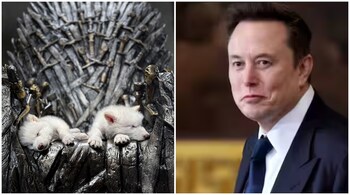
Elon Musk responded on X to the claim by Colossal Biosciences that it had successfully “brought back” dire wolves from extinction using genetic engineering. The Texas-based company announced that it had created three genetically engineered cubs resembling the long-extinct species, featuring white fur and pronounced muscular jaws.
Musk, reacting to a video showing the cubs trotting, sleeping, and howling, described the footage as “cool” and went on to express his desire for a miniature version of another extinct species. In a repost of his own X message, he wrote: “Please make a miniature pet woolly mammoth (sic).”
In his initial post, the world’s richest man shared two visuals. The first was the cover of Time magazine, which featured an image of a white wolf with the word “Extinct” boldly crossed out. The second was an edited illustration showing two wolf pups lounging on the Iron Throne, a cultural reference to the television series Game of Thrones, which helped popularise the dire wolf.
Colossal Biosciences stated that it had revived three cubs in what it called the “world’s first de-extinction”. The two male cubs—both six months old—were named Romulus and Remus. The third, a two-month-old female, was named Khaleesi, after a prominent character from Game of Thrones. According to the company, Romulus and Remus were born on October 1, 2024, while Khaleesi was born on January 30, 2025.
“The dire wolf has been extinct for over 10,000 years. These two wolves were brought back from extinction using genetic edits derived from a complete dire wolf genome, meticulously reconstructed by Colossal from ancient DNA found in fossils dating back 11,500 and 72,000 years,” the company wrote in a post on X.
Colossal added that its broader goal was to “revolutionise history and be the first company to use CRISPR technology successfully in the de-extinction of previously lost species.”
Ben Lamm, co-founder and CEO of Colossal Biosciences, called the breakthrough a landmark moment. In a press statement, he said: “This massive milestone is the first of many coming examples demonstrating that our end-to-end de-extinction technology stack works. Our team took DNA from a 13,000-year-old tooth and a 72,000-year-old skull and made healthy dire wolf puppies.”
According to Time, following their birth, the pups were initially fed by a surrogate for several days, after which the Colossal team took over and began bottle-feeding them. The company confirmed that the animals were now living as “healthy young dire wolves”.
However, the behaviour of the pups differs markedly from modern wolf species. Unlike other canines, the trio does not exhibit typical puppy exuberance in the presence of humans. Romulus and Remus, in particular, maintain distance and retreat when approached—even from one of their primary handlers, who has raised them since birth. This aloof temperament, according to Colossal, may align with the behaviour of actual dire wolves.
“The behaviour is said to be typical of dire wolves—they want to be lonely,” reported Time.
The cubs are currently housed on a 2,000-acre site at an undisclosed location. The property is enclosed by 10-foot-high fencing and is under constant surveillance via drones, live camera feeds, and security personnel.
The revival of dire wolves forms part of Colossal’s wider ambition to resurrect several extinct species. Among those on its list are the woolly mammoth, the dodo, and the Tasmanian tiger. While progress on other de-extinction projects has been limited so far, company scientists remain optimistic.
Meanwhile, Musk’s remarks prompted widespread engagement on X. In response to his woolly mammoth request, one user wrote, “Yes! I'm also still waiting for the micro hippopotamus.” Another added, “Please make Jurassic Park.” A third commenter said, “Omg, yes, I would love to play with one. I definitely would love a Dire Wolf, also. I love my wolf dog. The Dire wolves are beautiful.”
Despite the buzz, not all experts were convinced by Colossal’s claims. Vincent Lynch, a biologist at the University at Buffalo who was not involved in the research, cast doubt on the authenticity of the de-extinction.
“All you can do now is make something look superficially like something else,” Lynch told the Associated Press, highlighting the limitations of current genetic engineering when it comes to fully reviving extinct species.
Discover the latest Business News, Sensex, and Nifty updates. Obtain Personal Finance insights, tax queries, and expert opinions on Moneycontrol or download the Moneycontrol App to stay updated!





