

In September 2019, an estimated 250,000 people took to the streets of New York City. The marchers, who helped kick off a week of global protests timed with the United Nations Climate Action Summit, aimed to send world leaders a message: Do more to fight climate change.
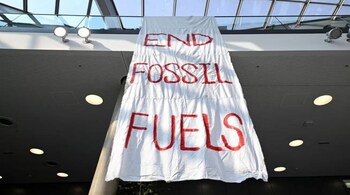
On September 17 — nearly four years later to the day — climate activists will fill the streets of New York with the March to End Fossil Fuels. The march, part of three days of worldwide protests ahead of another UN climate summit, hopes to recapture some of the momentum that dissipated in 2020 when the Covid-19 pandemic halted most of these kinds of mass actions.
“We have hopes of it being one of the biggest climate marches since 2019,” says Bree Campbell. A senior at New York’s Frank Sinatra High School, Campbell is also an organizer with Fridays for Future, the movement started by Greta Thunberg that is one of the conveners of the march.
“We’re marching to make clear to President Biden that we expect him to uphold his campaign promise for him to be the climate president that we elected,” says Campbell. Those taking part want him “to stop approving fossil fuel projects and leases, phase out fossil fuel production on public lands and waters, and to declare a climate emergency so that he could halt crude oil exports and investments in fossil fuel projects abroad.”
Large mass protests serve two functions, according to Colin Davis, chair in cognitive psychology at the UK’s University of Bristol and a researcher of protests. “One is a message to politicians,” Davis says. “One is as a message to the public reminding people that this is an issue that lots of people care about".
But unlike in 2019, this march will occur amidst a global crackdown on direct-action protests. Countries including Australia, Germany, France and the UK have passed laws, increased fines and jail time or invoked statutes typically used in cases of organized crime to curb protest activities. This follows an uptick in what some call disruptive protests by groups such as Extinction Rebellion, Just Stop Oil and Blockade Australia, which have blocked roads and airport runways, deflated SUV tires and thrown tomato soup on a (glass-protected) Vincent Van Gogh painting.
Recently, protestors sporting “End Fossil Fuels” t-shirts disrupted the women’s semi-final at the US Open for an hour after one of the protesters glued his bare feet to the stadium floor.
The rise of disruptive protests is, in part, a reaction to the feeling among some activists that traditional mass actions aren’t effective. Marches — even quite large ones — don’t always get widespread media coverage, limiting their usefulness in garnering attention. And even when turnout is very high, it doesn’t necessarily change policy.
"We had 2 million people on the streets [in the UK in 2003], protesting against the invasion of Iraq. Obviously, it happened anyway, despite the people coming out against it," says Davis. "Then we had over a million people coming out against Brexit. That also happened anyway. Things like that have led people to have a loss of faith in the ability of that kind of protest to bring about change".
Research suggests that many people dislike disruptive protests, but Coco Gauff, the tennis star whose set was interrupted, had a more nuanced perspective when asked about it after the match.
I always speak about preaching about what you feel and what you believe in,” Gauff said at a press conference. “It was done in a peaceful way, so I can’t get too mad at it. Obviously, I don’t want it to happen when I’m winning, up 6-4, 1-0. I wanted the momentum to keep going but, hey, if that’s what they felt that they needed to do to get their voices heard, I can’t really get upset at it".
The public’s short-term discomfort with disruptive protest tactics doesn’t necessarily mean they undermine protestors’ long-term goals, says Davis.
In the case of the US Civil Rights Movement, for example, the emergence of Black militant groups in the 1960s made organizations like Martin Luther King Jr.’s Southern Christian Leadership Conference seem moderate in comparison — or at least less militant. The end result was it made it easier for them to fundraise even though the groups’ positions hadn’t changed.
Research on whether these kinds of large protests move the needle on public policy is mixed, Davis says, but they can be important psychologically.
"The problem people often have with climate change is not that they don’t think the threat is real, but they quite rightly recognize that this is a global issue, and that their personal behaviour doesn’t actually have that much direct impact," he says. "Part of what can be achieved by a mass protest is people saying, ‘Well, actually, maybe there is something we can do about it.’ It expresses a belief in collective efficacy".
“It’s very necessary to see everyone in action together, especially after the pandemic,” agrees Campbell. “Because you get that connection with people that, ‘Hey, we’re fighting on the same side. I’m not alone, I’m not the only one with climate anxiety. I’m not the only one who’s scared for our future and for the sake of our planet".
Discover the latest Business News, Sensex, and Nifty updates. Obtain Personal Finance insights, tax queries, and expert opinions on Moneycontrol or download the Moneycontrol App to stay updated!





