

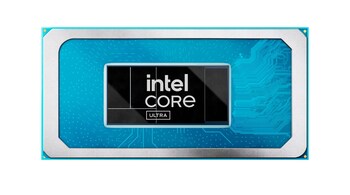
Intel has announced the new chips designed for PCs and data centres in a bid to widen its reach in the Artificial Intelligence (AI) market.
At the "AI everywhere" event, Intel announced new Core Ultra chips, which the company says is the "most AI-capable and power-efficient client processor in the company’s history.”
Also read: Intel partners with 8 Indian manufacturers for ‘Make in India’ laptops
Intel claims that the Core Ultra family consumes up to 79 percent less power than last-gen AMD chips while idling in Windows. The company says they are 11 percent faster in multi-threading tasks compared to the competition.
The Ultra series is built on Intel's 7nm process and features FOVEROS 3D packaging, which is an advanced stacking solution that allows the company to improve performance and efficiency using a smaller footprint.
Intel says that these are, "the most efficient x86 processors for ultrathin systems". They include the now familiar performance and efficiency cores along with integrated Intel Arc graphics, which the company says is twice as fast as the last generation.
The flagship of the new series is the Ultra 7 165H, which has 16 cores divided between 6 performance cores, 8 efficiency cores and 2 low-power cores with a 5GHz max turbo frequency.
The Ultra 9 185H will release in the first quarter of 2024 featuring the same amount of cores but with a slightly faster clock at 5.1GHz max turbo speed, and a faster integrated GPU.
Coming to AI applications, the new chips according to Intel, can reach up to 34 TeraOPS in combined performance with the NPU, GPU and CPU.
The starting line-up of processors is available now in stores and will be powering PCs from OEM partners including Acer, ASUS, Dell, Dynabook, Gigabyte, Google Chromebook, HP, Lenovo, LG, Microsoft Surface, MSI and Samsung.
Also read: PC market recovery gathers pace as Intel, AMD tout potential of 'AI PC'
Besides these are the upgraded 5th Gen Xeon processors that are designed to address end-to-end AI workloads. Intel says that the new chips have less than 100 ms latency on Large Language Models (LLM) with less than 20 billion parameters.
The new Xeon chips support up to 64 cores per CPU and offer eight DDR5 channels per CPU. They are also pin-compatible with the previous generation.
Intel also unveiled Gaudi 3, the latest AI accelerator, that competes with Nvidia's much-wanted H100 series of accelerators. Gaudi 3 will be released sometime in 2024.
Discover the latest Business News, Sensex, and Nifty updates. Obtain Personal Finance insights, tax queries, and expert opinions on Moneycontrol or download the Moneycontrol App to stay updated!





