

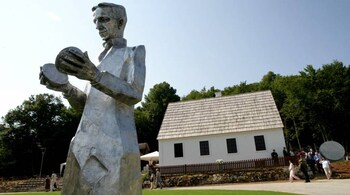
Nikola Tesla, the fabled scientist who is credited for the design of the modern alternating current (AC) electricity supply system which powers our houses today, also envisioned the device which is loved by all of us—smartphone.
Tesla who held about 300 patents when he died and spoke eight languages was a physicist, mechanical and electric engineer, inventor and futurist.
In 1926, talking about wireless technology, he envisioned smartphones as we see it today. In an interview given to John B. Kennedy in January, he said:
"When wireless is perfectly applied the whole earth will be converted into a huge brain, which in fact it is, all things being particles of a real and rhythmic whole. We shall be able to communicate with one another instantly, irrespective of distance. Not only this, but through television and telephony we shall see and hear one another as perfectly as though we were face to face, despite intervening distances of thousands of miles; and the instruments through which we shall be able to do this will be amazingly simple compared with our present telephone. A man will be able to carry one in his vest pocket."
Mind you, at that point, the world had experienced the telephone and the radio as communication devices, whether wired or wireless (not TV, it was invented in 1936).
"We shall be able to witness and hear events--the inauguration of a President, the playing of a world series game, the havoc of an earthquake or the terror of a battle--just as though we were present,” Tesla adds.
"When the wireless transmission of power is made commercial, transport and transmission will be revolutionized. Already motion pictures have been transmitted by wireless over a short distance. Later the distance will be illimitable, and by later I mean only a few years hence. Pictures are transmitted over wires--they were telegraphed successfully through the point system thirty years ago. When wireless transmission of power becomes general, these methods will be as crude as is the steam locomotive compared with the electric train.”
Tesla doesn’t stop here. He predicted things which we have not able to achieve today but are progressing towards them, for example, transportation of human bodies via wireless.
"Wireless will achieve the closer contact through transmission of intelligence, transport of our bodies and materials and conveyance of energy,” Tesla adds.
Discover the latest Business News, Sensex, and Nifty updates. Obtain Personal Finance insights, tax queries, and expert opinions on Moneycontrol or download the Moneycontrol App to stay updated!





