

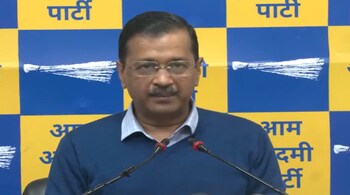
The Supreme Court on April 29 asked Delhi Chief Minister (CM) Arvind Kejriwal as to why he did not move a bail plea in the lower court after his arrest by the Enforcement Directorate (ED) in the liquor policy case on March 21.
Responding to this, senior advocate Abhishek Manu Singhvi, who appeared for the CM, stated that Kejriwal has chosen to challenge the validity of his arrest rather than pursuing a bail plea. Singhvi told the court that as per section 19 of the Prevention of Money Laundering Act (PMLA), 2002, ED must have had a reasonable basis to suspect Kejriwal's involvement in the alleged scam, however they have no such proof.
Singhvi argued that while the investigative agencies started investigating into the suspected scam in 2022, they chose to arrest Kejriwal in March 2024 after the elections were announced and the Model Code of Conduct (MCC) kicked in, thus raising questions on the timing of his arrest. According to Singhvi, the ED had no new materials after July 2023, on the basis of which Kejriwal could have been arrested.
Taking the court through alleged statements against Kejriwal made by a few approvers, Singhvi pointed out that the ED had classified statements that were in Kejriwal's favour as unreliable while arresting him on the basis of a few statements made against him. A bench of justices Sanjiv Khanna and Dipankar Dutta at this point observe that a law enforcement agency is required to give reasons as to why any statements is considered unreliable.
The court will continue hearing the case on April 30 (Tuesday).
In its written response filed recently, the ED said that the Aam Aadmi Party (AAP) convenor is the major beneficiary of the proceeds of crime generated in the alleged Delhi excise policy scam and has committed the offence of money laundering through its national convenor and chief minister Arvind Kejriwal.
In his rejoinder, Kejriwal alleged that ED acted in a "most highhanded manner" in a money-laundering case stemming from the alleged excise policy scam.
On April 15, the SC refused to grant any immediate relief to Kejriwal. The court, however, issued notice to ED and asked it respond to the AAP chief’s petition by April 24. The case is likely to be heard in the week beginning April 29.
Kejriwal moved the court against the Delhi High Court order that upheld his arrest. The high court said the material collected by the ED showed the chief minister was actively involved in the use of proceeds of crime.
Discover the latest Business News, Sensex, and Nifty updates. Obtain Personal Finance insights, tax queries, and expert opinions on Moneycontrol or download the Moneycontrol App to stay updated!





