

Jhinuk Chowdhury
India is intentional about playing a “leading” rather than a “balancing” role in Asia, Minister of External Affairs Subrahmanyam Jaishankar said in 2015. The remark was a subtle indication to the international community that New Delhi is more than just a counterweight to Beijing.
This confidence has been visible in the subsequent big ticket alliances that India entered into, especially with the big powers. Inclusion to the ‘2+2’ dialogue process with the United States, ‘the Quad’ meetings between the US, Japan, India, and Australia, or renaming of the US Pacific Command as the Indo-Pacific Command — all these underline not only India's centrality in the region, but also demonstrate that New Delhi is ready to project and leverage its strategic peninsular position.
Although many viewed it as a lost opportunity, India’s RCEP departure was in fact a deft step to stay away from a China-heavy regional grouping and enter into stronger bilateral relations with the ASEAN. New Delhi took a conscious step to engage with Southeast Asia through its minilateralist organisations, such as the Bay of Bengal Initiative for Multi-Sectoral Technical and Economic Cooperation (BIMSTEC) and the Mekong-Ganga Cooperation.
There is another geopolitical development that poses both challenges and opportunities for New Delhi. Asia observers fear intensified competition for power-sharing between Beijing and Washington, owing to the recent heightening of tension between the G-2. After the US-China feud over COVID-19, the current situation in Hong Kong is widening the rift. The smaller Asian nations, wary of big power domination, are looking for a neutral leader. India, one of the world's strongest democracies with a non-aggressive track record, is the only power that can fill this void provided it takes a definitive stance on some of the contentious geopolitical issues in the region.
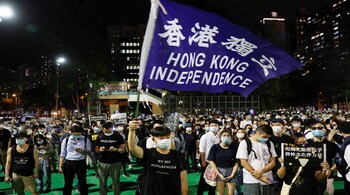
The pro-democracy struggle in Hong Kong is one such geopolitical theatre where India can project assertive yet benign power. For over two years now, this erstwhile British colony has been fighting to keep its ‘one country, two systems’ principle that China and the United Kingdom agreed upon while signing Hong Kong's independence pact in 1997. As per this principle, the metropolitan area would enjoy “a high degree of autonomy, except in foreign and defence affairs” for 50 years.
However, there are multiple attempts by Beijing to undermine Hong Kong's autonomy — from an extradition law, the anthem bill to the latest security law. Many fear these laws would be used to target political dissidents — a disquiet bringing Hong Kongers to the street to protest.
Hong Kong's political scene comprises two factions — the pan democratic and the pro-establishment groups. The pan-democrats call for incremental democratic reforms while recognising that these cannot jeopardise Beijing's central authority and are more likely to succeed when they are mutually beneficial.
These ideals are close to the political values India stands for. In fact some of the pro-democracy leaders have drawn inspiration from India's freedom struggle. Benny Tai, Hong Kong's democracy activist, has in the past, led a civil disobedience movement.
The city is likely to have its next legislative council election in September. Beijing is worried that Hong Kong might repeat the November 2019 results when it gave a landslide mandate to the pro-democrat groups.
Can India take some definitive steps to show solidarity with the pro-democratic leaders and ensure that they remain in the political scene of Hong Kong? India has been involved in several multilateral institutions for democracy promotion worldwide along with the US, such as the Global Democracy Initiative (GDI) or the UN Democracy Fund. Can these initiatives be used to support the democratic cause Hong Kongers?
Meanwhile, a concerted international voice is underway against China's heavy handedness in Hong Kong. While the US has promised to revoke the city's privileged trade status, a BBC report says there’s an urge in the UK to form a global alliance to co-ordinate the response to the China-Hong Kong crisis. Australia has also condemned Beijing's heavy crackdown.
While none of the international scorns, in the past, have deterred China from its aggressive posturing, this time there seems to be a more constructive effort through collaboration to provide asylum to the fleeing Hong Kongers. Both the UK, which grants British National (Overseas) (BNO) passports, and Australia might join hands in this. The Taiwanese President Tsai Ing-wen too said her government will provide “necessary assistance”.
Can India open its doors too to these political activists? We have an intimate past with the city since the early 19th century — from Indian soldiers fighting for its security and Indian entrepreneurs adding to the dynamism of Hong Kong's commercial scene. As per data, Hong Kong is India's top trading partner with a business worth $4.2 billion as against $2.3 billion with China. Standing up for Hong Kong is in India's interest — both economically and diplomatically.
Jhinuk Chowdhury is a communications professional with interest in South Asian affairs. Twitter: @jhinuk28. Views are personal.
Discover the latest Business News, Sensex, and Nifty updates. Obtain Personal Finance insights, tax queries, and expert opinions on Moneycontrol or download the Moneycontrol App to stay updated!





