

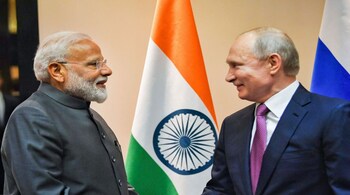
Russian President Vladimir Putin’s long-anticipated military action in Ukraine has rocked the world in more ways than one.
The conflict reflects the reality of a new world order where a hesitant United States looks at its own diminishing global clout, emergence of a new multi-polar world order, the challenges the North Atlantic Treaty Organization (NATO) is faced with in its expansionist plans, and how simmering embers of post-Soviet era politics can trigger cartographic tussles.
As the US, Europe, and some African countries went after ‘Russian aggression and invasion’, India’s position on the issue remains what it has always been: realistic, balanced, and derived out of its own national interests, and old association with Russia, and erstwhile Soviet Union.
In the real world, diplomatic or political posturing need not always pay dividends other than temporary applause from countries whose national interests match your own. When dividends are less or nil, it is wise to keep your old and trusted investments safe and as they are.
That doesn’t mean a western-backlash on Russia will be easy for India to deal with when it comes to the impacts of western financial sanctions, on New Delhi’s military purchases with Moscow, and oil prices shooting up. Then, that’s the nature of international politics in a fast-changing world.
Let’s cut to March 2014, when the Congress-led United Progressive Alliance (UPA) government was in power, India was the first major power to say it understood the “legitimate” concerns of Russia in Ukraine.
The statement by then National Security Adviser Shivshankar Menon on the same day the Crimea’s parliament voted to hold a referendum for secession from Ukraine left little ambiguity. Menon said: “We hope that whatever internal issues there are within Ukraine are settled peacefully, and the broader issues of reconciling various interests involved, and there are legitimate Russian and other interests involved…. We hope those are discussed, negotiated and that there is a satisfactory resolution to them.”
In November 2020, India voted against a Ukraine-sponsored resolution in the United Nations that condemned alleged human rights violations in Crimea thereby throwing its weight behind Russia.
In between, Putin had told the Russian parliament that India is one of the countries that showed understanding for Russia’s role in the Ukraine crisis, and the Crimean issue.
At the emergency meeting called by the United Nations Security Council (UNSC), after Putin recognised the independence of two Russian-backed regions in Eastern Ukraine on February 21, what the Indian envoy said was the continuation of this stance. The envoy said the escalation of tensions along the border between Ukraine and the Russian Federation was a “matter of deep concern”, and explained what India is looking for.
“We believe that the solution lies in sustained diplomatic dialogue between the concerned parties. In the meantime, we strongly emphasise the vital need for all sides to maintain international peace and security by exercising the utmost restraint,” India’s Permanent Representative to the UN T S Tirumurti said.
The western narrative of a geopolitical situation often masks certain realities. Though the West stresses on promoting democracy as a central piece of its foreign policy, it has always been a case of making convenient choices clothed in empty rhetoric.
Their support for attempted or succeeded coups against democratically-elected governments has only weakened democratic moorings in these countries.
Certain geopolitical realities are taken as they come, dealt with factoring in ground realities. That’s the basis of strategic autonomy that Indian foreign policy is known for, though the many western narratives still brand this as a non-aligned hangover.
For example, to say that democratic India shouldn’t deal with a military junta in Myanmar, the only South East Asian country India shares a land border with, would be an act of foolishness, giving China a walkover in its backyard.
More than anything else, what is happening in Ukraine is a culmination of many factors, and heralds the way an international order is unfolding now. The way India has been dealing with the situation in Ukraine looks the best bet it can have, for the time being.
Jayanth Jacob is a foreign policy commentator who covered the ministry of external affairs for more than two decades. Twitter: @jayanthjacob.
Views are personal and do not represent the stand of this publication.
Discover the latest Business News, Sensex, and Nifty updates. Obtain Personal Finance insights, tax queries, and expert opinions on Moneycontrol or download the Moneycontrol App to stay updated!





