

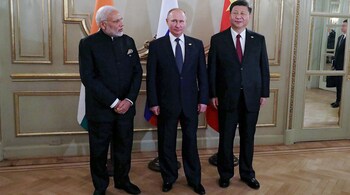
At the end of G20 Osaka summit, the ministry of external affairs spokesperson announced on twitter that Prime Minister Narendra Modi had more than 20 engagements during his three-day visit. These included nine bilaterals (Australia, Brazil, Germany, Indonesia, Japan, South Korea, Saudi Arabia, Turkey, and the United States), two trilaterals (Japan, India, USA as well as Russia, India, China) and also an informal meeting of BRICS leaders.
The conflicting agendas of all these meetings somehow confused the ordinary citizen about what is actually being discussed at Osaka G20. Every media agency picked up their own bites either from G20 meetings or from the plethora of bilateral or multilateral meetings.
From its inception in 1999, the main agenda of any G20 meeting has been to discuss global economic governance. It was founded as a forum of finance ministers and central bankers in the wake of Asian financial crisis. In the middle of 2008 global crisis, leaders of all major economies were called to work out a response to the financial crisis.
Any other issue is highlighted by media or by individual leaders only because of its contemporary relevance or its impact on the global economy. There are other multilateral forums to discuss specific issues ranging from terrorism to climate change. So the outcome of G20 has to be judged purely from its impact on contemporary global economic issues.
The summit declaration noticed that although ‘global growth appears to be stabilizing’, yet ‘trade and geopolitical tensions have intensified’. In this context, one of the major outcomes of the summit is a truce between the US and China. Both have agreed not to raise tariffs further, at least for the time being. It means the US has postponed new tariffs on roughly $300 billion Chinese goods in a year that Trump had threatened to impose. In addition, the US companies will be allowed to sell components to Chinese giant Huawei. In exchange, it was announced that China has agreed to purchase “tremendous amount” of American food and agricultural products.
The US-China trade war had affected global trade and market sentiments for months. Many markets may react to this news positively. For months, the US was pressurising its allies not to do business with Huawei due to security concerns. Now, many will start wondering if this was due to security concerns or to protect American economic interests. At the concluding press conference Trump even announced that if the right deal is struck “We [US and China] are going to be strategic partners.”
This indicates that to a large extent the summit was taking place at a time when global power politics is in transition. This was clearly reflected in all bilateral and multilateral meetings happening on the sidelines of G20. In fact, news dynamics from these meetings were much more interesting than the G20 summit itself.
On the one hand, Japan-America-India (JAI) trilateral talked about improving connectivity and infrastructure in the Indo-Pacific region in the context of rising China. On the other, Russia-India-China (RIC) trilateral talked about a democratic, multipolar and rules based international order. Chinese President XI urged RIC countries to “expand cooperation in 5G network, high technology, connectivity, energy and other areas”.
Leaders of major economies also supported reforming the WTO, quality infrastructure investment, modern international tax system and importance of interface between trade and digital economy. In addition, they talked about women economic empowerment, energy security and migration. Except the US, all countries also agreed to further implement the Paris Climate Agreement. A separate statement on preventing exploitation of the Internet for terrorism and violent extremism conducive to terrorism was also issued.
In a rapidly changing geopolitical environment, many issues were at stake for New Delhi. In the wake of US withdrawal of preferential access of Indian products under GSP and India’s retaliatory tariffs on some US products, Modi and Trump agreed for trade talks “at an early date” and the level is still being decided. Indian purchase of Russian military hardware (S-400) is causing some unease in Washington. As per the foreign secretary’s briefing, the issue was not discussed in Osaka.
India’s position on 5G is still evolving. For energy and its connectivity plans, Iran is important but American obsession with Iran still continues. On Indo-Pacific, India is closer to the US but does not want to be seen playing into American designs.
The Non-Alignment (NAM) may be an old fashioned concept, but India’s celebrated multi-alignment strategy slowly turning into tactical-non-alignment was clearly at display in Osaka.
Gulshan Sachdeva is Jean Monnet Chair at the School of International Studies, Jawaharlal Nehru University and Editor-in-Chief, International Studies. Views are personal.
Discover the latest Business News, Sensex, and Nifty updates. Obtain Personal Finance insights, tax queries, and expert opinions on Moneycontrol or download the Moneycontrol App to stay updated!





