

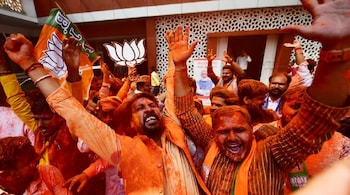
Sociologists, if they decide to make an assessment today, will have little doubt in concluding that India in 2022 is virtually unrecognisable from India before 2014.
The eight years of the Modi regime has injected such sharp changes in society, notably dominated by a centuries-old, rigid caste system, that it would appear that it is only a question of time when India could be officially termed a Hindu rashtra or nation.
Not that there was any doubt about the preponderant dominance of the vast Hindu majority at any time, but caste and the varna system, and a western secular template, had traditionally acted as a check and balance against religious revivalism of any kind.
When the BJP increased its tally in the Lok Sabha from 282 in 2014 to 303 in 2019, it was noticeable that half of its additional members were elected from reserved (SC/ST) constituencies: the party had won 77 out of 131 seats reserved for such constituencies as compared to 67 in 2014. Clearly, the caste divide had been reduced to a significant degree.
While there is little doubt that the advent of Narendra Modi as prime minister and an energetic mass leader in 2014, and his unapologetic presentation of an alternative India has made a tectonic shift in politics, the question to ask is whether this marks the end of the caste system, electorally speaking, or is it an ephemeral political phase, that has it limits?
Moneycontrol talked to leading academics, social reformers, and analysts to decipher whether the once-powerful Mandal politics, as well as Congress’s centrist liberalism, the dominant strain for a better part of the last seven decades, have been outflanked by the BJP’s avowedly saffron politics, which has traditionally opposed caste divisions.
Also read: Modi Govt @ 8 : How the BJP’s dominance changed the political landscape of India
Political Parties are unable to understand the civilizational push of Hindutva
Kodipakam Neelameghacharya Govindacharya, RSS Pracharak, environmental and social activist
Political parties are unable to understand the civilisational push. Hindutva, like earlier political variants in India, has many shades, just as there were different shades of socialism and communism at one time in the country.
I would say that the politics between 1920 and 1950 was one phase; the second phase was between 1950 and 1980, which saw socialism and communism. After 1980, the notion of India as one-nation, one-culture began to pick up steam. It gathered further momentum after 2010 and it has now reached a stage when the more you move away from Hindutva, the more irrelevant you will become. You can see it now – even the likes of Arvind Kejriwal and Priyanka Gandhi are now visiting temples and religious places.
I see Hindutva as a qualitative term; its English translation is 'Hinduness', not Hinduism, though it includes the latter. It signifies five qualities to me. One, an undivided respect towards all forms of faith and worship, because all prayers reach the same unified divine. Two, divinity pervades all and everything, living and non-living; this is a unity of understanding and belief. Three, humans are a part of the natural world, not its conquerors, because the world has not been created for human consumption. (This means it is not just humans who have rights, but all flora and fauna, and even land and water bodies and the atmosphere are entitled to their rights.)
Four, a recognition of the special place of women in society, given the unexceptional human dependence on mothering and motherhood. (I do not equate this with the arguments in favour or against women's rights, because that comes from a western context, and conflating the two creates a distortion, causing more problems than it resolves.) Five, a living sense that there is more to life than consumption and material satisfaction; non-material goals can vary from nirvana to moksha to innumerable others. All effort to create material prosperity should be based on these values of Hinduness. Such prosperity will reach all around.
Modi and BJP have best adopted Mandal politics, Ambedkar since 2014
Kancha Ilaiah Shepherd, political theorist, and India’s leading Dalit rights activist
I believe Kamandal has swallowed Mandal. It is the RSS-BJP, who have adopted the Mandal agenda and backward politics. It has been 30 years since the implementation of the Mandal Commission, but it is BJP, which is steeped into OBC politics. Narendra Modi’s repeated hailing of BR Ambedkar - being a backward caste leader himself – makes his party a formidable Shudra-Dalit-OBC combine. Modi and the BJP are presenting themselves as the representatives of this combination, in addition to presenting himself as a religious figure, as witnessed in the repeated inauguration of temples.
Let me tell you that there is a lot of opposition from the upper caste Brahmans, Kayasths and Khatris, to this backward mobilisation by Modi. And sooner or later, there is going to be a push back; nothing can be taken for granted.
Congressmen, secularists, and Leftists have for years overlooked the role of Ambedkar and caste, and the way I see it, they have to be prepared for further political setbacks. So far from caste contradictions going away, they have actually sharpened.
And that is precisely why the BJP is leading the anti-English campaign. It is the Brahminical orientation of the party. The only way to break the BJP stranglehold is to make English the language of the people; let us not forget - Ambedkar, Jyotirao Phule and Savitribhai Phule - did not write in Sanskrit but English. English is the language of the masses. And I don’t think even the RSS would be able to stop that.
Trust capital is vital in politics today and Modi has most of it
Badri Narayan, Professor Gobind Ballabh Pant Social Sciences Institute, Allahabad
The most valuable asset in the political arena today is 'trust capital'. It has emerged as the key factor in ensuring winnability in elections. No one can deny that Prime Minister Modi has the greatest amount of trust capital in Indian politics today. This trust is acquired as a result of intricate weaving of three elements – commitment, words and action. People trust him, despite the criticism circulating in a section of social media. This is one of the reasons for the BJP’s victory in the recent state elections – and in the past elections as well.
Trust capital has acquired a new meaning after getting intertwined with practices related to image building, effective messaging and aggressive advertising of the initiatives and achievements of leaders and parties. Political entities that succeed in gaining the trust of the public because of varied engagements with the people through oral, written and visual communications, gain success in electoral politics.
Unlike charisma, which denotes the magical pull of a leader, trust capital is acquired slowly by building connections and delivering on promises. It’s also linked to the reception given by people to the performances of politicians. Primordial identities such as caste and religion, as well as the social and moral standing of leaders and parties help them to consolidate this hard-earned public trust.
The RSS has reduced the caste deficit by working quietly with Dalit groups for decades now
S Anand, publisher of anti-caste imprint `Navayana’, former journalist
Kamandal has swallowed Mandal. The RSS has worked with various Dalit groups for several decades now. The Dalits are not waiting for a liberal or Left revolution to come by and uplift their lot. So, while the intelligentsia has been raving and ranting about the conditions of Dalits, they have hardly left their comfortable urban environs to improve the lot of the downtrodden. The Dalits, in turn, have been co-opted by the saffron brotherhood. Under this system, every caste will get its share, but it will be the Brahman who will decide who gets what share, the old Sanatani Hindu way.
I don’t believe that the Dalits are looking at becoming Brahmans or there is upwardly mobile Sanskritisation, which is helping the BJP and Modi; neither does the BJP want Dalits to become Brahmans. The Dalits just want to be proud of their life and it seems that the Modi government can provide them their place under the sun.
Religion has become the basis of electoral politics since 2014
Sukhdeo Thorat, former chairman of the University Grants Commission and professor emeritus at the Centre for the Study of Regional Development, JNU
There is little doubt that religion has become the basis of electoral politics in India since 2014. Religion now has a big role to play in elections and it is being exploited to the hilt. But more than Hindu revivalism, I believe it is revival of Brahminical Hinduism. While Prime Minister Narendra Modi has a role to play, this Hindu consolidation is more the work of the political formations and fronts, of the mother organisation, i.e. the RSS, which have been working at this for decades now.
Frankly, I do not see the end of this kind of politics anytime soon, or in the immediate foreseeable future, let’s say, a time span of 10 years or so. As to the question why Dalits have been voting for the BJP, a Brahminical outfit, more data is needed to study the trends minutely and to arrive at definitive conclusions.
Discover the latest Business News, Sensex, and Nifty updates. Obtain Personal Finance insights, tax queries, and expert opinions on Moneycontrol or download the Moneycontrol App to stay updated!





