

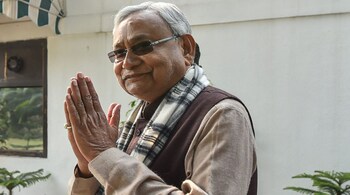
As the Bharatiya Janata Party (BJP) electoral juggernaut keeps rolling, the opposition parties have revived talks of unity ahead of the 2024 general elections. Nitish Kumar, Chief Minister of Bihar, fresh after parting ways with the BJP, is leading the efforts to put up a joint fight against the saffron party. At the same time, he has revived efforts to bring together political parties that broke away from the Janata Dal, such as the Samajwadi Party (SP), the Rashtriya Janata Dal (RJD), among others. Kumar is sniffing an opportunity like in 1989 and 1996, when these socialist parties came together to play a pivotal role at the Centre.
These parties have a respectable presence in the Hindi heartland states of Bihar, Uttar Pradesh, Jharkhand, Haryana, and few other states such as Odisha, and Karnataka. Kumar’s calculation could be to form a big block so that he can bargain for a large share of seats in any grand alliance that will form in the Opposition space in the run-up to 2024. Alternatively, after the general elections, if no party has a clear majority, Kumar’s calculation could be that the socialist bloc could play a big role in government formation.
The Janata Dal was once a strong pole in Indian politics from 1989 to 1998, having given India four Prime Ministers: VP Singh, Chandra Sekhar, HD Deve Gowda, and IK Gujral. However, during this period, the party also disintegrated into many groups as tall leaders such as Mulayam Singh Yadav, Lalu Prasad, Gowda, Sharad Yadav, OP Chautala, Biju Patnaik, and Kumar himself formed their own regional outfits. This reduced their national relevance, limiting them to regional powerhouses.
With the merger, these regional parties become stronger, and their acceptability increases as they could pitch to the Election Commission of India to be identified as a single, national party. This new combine could appeal to that section of voters impacted by inflation, unemployment, and farm distress.
Earlier talks of such a grand merger failed due to ego clashes, mistrust, and lack of consensus on leadership. However, this time it could be different. Arch rivals Mulayam Singh Yadav and Lalu Prasad are now relatives. Prasad would not mind Kumar taking the centre-stage as this clears the path for his son Tejashwi Yadav to become Chief Minister of Bihar when Kumar moves to the Centre. Kumar’s image of an upright leader and his pan-India appeal make him a natural choice to head this combine.
Kumar could offer the president’s post of the new combine to Mulayam Singh Yadav, which would placate the Samajwadi Party. Through this merger Gowda gets a chance to come back into national politics. Kumar’s personal equations with Left parties could help him win their backing as well.
This time there are fewer complications in the merger. It is a better option than Kumar trying to become the leader of the joint opposition, where there would be other contenders such as Trinamool Congress’ Mamata Banerjee, Telangana Rashtra Samithi’s KC Rao, among others.
The Janata Dal will have to present its vision and roadmap of a new India, and showcase how it will be different from the BJP’s vision for India. The new block could realistically target 50 seats for 2024, emerge as the third-largest bloc, and in the event of a fractured mandate, Kumar could have his Deve Gowda moment.
This bloc could have a bigger impact if Naveen Patnaik’s Biju Janata Dal (BJD) was to join it. Though the BJD has been backing the BJP on important Bills in Parliament, it would be in Patnaik’s interest to join hands with Kumar to stop the BJP from making further inroads in Odisha.
What goes against a Janata Dal combine is its past record. None of its four Prime Ministers could complete a year in office. A stable government at the Centre is crucial for India’s economic growth.
Kumar considers the Congress as an important piece in joint anti-BJP opposition. Post-polls, if the anti-BJP parties think they could form the government, a Congress leader would not be the natural choice for Prime Minister, and this would likely see a repeat of the 1989/1996 model.
Discover the latest Business News, Sensex, and Nifty updates. Obtain Personal Finance insights, tax queries, and expert opinions on Moneycontrol or download the Moneycontrol App to stay updated!





