

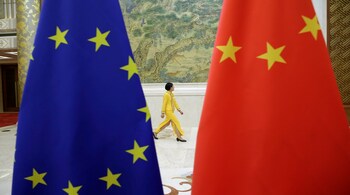
At the recent 22nd EU-China summit, which took place via video conference, the EU leaders recognised that engagement with China is “both an opportunity and necessity” and the partnership is crucial for “trade, climate, technology and the defence of multilateralism”. However, it was also distinctly asserted that the European Union and China “do not share the same values, political systems, or approach to multilateralism”. It also stated that for these relations to develop further, “they must become more rules-based and reciprocal, in order to achieve a real level playing field”.
In its earlier strategy paper on China, the EU recognised China as “an economic competitor in the pursuit of technological leadership, and a systemic rival promoting alternative models of governance”. As China is becoming more assertive, EU’s suspicions about Beijing are growing.
The EU and China are both economic heavyweights. They have strong influence within their own regions and beyond. They also have global ambitions. Economically they are deeply engaged with each other. The EU is number one trading partner of China. In 2019, bilateral trade in both goods and services was about 640 billion euros. It means close to $2 billion worth of goods and services are being exchanged between the EU and China every day.
This engagement led to their strategic partnership in 2003. A huge institutional mechanism, including more than 50 dialogues, has also been developed. Initial enthusiasm from both sides led to more sober and mature ties in later years. Still, most policy papers released both by the EU and China looked at each other’s economic strengths as huge opportunities. In addition to the EU, China also signed separate strategic partnerships with the United Kingdom, Germany, France, Italy, Spain, Portugal, Poland, Greece, Hungary and Czechia. In has established 17+1 dialogue with Central and East European countries.
The European approach towards China’s Belt and Road Initiative (BRI) is also changing. Initially, the EU focused more on the developmental aspect of the initiative. It also established the EU-China Connectivity Platform in 2015. Italy, Greece, Hungary support the initiative. Few others recognised advantages, but have shown some concerns. When China started dividing Europeans, buying infrastructure facilities and started investing in key technology companies, the EU policy makers woke up to the reality of increasing Chinese influence in the continent.
In 2019, the EU outlined its own Europe-Asia connectivity strategy. It has also established partnership with Japan for sustainable connectivity and quality infrastructure. Recently, its High Representative for Foreign Affairs and Security Policy Josep Borrell asserted that “China is getting more powerful and assertive and its rise is impressive and triggers respect, but also many questions and fears”. He favoured a “more robust strategy for China” which he argued will require better relations with India, Japan and South Korea.
Broadly, Europe has been regarded by China as a group of countries that have “no fundamental conflicting interests” with Beijing. This assessment was emphasized in a recent editorial in The Global Times. Although Chinese position about Europe has not changed, the EU is definitely re-assessing its ties with China.
When various strategies of counterbalancing China in Asia are being proposed, the EU has been careful not to be part of any US-China geopolitical struggle. Its foreign policy chief Joseph Borrell believes that “following Frank Sinatra, we Europeans have to do things ‘My Way’. This includes keeping the multilateral system as a space for cooperation even if great powers use it increasingly as a battleground”. Within days of this assertion, however, the EU and the US have established a new transatlantic dialogue on China to deal with Beijing’s assertiveness on many fronts.
The EU’s global ambition is changing and becoming more geopolitical. Despite a solid economic engagement, its ties with Beijing are witnessing lack of trust, transparency and reciprocity. Many issue including COVID-19, Hong Kong’s security law, South China Sea, market access, subsidies, illegal technology transfers, cyber security threats and human rights have raised concerns in the EU. Under German presidency, the Leipzig Summit in September between the Chinese authorities and 27 European heads of government or states has been postponed. The European parliament has condemned new security law on Hong Kong and voted in favour of bringing China before the International Court of Justice.
Due to border clashes, India-China ties are on a turning point. Apart from working with the US and the Quad to counterbalance an assertive China, New Delhi also must upgrade its consultations with Brussels. In its developing China strategy, the EU is looking for new inputs and partners. As India-EU summit is likely to happen soon, New Delhi and Brussels can also establish a new dialogue to deal with China.
Gulshan Sachdeva is Chairperson, Centre for European Studies at Jawaharlal Nehru University, New Delhi. Views are personal.
Discover the latest Business News, Sensex, and Nifty updates. Obtain Personal Finance insights, tax queries, and expert opinions on Moneycontrol or download the Moneycontrol App to stay updated!





