

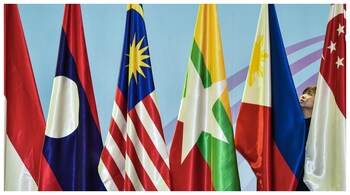
The 46th ASEAN Summit in Kuala Lumpur convened against a backdrop of intensifying geopolitical tensions, economic shocks, and internal crises that threaten the cohesiveness and future direction of the bloc. ASEAN's vision of "One Vision, One Identity, One Community" has long provided an ideational anchor, but 2025 is emerging as a year that will test the practical meaning of that mantra.
The biannual summit is being hosted by Malaysia after a decade. The mid-year summit usually focuses on internal ASEAN matters, such as economic integration, political-security cooperation, and socio-cultural development, while the end-of-year summit expands discussions to include its dialogue partners, namely, China, Japan, South Korea, India, and the United States.
Strategic Fragility
The agenda focused on maritime security and economic resilience, while Myanmar revealed the strategic fragility that ASEAN currently faces. As the South China Sea turns into a geopolitical tinderbox, recent maritime collisions and a Chinese water cannon assault on Philippine vessels illustrate Beijing's continued assertiveness in the region. In parallel, the U.S. is pushing back with a forward-deployed missile system, NMESIS, on the northern Philippine island of Batan, capable of targeting Chinese naval assets within 115 miles.
Concurrently, the annual KAMANDAG island defence exercises between the US Marine Corps and counterparts from the Philippines, Japan and the Republic of Korea are underway.
This militarisation, while framed as deterrence, draws ASEAN deeper into a potential great-power confrontation. For member states like Vietnam and the Philippines, security cooperation with the U.S. is seen as increasingly essential. Others, like Cambodia and Laos, which lean toward Beijing, remain uneasy about any unified ASEAN response to Chinese actions. Further, the long-delayed Code of Conduct in the South China Sea, under discussion last week, remains a hollow promise.
The Tariff Trap
Compounding the security problem is Trump’s fresh wave of protectionist policies. U.S. tariffs targeting ASEAN exports are as high as 49% imposed on Cambodia and 10% on Singapore, affecting primarily the electronics, textiles, and agriculture sectors. These moves threaten to dismantle years of supply chain integration and jeopardise the export-led growth models of several ASEAN states.
Malaysian Prime Minister Anwar Ibrahim emphasised the importance of regional unity in addressing these economic challenges. ASEAN has formed a task force to coordinate a common stance and is seeking a meeting with U.S. President Donald Trump to negotiate the tariffs. Meanwhile, Vietnam, Thailand, and Indonesia are pursuing bilateral negotiations, while others are exploring trade redirection toward China, India, and the EU.
Rather than frame these developments solely as challenges, ASEAN leaders are approaching them as opportunities to build economic resilience. Malaysia’s leadership has emphasised expanding partnerships through RCEP, deepening ASEAN-EU trade, and supporting regional supply chain initiatives. Additionally, the summit saw the launch of a new 20-year vision document and a dedicated forum to engage in broader cooperation with China and the Gulf Cooperation Council. While Malaysia, as the 2025 Chair, has advocated for a combined response, internal fragmentation impedes joint action.
Myanmar’s Crisis and ASEAN’s Inertia
Nowhere is ASEAN's indecision more glaring than in its Myanmar policy. Despite calls for direct negotiations between the junta and opposition forces, as well as proposals for a permanent ASEAN envoy, the bloc remains largely paralysed. The post-coup conflict has escalated into a full-scale civil war, with resistance groups making gains against a beleaguered military regime. Humanitarian fallout, including school bombings, mass displacement, and the Rohingya refugee crisis, continues to mount. More than 400 Rohingya refugees perished at sea this month, and over 3.5 million remain displaced.
Thailand's call for "constructive engagement" and Malaysia's insistence on extension of the post-earthquake ceasefire, which is set to expire at the end of May, reflect competing national preferences that dilute collective leverage. A proposal for appointing a permanent ASEAN envoy to facilitate dialogue is under discussion. Malaysian Foreign Minister Mohamad Hasan has indicated plans to visit Myanmar next month to further these initiatives.
Europe’s Indo-Pacific Overture
Into this volatile environment steps French President Emmanuel Macron, whose diplomatic tour of Southeast Asia reflected a broader European interest in anchoring engagement beyond aid or arms sales. His stop at Hanoi saw 14 agreements signed across sectors, reinforcing Vietnam as a pivot state in both regional stability and Franco-Asian relations. With upcoming visits to Indonesia and Singapore and a keynote address at the Shangri-La Dialogue, Macron's strategy is clear: offer France as another pole in an increasingly bipolar Indo-Pacific. But it is not alone. Germany recently signed a formal defence agreement with the Philippines, which is also negotiating several contracts with the visiting forces of other partners, such as Canada.
It is uncertain if ASEAN can translate these overtures into sustainable multilateral partnerships, especially given its existing dependence on China and the U.S. Whether it continues as a community of convenience or evolves into a community of shared responsibility will shape not just Southeast Asia’s future but also the broader Indo-Pacific order. While significant challenges remain, the Kuala Lumpur summit shows that ASEAN is not adrift. It is weathering the currents of change with a steady hand, attempting to chart a course that prioritises peace, development, and cooperation. In doing so, ASEAN may not always move fast, but it continues to move forward.
(Vanshika Saraf, is a Research Analyst - Indo-Pacific Studies Programme, Takshashila Institution.)
Views are personal, and do not represent the stance of this publication.
Discover the latest Business News, Sensex, and Nifty updates. Obtain Personal Finance insights, tax queries, and expert opinions on Moneycontrol or download the Moneycontrol App to stay updated!





