

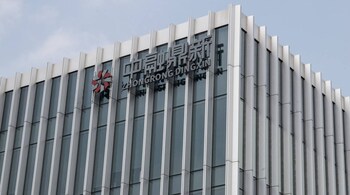
Zhongzhi Enterprise Group Co, one of China’s largest private wealth managers, is sending shockwaves through the country’s financial system. Its affiliates have missed payments on dozens of products. Rare public protests erupted in Beijing as investors lost patience. Stock traders sold off shares fearing that listed companies had invested spare cash into its funds. The conglomerate, which manages about 1 trillion yuan ($137 billion), plans to restructure debt after an internal audit.
China has been cracking down on shadow banking since late 2017. So people naturally ask why this is happening now, and if we might expect more blowups in the near future.
A lack of ring-fencing appears to be a key cause of Zhongrong’s default. For instance, the 30 million yuan trust product Nacity Property Services had bought was supposed to be similar to a money-market fund, with an expected 5.8 percent return. But it turned out to be a so-called “cash pool.”
Nacity’s money was put into a common pool, which the trust could use to repay older, existing investors.
By the end of 2021, Zhongzhi’s cash pools, not including that of its trust affiliate Zhongrong, had reached 300 billion yuan. They were backed by about 150 billion yuan worth of underlying assets, reported financial media outlet Caixin. No surprise then that, when new fundraising dried up, Nacity’s money was not returned at maturity.
The government, of course, frowns upon this practice. A polite description is excessive leverage, while a more crude one is a Ponzi scheme. However, because of their complex nature, regulations covering cash pool products have only been loosely enforced, according to CreditSights. Officials don’t get to see the lending documents — they are, by definition, private. They don’t have the resources to sift through and understand the tailor-made borrowing terms either.
Caixin cited other eyebrow-raising practices. For instance, a Zhongzhi subsidiary had raised $1 billion against a certain project. Another subsidiary consolidates the balance sheet of the first one and also borrows $1 billion from the same project. In other words, an asset is pledged away many times. As an outside investor, how do you conduct this level of detailed due diligence?
Zhongzhi has hired KPMG LLP to conduct an audit of its balance sheet to find out if it has enough assets it can sell to repay investors. Chances are, it’s already reached negative equity.
Most private-credit products are only available to wealthy individuals or corporate treasuries. Zhongzhi’s wealth management offerings had a minimum investment of 3 million yuan, while that of a trust was normally above 300,000 yuan. However, just because these investors were richer, they were not necessarily savvier. Many simply got lured by the 7 percent to 9 percent yield. That’s attractive considering China’s 10-year government bond pays only 2.6 percent.
Shuli Ren is a Bloomberg Opinion columnist covering Asian markets. Views are personal, and do not represent the stand of this publication.
Credit: Bloomberg
Discover the latest Business News, Sensex, and Nifty updates. Obtain Personal Finance insights, tax queries, and expert opinions on Moneycontrol or download the Moneycontrol App to stay updated!





