

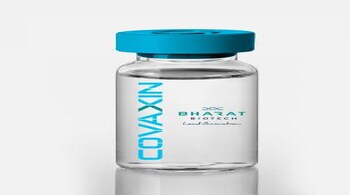
The phase-I human clinical trial of India's first indigenously-developed vaccine against novel coronavirus, Covaxin, began at the AIIMS in Delhi on Friday with the first dose of the injection given to a man, who is in his 30s.
Already, over 3,500 volunteers have registered themselves for the trial at AIIMS since last Saturday, of whom the screening of at least 22 people is underway, said Dr Sanjay Rai, Professor at the Centre for Community Medicine at AIIMS and the principal investigator of the study.
"The first volunteer, a resident of Delhi, was screened two days ago and all his health parameters were found to be within the normal range. He also does not have any co-morbid conditions.
"The first dose of 0.5 ml intramuscular injection was given to him around 1.30 pm. No immediate side-effects have been observed so far. He was under observation for two hours and will be monitored for the next seven days," Rai said.
Few more participants would be given the vaccine on Saturday after their screening reports come.
AIIMS-Delhi is among the 12 sites selected by the Indian Council for Medical Research (ICMR) for conducting phase I and II randomised, double-blind, placebo-controlled clinical trials of Covaxin.
In phase I, the vaccine would be tested on 375 volunteers and the maximum of 100 of them would be from AIIMS. The second phase would include around 750 volunteers from all 12 sites together, Rai said.
Phase I of the vaccine trial will be done on healthy people aged 18-55 years having no co-morbid conditions. Women with no pregnancy will also be selected to be a part of the trial in the first phase.
In the second phase, 750 people will be recruited between 12-65 years, AIIMS Director Dr Randeep Guleria had said.
Already, around 1,800 volunteers have registered themselves for the trial at AIIMS, he had said.
"In the first phase we see the safety of the vaccine which is of primary importance and the dose range is also calculated," he said.
There are three formulations of the vaccine, and each subject will be given any one of the formulation in two doses two weeks apart.The first 50 will get the lowest strength dose of the vaccine. If it is found to be safe in them, then it will be given to another 50 patients in high doses, acording to Rai.
COVID-19 vaccine candidate Covaxin, developed by the Hyderabad-based Bharat Biotech in collaboration with the ICMR and the National Institute of Virology (NIV), had recently got the nod for human clinical trials from the Drugs Controller General of India (DCGI).
Follow our full coverage of the coronavirus pandemic here.
Discover the latest Business News, Sensex, and Nifty updates. Obtain Personal Finance insights, tax queries, and expert opinions on Moneycontrol or download the Moneycontrol App to stay updated!





