

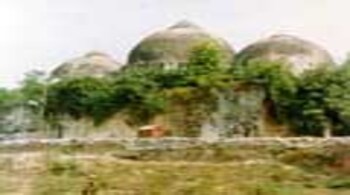
The administration had sealed the inner courtyard of the structure following the appearance of Ram Lalla idols inside the central dome of the Babri Masjid on the night of 22-23 December 1949 — an incident recorded in Faizabad district police diaries, the magistrate’s 1949-50 reports, and described in the Government of India’s 1993 Ayodhya White Paper. The sealing was intended to prevent communal tension and maintain public order after the idols’ placement.
This produced a long-standing status quo, reflected in civil suit filings from 1950 onwards, district administrative orders, and summaries in later judicial reviews:
· Idols remained inside the structure behind locked gates
· Hindu worship was allowed only from outside the grill
· Muslim prayers ceased within the mosque
· Multiple civil suits were filed by Hindu and Muslim litigants seeking access, restoration and rights-of-worship
For nearly 36 years, the gates remained locked under court supervision, as noted in Faizabad court records from the 1950s-1980s, even as pilgrims continued to arrive outside the structure.
Litigation leading up to the 1986 order
One of the earliest petitions for access was filed in 1950 by Gopal Singh Visharad, seeking permission to worship the idols inside. His suit, along with the petition of Paramhans Ramchandra Das, is detailed in Civil Suit No. 2/1950 and referenced in later judgments of the Allahabad High Court (2010).
None of the early petitions succeeded in reopening the gates. The administration consistently argued—based on executive file notes, district magistrate reports, and Home Department communications—that the locked status was necessary to maintain public order.
By the early 1980s, however, religious mobilisation had increased significantly, largely driven by the Vishva Hindu Parishad’s campaigns, documented in VHP’s 1983-84 resolutions and widely reported in the national press. Petitions now argued that the presence of idols established a deity whose worship must be facilitated, and that restrictions violated religious rights—a claim repeatedly made in court affidavits submitted in 1984-85.
Counter-petitions, including those filed by Muslim litigants and summarised in the records of the Babri Masjid plaintiffs, warned that opening the gates would destabilise communal harmony and prejudice ongoing title suits.
The 1 February 1986 judgment: Unlocking the gates
On 1 February 1986, District Judge K.M. Pandey of the Faizabad District Court issued an order directing that the locked gate be opened “forthwith.” The judgment is preserved in District Court
Record: Misc. Case No. 25/1986, and its reasoning is summarised in the Allahabad High Court judgment (2010) and referenced in the Supreme Court’s 2019 verdict.
Key observations of the court (based on original judgment and administrative file summaries):
· Public order concerns were insufficient grounds to deny devotees access
· The administration should not obstruct worship where idols were already installed
· No compelling justification existed for maintaining the 36-year-old locked-gate arrangement
· The district magistrate was directed to open the gates immediately
The administration complied the same evening. Local police station logs, press photographs, and contemporaneous news reports record that thousands of devotees gathered within hours.
Reaction from Hindu organisations
Organisations such as the VHP welcomed the order. Contemporary VHP statements, preserved in VHP press notes (1986) and covered extensively in newspapers, described the unlocking as a “restoration of religious rights.”
Years of VHP activity—documented in meeting resolutions, public mobilisation leaflets, and reports in national newspapers—meant the movement was prepared to capitalise immediately. Celebratory gatherings, processions and temple events were reported across several states.
Reaction from Muslim organisations
Muslim community leaders saw the unlocking as a major setback. Within days, clerics and leaders formed the Babri Masjid Action Committee (BMAC), whose founding resolutions are recorded in BMAC’s 1986 meeting minutes and referenced in contemporary reporting in The Times of India and The Indian Express.
The BMAC coordinated:
· Legal appeals against the unlocking
· Nationwide meetings and public statements
· Efforts to restore the pre-1986 arrangement
Muslim petitions filed after 1986, and summarised in Allahabad High Court records, argued that the unlocking prejudiced pending suits and disturbed fragile equilibrium.
Why the unlocking became nationally significant
Although issued by a district court, the order’s impact travelled far beyond Ayodhya.
1. Escalating Hindu mobilisation
VHP campaigns through the early 1980s—including 1983 Ramayana conferences, Ram-Janaki Rath Yatras, and religious conventions—had built a national network. The unlocking validated and energised these efforts.
2. Communal polarisation in the political climate
Debates around the Shah Bano case (1985-86)—recorded in parliamentary debates and press coverage—had already heightened identity politics. The unlocking added to this volatile landscape.
3. Government response under scrutiny
The order came during the tenure of Prime Minister Rajiv Gandhi. While the unlocking was judicial, media analyses and political commentaries in 1986 questioned whether administrative discretion accelerated implementation.
4. BJP’s strategic repositioning
As documented in BJP’s 1989 Palampur resolution and earlier party publications, the BJP increasingly aligned itself with the Ram Janmabhoomi movement. The 1986 unlocking created an opportunity for the party to foreground the issue in its public messaging.
Religious mobilisation intensifies after 1986
Post-unlocking, Ayodhya saw:
· Surging numbers of pilgrims visiting the site
· Expanded religious gatherings and meetings
· Rapid circulation of devotional cassettes, posters and pamphlets
Press archives of 1986–88 show Ayodhya transforming into a continuous religious centre.
Muslim mobilisation strengthens
In response, organisations under the BMAC banner organised:
· Legal appeals
· State-level conventions
· Mass outreach campaigns
These actions are recorded in BMAC releases, All India Muslim Personal Law Board statements, and court filings from 1986–1989.
Nationwide media coverage
The unlocking was one of the most extensively covered domestic events of 1986. Photographs of the opened gate, reports on political reactions and editorials analysing its implications appeared across all major Indian newspapers, as preserved in national press archives.
Long-term consequences of the 1986 unlocking
The order had enduring effects:
1. Changed access to the structure for the first time since 1949 (noted in later Allahabad High Court and Supreme Court summaries).
2. Transformed the dispute from a court-centred case to a national political issue.
3. Institutionalised parallel religious mobilisation through VHP and BMAC.
4. Set the stage for mass movements of 1989-1992, including Shilanyas (1989) and the 1990 Rath Yatra, described in organisational records and press reports.
5. Became a critical point of reference in all later judicial findings, including the 2010 and 2019 judgments.
Conclusion: Why 1986 is a defining milestone
The 1986 unlocking of the Babri Masjid gates remains one of the most consequential events in the modern history of the Ayodhya dispute. Though judicial and local in origin, its political, religious and national effects were profound. Drawing from court records, government documents, organisational resolutions, and press archives, it is clear that the unlocking reconfigured patterns of worship, intensified mobilisation across communities and altered the trajectory of Indian politics.
Discover the latest Business News, Sensex, and Nifty updates. Obtain Personal Finance insights, tax queries, and expert opinions on Moneycontrol or download the Moneycontrol App to stay updated!





