

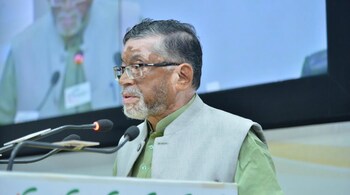
India is committed towards making all possible efforts to counter the impact of the pandemic and emerge stronger, Labour Minister Santosh Gangwar has said.
He was addressing the virtual Non-Aligned Movement Labour Ministers Meeting under 109th session of the International Labour Conference last evening.
Gangwar noted that the world has witnessed loss of lives and livelihood, slowdown of economies and adverse impact on all sections of the society, especially the weaker ones.
He said there is a need to ensure better support to the healthcare systems, social protection and employment generation.
"Governments are required to deal with the pandemic and provide an effective response at policy levels, to balance business continuity, income security and above everything, well-being of all," he added.
The minister said India has undertaken a massive vaccination drive, and total 22.3 crore vaccines have been administered so far. He said there have been extraordinary changes in the lives and livelihoods and new approach should be developed for style of work.
Use of digital platforms has posed challenges but also provided more opportunities.
He added that India has made legal framework for social security of Gig and Platform workers.
A gig worker is someone who takes on hourly or part-time jobs, while the one working for an organization which provides specific services using online platform directly to individuals or organizations is called a platform worker.
Gangwar said employment being an important aspect, India is putting key efforts through various schemes and programmes to provide employment and support on health and financial fronts also.
India launched Aatmanirbhar Bharat package worth Rs 27 lakh crore for self-reliance to strengthen the economy, which also includes payment of EPF contributions up to 24 per cent of wages by the government for eligible new employees.
Further, collateral free loans worth Rs 9 lakh crore have been disbursed under MUDRA Yojana in the last three years, having around 70 per cent accounts of women.
The minister added that increase in daily wages, under Mahatma Gandhi NAREGA scheme for rural India, has resulted in employment generation of 390 crore man days during last financial year alone.
Discover the latest Business News, Sensex, and Nifty updates. Obtain Personal Finance insights, tax queries, and expert opinions on Moneycontrol or download the Moneycontrol App to stay updated!





