

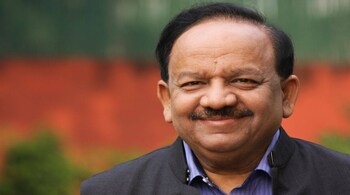
Union Health Minister Harsh Vardhan on Sunday saidthe government has not yet taken a view on granting emergency authorisation to COVID-19 vaccines in India, as and when they become available. The minister also said that the indigenously developed Feluda paper strip test for SARS-CoV-2 diagnosis could be rolled out in the next few weeks.
Presently COVID-19 vaccines are in various stages of phases 1, 2 and 3 ofhuman clinical trials, the results of which are awaited, Vardhan said during an interaction with his social media followers on the fifth episode 'SundaySamvaad' platform. "Adequate safety and efficacy data is required for emergency use authorisation, vaccine approval for ensuring patient safety. Further course of action will depend on the data generated," he underlined.
The ministerhad earliersaid that a COVID-19 vaccine is likely to be available by the first quarter of 2021. Categorically rejecting speculation that the government is prioritizing young and working-class for the COVID-19 vaccine for economic reasons, Vardhansaid, The prioritisation of groups for COVID-19 vaccine shall be based on two key considerations — occupational hazard and risk of exposure to infection, and the risk of developing severe disease and increased mortality.
Asked how the government plans to roll out the COVID-19 vaccine, he said that it is anticipated that supplies of vaccines would be available in limited quantities in the beginning. In a huge country like India, it is critical to prioritise vaccine delivery based on various factors such as the risk of exposure, comorbidity among various population groups, the mortality rate among COVID-19 cases, and several others," the minister said.
He also added that India is looking at the availability of several different types of vaccines, of which some may be suitable for a particular age group while others may not be so. He reiterated that the most important component of the planning is the cold chain and other logistics to ensure no glitches occur in vaccine delivery even at the last mile.
On the need to include other candidates of COVID-19 vaccine, Vardhan said considering the large population size of India, one vaccine or vaccine manufacturer will not be able to fulfil the requirements of vaccinating the whole country. "Therefore, we are open to assessing the feasibility of introducing several COVID-19 vaccines in the country as per their availability for the Indian population, he said.
Sharing his views on public-private partnership during the pandemic,Vardhan said that the present situation demands multiple vaccine partners to ensure maximum vaccination coverage to the Indian population. He also said that the use of a single vaccine from a certain company should not be seen through a negative lens.
Vardhan also highlighted the need for massive advocacy for building community sensitization activities to understand the reasons for vaccine hesitancy and address them appropriately. On the rollout of the Feluda test, he said that based on tests in over 2,000 patients during the trials at the Institute of Genomics and Integrative Biology (IGIB) and testing in private labs, the test showed 96 pc sensitivity and 98 pc specificity.
This compares favourably to ICMR's current acceptation criteria of RT-PCR Kit of at least 95 pc sensitivity and at least 99 pc specificity, he stated. He added that the Feluda paper strip test for SARS-CoV-2 diagnosis has been developed by CSIR-IGIB and has been approved by the Drug Controller General of India for a commercial launch.
"The kit has already been validated by the Department of Atomic Energy's National Centre for Biological Sciences, Bangalore. While I cannot put an exact date on the availability, we should expect this test within the next few weeks," he said. Referring toreports of reinfection surfacing in various states, Vardhan said an analysis by the ICMR has revealed that many cases reported as COVID-19 reinfection have been misclassified because RT-PCR tests can detect dead-virus shed for prolonged periods after recovery.
Actual reinfection would mean a fully recovered person getting infected by a freshly introduced virus in his/her body, belonging to the same or different strain. ICMR is commissioning a study to understand the true burden of re-infected cases. Results will be shared in a couple of weeks," he said. Vardhan explained that the phase-1 trials for vaccines are done primarily to establish the safety of the product while the phase 2 clinical trial measures immunogenicity as a primary endpoint and safety as a secondary endpoint.
In phase-3 clinical trials, both safety and immunogenicity continue to be measured as secondary endpoints, efficacy being the primary endpoint for this phase of a clinical trial. Currently, twoindigenously-developedvaccine candidates, onebyBharat Biotech in collaboration with ICMR and the other by Zydus Cadila Ltd,are in phase 2 ofthe human clinical trials.
Pune-basedSerumInstitute of India, which has partnered withAstraZeneca for manufacturing the Oxford COVID-19 vaccine candidate also, isconducting phase 2 and 3 human clinical trials of the candidate in India. During the Sunday Samvaad conversation, Vardhan shared that in the first phase the Government of India has released Rs 3,000 crore to states and UTs to battle COVID-19 pandemic.
Almost all, except three states and UTs, have utilized the complete grant given to them: Maharashtra has only used 42.5 pc of the grant followed by Chandigarh at 47.8 pc and Delhi at 75.4 pc, he stated. In view of the upcoming festivals, Vardhan urged the people to stay away from congregations and diligently follow COVID appropriate behaviour, saying "no religion or God says that you have to celebrate a festival in an ostentatious way".
Discover the latest Business News, Sensex, and Nifty updates. Obtain Personal Finance insights, tax queries, and expert opinions on Moneycontrol or download the Moneycontrol App to stay updated!





