

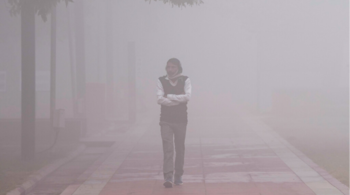
On most days, cities pollute, and the atmosphere quietly does the unglamorous job of diluting it. Delhi-NCR, for a chunk of every winter, loses that service.
That’s the simplest way to understand why the capital’s air crisis feels uniquely vicious, and why the same conversation repeats every year: the emissions may not change overnight, but the sky does.
The sky shrinks. Seriously.
The winter problem is not that Delhi suddenly invents new pollution in November. It’s that the atmosphere becomes a smaller box.
Two things matter here:
1) Temperature inversions
Normally, warm air near the ground rises and takes pollutants with it. In winter nights (and many mornings), you often get the opposite: cooler air hugs the ground while warmer air sits above it like a lid. According to ScienceDirect and MDPI, that lid traps emissions close to breathing height. Researchers tracking Delhi’s winter air repeatedly flag this mechanism as central to the city’s spikes.
2) Low 'mixing height'
Mixing height is basically how tall the atmosphere’s 'stirring zone' is. A major review of Delhi’s air by MDPI points out that mixing/inversion heights are lowest in winter, and can drop to very low levels at night (reported as under ~100 m in that review), leaving a much smaller volume of air to dilute emissions.
When the box shrinks, the same emissions produce a much uglier concentration. AQI is a concentration story.
Delhi is not only a source. It’s also a collection point.
Now add the second, politically messier part: Delhi’s air is an airshed problem, not a municipal one.
Airshed is a simple idea with big consequences: air doesn’t respect state borders. The Indo-Gangetic Plain is densely populated, industrial, and heavily trafficked, and in winter, dispersion weakens across the region.
About stubble: it matters, but it’s not the whole plot
Crop-residue burning becomes a political punching bag because it’s visible (satellite fire counts), seasonal (easy to time with spikes), and emotionally satisfying (a clear villain).
But evidence doesn’t support the 'it’s all stubble' version.
A DPCC real-time source apportionment note from November 2023 reported the mean contribution of parali burning at 22 percent during that period, with some days exceeding 35 percent.
Simple translation for you:
On certain days, farm fires can be a major accelerant.
On most days, Delhi is choking on a multi-source cocktail: vehicles, dust, industry, waste burning, regional transport, and winter make the cocktail stay in the glass.
Even if you could switch off every farm fire, Delhi-NCR would still have a serious winter problem, because the city (and NCR) runs a steady set of emissions all year.
What source apportionment studies keep finding
A well-cited Delhi-NCR source apportionment report by TERI (commissioned work focused on identifying major sources) is part of the evidence base policymakers refer to when they talk about dominant contributors and the need for sector-wise controls.
And reporting around IIT Kanpur’s earlier source apportionment work has consistently flagged road dust and transport as major contributors, with stubble burning typically a smaller share on average (though it can spike). Business Standard summarised one such set of findings, citing the 2013 IIT Kanpur study: road dust as a large portion of PM10 and a sizeable part of PM2.5; vehicles as a major PM2.5 contributor; stubble burning in a lower band on average.
Separately, CAQM’s own recent framing around transport reflects how central vehicles are: an expert panel it formed noted studies estimating vehicular sources contribute roughly 20 percent to 41 percent to PM2.5 in Delhi (range varies by season, method and geography).
The point isn’t the exact percentage as a debating sport. The point is this: Delhi has multiple large taps turned on at once, and winter makes the sink drain slow.
So why doesn’t Mumbai look like Delhi, every winter, every year?
Mumbai’s air can get bad, it has, and it will again, but it usually avoids Delhi’s multi-day 'stuck' episodes because it has something Delhi lacks: a frequent ventilation reset.
Mumbai’s coastal meteorology, especially land–sea breeze circulation, often helps flush pollutants away from land. A scientific paper discussing meteorology and pollution extremes explicitly contrasts Delhi’s winter trapping with Mumbai’s sea-breeze-driven flushing. ScienceDirect
Even mainstream explainers that got traction during Mumbai’s rare bad-air spells leaned on the same core mechanism: strong sea breezes tend to disperse pollution faster than landlocked North Indian winter air can. The Indian Express
That doesn’t mean Mumbai is 'clean'. It means Mumbai often gets a daily 'air change.'
Delhi has nights where the city emits pollution and the atmosphere basically says, “Noted. I’ll keep that.”
“But the government is doing things.” Yes, and here’s why it still feels futile.
Delhi’s policy response often looks dramatic because it is designed for emergencies: GRAP (Graded Response Action Plan) escalates restrictions by AQI category, including severe and 'severe+'. The central government’s PIB note on CAQM revising the GRAP schedule describes it as an emergency response mechanism for the NCR based on AQI and forecasts.
During this December’s spike, CAQM invoked Stage IV actions (the 'Severe+' bracket). A CAQM-linked order circulated to the education department in Delhi notes Stage IV invocation for AQI >450 under the modified GRAP schedule.
India implemented the highest level of measures under GRAP around December 14, 2025 as AQI readings climbed sharply in parts of Delhi, driven by stagnant winds and winter smog conditions.
So why the public despair?
Because emergency measures often target what’s easy to stop quickly, not what’s structurally dominant year-round.
Construction bans, sprinklers, work-from-home, restrictions on certain vehicles, these reduce exposure and shave peaks. But they don’t permanently change the big pipes feeding the problem: dust management, fleet transition, freight redesign, enforcement consistency, and regional coordination.
GRAP is the fire extinguisher. Delhi needs building codes.
The stakes aren’t abstract: the benchmark keeps moving, downward
The World Health Organization’s 2021 global air quality guidelines tightened the recommended limits, including annual mean PM2.5 at 5 μg/m³, a signal of how even 'moderate' particulate exposure carries health risk.
That doesn’t translate neatly to one city-day AQI headline. But it explains why Delhi’s winter spikes land like a public-health alarm, not just a weather complaint.
What 'fixing Delhi air' actually means (without selling fantasies)
If you want a single sentence that doesn’t lie: Delhi needs year-round structural controls, and the NCR needs regional governance that matches the airshed.
In practice, that means:
Dust as infrastructure, not aesthetics: paved shoulders, vacuum sweeping that’s real, construction compliance that sticks, roads designed to reduce resuspension. Source apportionment repeatedly points to dust as a major component of particulate pollution.
Vehicles beyond sticker bans: congestion management, cleaner freight movement, inspection systems that can’t be gamed, and transit that actually competes with private vehicles. CAQM’s own focus on transport’s PM2.5 share signals the scale of this lever.
And that’s the angle: Delhi doesn’t just 'get polluted.' It gets trapped, and we keep treating a structural problem like a seasonal surprise.
Discover the latest Business News, Sensex, and Nifty updates. Obtain Personal Finance insights, tax queries, and expert opinions on Moneycontrol or download the Moneycontrol App to stay updated!





