

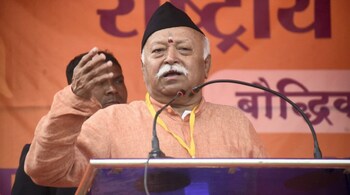
In what could his most detailed articulation on bridging caste divisions so far, Rashtriya Swayamsevak Sangh sarsanghchalak Mohan Bhagwat on Sunday said that friendship of individuals and families was imperative for social harmony and called upon RSS karyakartas to go to society with the message of mutual goodwill within the entire Hindu society. The RSS chief was addressing his annual Vijayadashami speech at the organisation's headquarters in Nagpur.
Claiming that a 'Deep State' was at work to divide the country on the lines of caste and community with the help of some political parties who were working for their "selfish interests", Bhagwat called upon the Hindu society to overcome caste differences and encouraged a mass outreach to Dalits and the weaker sections of society.
Bhagwat said that India's diversity has reached a point where Hindus have divided their own saints and deities. "Why should Valmiki Jayanti be celebrated only in Valmiki colony? Valmiki wrote Ramayana for the entire Hindu society. So, all should celebrate Valmiki Jayanti and Ravidas Jayanti together. All festivals should be celebrated together by the entire Hindu society. We will go to the society with this message,” he said.
Underlining social harmony and mutual goodwill among different sections as a prerequisite for a healthy society, Bhagwat said that symbolic programmes cannot suffice in accomplishing this objective.
"In all sections of society, there should be friendship between individuals and families. Wherever I go and where I work, I should have friends among all kinds of people. Languages can be diverse, cultures can be diverse, food can be diverse, but this friendship of individuals and families will bring harmony in society,” he said, according to The Indian Express.
The RSS chief further advocated an environment in which all sections of society can participate in places of public use and worship like temples, drinking water and crematoriums, among others. The needs of the weaker sections of society, Bhagwat said, arise from the circumstances they face, and called for wider understanding of this facet.
"I was in a meeting where our Valmiki brothers were there. They said our children do not have schools. People from the Rajput community were there. They got up and said your colony is adjacent to ours and we have a school. We will take 20% students from your colony and teach them without any fees. Just as the strong members of a family make more provisions for the weaker members, sometimes even at the cost of their own loss, similarly such needs should be considered with the feeling of belongingness to each other,” he said.
While Bhagwat has repeatedly underlined the need for social harmony in multiple speeches over the past few years, this was arguably his most detailed articulation of the thought process required to achieve harmony in Indian society.
This articulation also assumes significance in view of the BJP's reduced tally in the recently concluded Lok Sabha elections where the party failed to win a majority on its own for the first time in three general elections. The BJP finished at 240 seats, 32 short of the majority mark and 62 lower than its tally in the previous Lok Sabha polls.
Dalits and backwards are believed to have played a key role in the BJP's below-par performance as a large section drifted away from the party after resolutely backing it in the 2014 and 2019 polls. The Opposition's narrative that a '400 paar' mandate would enable the BJP to end reservations has been cited as one of the possible reasons behind the setback in 2024.
Bhagwat's comments also need to be seen in the context of Congress leader Rahul Gandhi's call for a nationwide caste census and the promise of breaching the 50% constitutional limit for quotas as the cornerstone of his revamped politics.
Hinting at what the prevailing political atmosphere in the country, Bhagwat said that Words like ‘Deep State’, ‘Wokeism’, ‘Cultural Marxist’ are the sworn enemies of all cultural traditions. "Complete destruction of values, traditions and whatever is considered virtuous and auspicious is a part of the modus operandi of this group. In a society living together, an identity-based group is motivated to separate on the basis of its actual or artificially created specialty, demand, need or a problem. A feeling of victimhood is created in them."
"By fanning discontent, that element is pulled apart from the rest of the society, and made aggressive against the system. Direct conflicts are created by finding fault lines in the society. An atmosphere of anarchy and fear is created by intensifying distrust and hatred towards the system, laws, governance, administration etc. This makes it easy to establish one’s dominance over that country,” he added.
Discover the latest Business News, Sensex, and Nifty updates. Obtain Personal Finance insights, tax queries, and expert opinions on Moneycontrol or download the Moneycontrol App to stay updated!





