
HomeNewsIndiaCOVID-19 Updates: People without face masks will not be allowed to enter Mathura temples, says District Magistrate

COVID-19 Updates: People without face masks will not be allowed to enter Mathura temples, says District Magistrate

Nobody would be allowed to enter any temple of Mathura, Vrindavan, Goverdhan, Barsana and other areas without wearing a face mask and maintaining required distance, District Magistrate Navneet Singh Chahal said.

April 11, 2021 / 09:02 IST
Story continues below Advertisement
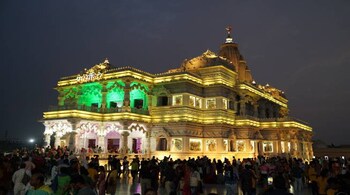
Prem Mandir in Vrindavan, Mathura, India. (File Image: Shutterstock)

Adhering to COVID-19 norms has been made mandatory for devotees visiting temples in Brijbhumi here amid rising coronavirus cases, officials said on April 10.

Nobody would be allowed to enter any temple of Mathura, Vrindavan, Goverdhan, Barsana and other areas without wearing a face mask and maintaining required distance, District Magistrate Navneet Singh Chahal said.

Story continues below Advertisement

He said surprise checks have already started in the temples.

Parikrama for devotees at Dwarkadhish temple has been banned with restricted entry at a time in the temple, Rakesh Tewari, media in-charge of the temple, said.

COVID-19 Vaccine
Frequently Asked Questions

View more

How does a vaccine work?

A vaccine works by mimicking a natural infection. A vaccine not only induces immune response to protect people from any future COVID-19 infection, but also helps quickly build herd immunity to put an end to the pandemic. Herd immunity occurs when a sufficient percentage of a population becomes immune to a disease, making the spread of disease from person to person unlikely. The good news is that SARS-CoV-2 virus has been fairly stable, which increases the viability of a vaccine.

How many types of vaccines are there?

There are broadly four types of vaccine — one, a vaccine based on the whole virus (this could be either inactivated, or an attenuated [weakened] virus vaccine); two, a non-replicating viral vector vaccine that uses a benign virus as vector that carries the antigen of SARS-CoV; three, nucleic-acid vaccines that have genetic material like DNA and RNA of antigens like spike protein given to a person, helping human cells decode genetic material and produce the vaccine; and four, protein subunit vaccine wherein the recombinant proteins of SARS-COV-2 along with an adjuvant (booster) is given as a vaccine.

What does it take to develop a vaccine of this kind?

Vaccine development is a long, complex process. Unlike drugs that are given to people with a diseased, vaccines are given to healthy people and also vulnerable sections such as children, pregnant women and the elderly. So rigorous tests are compulsory. History says that the fastest time it took to develop a vaccine is five years, but it usually takes double or sometimes triple that time.
View more
+ Show



