

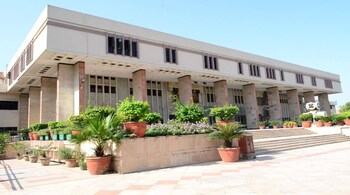
The Delhi High Court Thursday observed that the COVID-19 situation in the national capital has turned precarious with many hospitals running out of oxygen and directed the Centre to ensure the gas is supplied to the city as per the planned allocation and without any hindrances.
"As it stands, we all know that this country is being run by God," observed an anguish bench of Justices Vipin Sanghi and Rekha Palli which was of the view that all measures should be taken for removing obstructions in the transportation of oxygen. If the government wants it can do anything and can even make heaven meet earth, the bench, which heard the matter from 2 PM to 6:40 PM, said.
The bench, while dictating its order, said the position in Delhi has turned rather precarious with several hospitals reporting that either they have insufficient oxygen or will not last for longer period. The high court directed all the authorities concerned, which are bound by the order passed under the Disaster Management Act, to ensure strict compliance of the Centre's direction that there shall be no restriction on inter-State and intra-State movement of persons and goods, including medical oxygen.
The bench made it clear that non-compliance of the order will be viewed seriously since it is going to result in grave loss of lives and will invite criminal action. "We direct the Central government to peremptorily ensure strict compliance of the allocation order dated April 21, its own order passed on April 22 under Disaster Management Act, and our order dated April 21.
We also direct all the authorities concerned who are bound by the order passed under the Disaster Management to ensure strict compliance. We make it clear that non-compliance of the said orders will be viewed very seriously since non-compliance of these orders is likely to result in grave loss of life," the bench said. We also direct the Centre to ensure allocation of oxygen takes place as planned and transportation of the tankers takes place unhindered, the bench said and added that they shudder to think what will be the condition in other states.
It also directed that adequate security be provided to lorries transporting oxygen so that they move without obstructions and a special corridors may be created for immediate transportation of oxygen to hospitals. The court was informed by the Centre that the Ministry of Home Affairs has issued an order to all the states and union territories to ensure that no restriction shall be imposed on the movement of medical oxygen between the states and transport authorities shall be instructed to accordingly allow free inter-State movement of oxygen carrying vehicles.
The court's direction came after the Delhi government submitted that the amount of oxygen that was to come here from Panipat in Haryana was not being allowed to be picked up by the local police there. You don't even have to wait for the order. Your one word to Mr. (Haryana Chief Minister Manohar Lal) Khattar will do the job,"the bench told Solicitor General (SG) Tushar Mehta, representing the Centre.
The high court said the Centre's allocation of oxygen for Delhi from plants in other states like Haryana was not being respected by the local administration there and it needs to be resolved immediately. Senior advocate Rahul Mehra, representing the Delhi government, told the court that oxygen which was to be picked up from some units in Uttar Pradesh could also be not lifted from there.
With regard to Mehra's suggestion to transport oxygen by air, the bench said research by its legal researchers has shown that airlifting of oxygen was very dangerous and it has to be transported either by road or rail. Mehta told the bench "If there is any roadblock by any individuals or any officers, the officers have been instructed that if they are involved in any such activity they will be departmentally dealt with".
"We must respond with a sense of urgency and sense of responsibility which the situation demands," the SG said. During the hearing, Mehta informed the high court that the Supreme Court has taken suo motu cognisance of the prevailing grim situation of COVID-19 pandemic across the country.
He said the apex court wants a national plan on issues including supply of oxygen and essential drugs for treatment of patients infected with the virus. To this, the high court said, "Till the matter goes to the Supreme Court, this is not a matter we can adjourn".
Mehta also said the apex court has also agreed to hear Vedanta's plea for opening of its Sterlite copper unit at Tuticorin in Tamil Nadu on the ground that it would produce thousand tonnes of oxygen only for medical purpose and will give it free of cost to the Centre to treat COVID-19 patients. The high court was informed that there are three other plants from where allocation of oxygen is made to Delhi, that is, Durgapur in West Bengal, Kalinga in Odisha and Rourkela in Odisha, and logistically it will take a long time to transport oxygen here as they are at a distance of 1200 to 1500 km.
It asked the Railways to consider feasibility of running trains from these three locations to Delhi to transport oxygen. The high court, which was on Wednesday assured by the Centre that it will supply 480 metric tonnes of oxygen to Delhi yesterday itself, said on Thursday that it appeared the allocation is not practically implemented and the national capital has not get its share till now.
Discover the latest Business News, Sensex, and Nifty updates. Obtain Personal Finance insights, tax queries, and expert opinions on Moneycontrol or download the Moneycontrol App to stay updated!





