
HomeNewsIndiaCoronavirus pandemic | Ad placed to 'sell' Gujarat's Statue of Unity, case filed

Coronavirus pandemic | Ad placed to 'sell' Gujarat's Statue of Unity, case filed

Case filed against an unknown person in Gujarat for placing an online advertisement to "sell" the Statue of Unity for Rs 30,000 crore to meet the government's expenses for hospitals and medical infrastructure to fight the coronavirus outbreak.

April 06, 2020 / 12:29 IST
Story continues below Advertisement
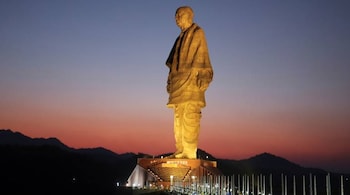
Statue of Unity | Gujarat, India (Image: Reuters)

A case was registered against an unknown person in Gujarat for placing an online advertisement to "sell" the Statue of Unity in Kevadiya in Narmada district for Rs 30,000 crore to meet the government's expenses for hospitals and medical infrastructure to fight the coronavirus outbreak.

The memorial to Sardar Patel, at 182 metres, is the world's tallest such structure and has attracted several lakh people since it was inaugurated by Prime Minister Narendra Modi in 2018.

Story continues below Advertisement

"Some unknown person placed an advertisement on OLX on Saturday stating he needs to sell the Statue of Unity for Rs 30,000 crore to meet the requirement of money to buy hospitals and healthcare equipment," a Kevadiya police station official said quoting the FIR.

"The memorial's authorities came to know of the issue after a newspaper ran an article, and approached police. A cheating and forgery case was registered under IPC, Epidemic Diseases Act and Information Technology Act," Inspector PT Chaudhary said.

COVID-19 Vaccine
Frequently Asked Questions

View more

How does a vaccine work?

A vaccine works by mimicking a natural infection. A vaccine not only induces immune response to protect people from any future COVID-19 infection, but also helps quickly build herd immunity to put an end to the pandemic. Herd immunity occurs when a sufficient percentage of a population becomes immune to a disease, making the spread of disease from person to person unlikely. The good news is that SARS-CoV-2 virus has been fairly stable, which increases the viability of a vaccine.

How many types of vaccines are there?

There are broadly four types of vaccine — one, a vaccine based on the whole virus (this could be either inactivated, or an attenuated [weakened] virus vaccine); two, a non-replicating viral vector vaccine that uses a benign virus as vector that carries the antigen of SARS-CoV; three, nucleic-acid vaccines that have genetic material like DNA and RNA of antigens like spike protein given to a person, helping human cells decode genetic material and produce the vaccine; and four, protein subunit vaccine wherein the recombinant proteins of SARS-COV-2 along with an adjuvant (booster) is given as a vaccine.

What does it take to develop a vaccine of this kind?

Vaccine development is a long, complex process. Unlike drugs that are given to people with a diseased, vaccines are given to healthy people and also vulnerable sections such as children, pregnant women and the elderly. So rigorous tests are compulsory. History says that the fastest time it took to develop a vaccine is five years, but it usually takes double or sometimes triple that time.
View more
+ Show



