

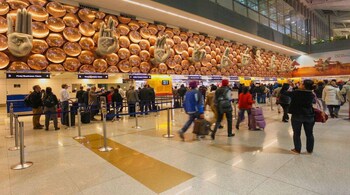
The Delhi airport authorities on Saturday said 20 dedicated counters have been set up for the passengers arriving from "at risk" countries and having pre-booked their mandatory COVID-19 test, after many flyers complained of chaos and crowding at the terminal following the implementation of new travel guidelines. According to the Union Health Ministry's guidelines issued earlier this week, all passengers coming from "at-risk" countries have to compulsorily undergo PCR test and five per cent of passengers arriving from other countries would also have to take the test on a random basis.
The passengers will have to wait for the results before leaving the airport or taking a connecting flight, according to the guidelines. "For the convenience of the passengers, DIAL has set up 20 dedicated counters on arrival piers for passengers who have pre-booked their RT-PCR/Rapid PCR test," Delhi International Airport Limited said.
There will be dedicated queues for these passengers, it noted. They will save the time taken for registration and will proceed directly for testing, it added.
Commenting on a tweet about the situation at the Delhi airport after the new travel rules kicked in, Congress MP Karti Chidambaram said, "As I feared & warned. Total confusion & crowding in airports." A Twitter user tagged Health Minister Mansukh Mandaviya and Civil Aviation Minister Jyotiraditya Scindia in a tweet and said, "No doubt our govt doing tremendous job in COVID-19 and taking all possible precautions on international flier testing. But if review Delhi airport is getting chaos day by day. No proper guidances and informations, no social distancing (sic)."
"Travellers are facing lots of issues, not having smooth instructions and information to follow in proper queue from RT-PCR to Emigration and luggage collection…. Indian with family planned their travel after 2-3 yrs. So please help them for smooth journey," the user wrote on Saturday. Another Twitter user shared pictures of long queues at the terminal and said on Friday, "Taxes Paid, Airport Charges paid. Huge rush but available resources are not being utilised. For 1 hour of flight approx 3 hours need to be spent in queue for processes to be completed."
The Union Health Ministry's recent guidelines have come due to the fear of Omicron variant of the coronavirus that reportedly has higher transmissibility. In a bid to ease the RT-PCR/Rapid PCR booking process for the passengers, DIAL, in collaboration with the Ministry of Civil Aviation and the Ministry of Health and Family Welfare, has allowed for online payment to pre-book the test from the originating airport itself, it mentioned.
About 80 per cent of the international arriving passengers from "at-risk" countries opt for Rapid PCR, it said. Rapid PCR test costs a passenger Rs 3,500 but the results come in 60-90 minutes. RT-PCR costs a passenger Rs 500 and the results come in around 6 hours. Passenger coming from an "at risk" country can choose either of the tests.
Countries in Europe including the UK, South Africa, Brazil, Botswana, China, Zimbabwe, Mauritius, New Zealand, Hong Kong, Singapore and Israel have been placed in the 'at-risk' category by the Union Health Ministry. DIAL said it is also facilitating RT-PCR tests of two per cent international arriving passengers who are not from at-risk countries.
Discover the latest Business News, Sensex, and Nifty updates. Obtain Personal Finance insights, tax queries, and expert opinions on Moneycontrol or download the Moneycontrol App to stay updated!





