

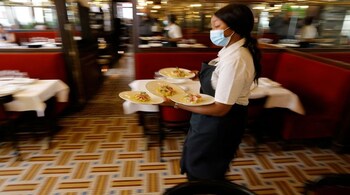
Jordan Frieda knew he was struggling to find servers and kitchen workers for his three Italian restaurants. But the depth of the crisis did not become clear until he hired a recruiter to try to lure people from other restaurants. Of the 100 or so people his agent typically contacted in a day, he recalled, fewer than four responded, and often only one agreed to turn up for a trial shift.
“It’s worse than COVID, worse than energy costs,” said Frieda, a well-connected actor-turned-restaurateur who worked briefly under celebrity chef Gordon Ramsay. “It’s been the most traumatic event of my career in restaurants. It has been an absolutely devastating, transformative event.”
Frieda is not alone. Restaurants across London are so short of staff that they have had to curtail operating hours, close on some days of the week, and in extreme cases shut their doors altogether. While the city’s once-thriving dining scene has also been hurt by the coronavirus pandemic and soaring energy prices, the labor shortage is almost wholly a result of Brexit — a conspicuous example of how Britain’s departure from the European Union is reshaping its economy.
London restaurants used to recruit many servers, chefs and bartenders from Italy, Spain and Greece. That talent pool has dried up since Britain ended the free movement of labor from the European Union. An estimated 11% of jobs in Britain’s hospitality industry are vacant, according to a recent industry survey, compared with 4% for the broader economy.
With multiple jobs unfilled, Frieda initially cut back the days his restaurants are open to five from seven. He eliminated double shifts worked by his chefs. But with labor costs up 10%, he has had to jack up his prices, and he worries about the long-term future of his restaurants.
There is also a human loss. For many young people from Mediterranean countries, waiting tables in London for a few years had been a rite of passage. “Brexit has been a disaster economically, culturally, personally, and in every other way,” Frieda said.
Remorse over Brexit has grown in recent months, as the country has tumbled into a grave economic crisis. Polls show that a clear majority of Britons now believe that the vote to leave was a mistake. A new report by the British Chambers of Commerce said more than half its members were having trouble trading across the English Channel. Yet quantifying Brexit’s negative impact, at a time of multiple upheavals, can be tricky.
Some of Britain’s economic woes, like stagnant productivity, predate its decision to leave the bloc. Others, like inflation, are afflicting many countries. Headline immigration statistics can paint a misleading picture: Net migration to Britain hit a record 504,000 in the 12 months ending last June, swollen by refugees from Ukraine and Afghanistan, as well as by British overseas passport holders from Hong Kong.
Yet when it came to EU citizens, there was a net outflow of 51,000 during the same period — and those tend to be the people who staff restaurants.
By design, Britain’s post-Brexit immigration policy has shifted the nature and origin of new arrivals, moving away from lower-skilled migrants from European countries toward higher-skilled people from South Asia and Africa.
“Labor shortages are a feature of the new system,” said Jonathan Portes, a professor of economics and public policy at Kings College London. By opening up jobs in industries like hospitality to Britons, he said, the government’s goal was to generate “higher productivity, wages and more training for U.K. resident workers.”
But the risk, he said, is that companies plagued with a lack of workers will simply scale back their output and employment. About 40% of restaurants have curtailed their hours, while more than a third of restaurants, pubs and hotels could face insolvency or even closure by early 2023, according to a recent survey by UKHospitality and the British Beer and Pub Association.
The Christmas holiday had beckoned as a year-end redemption for bars and restaurants. But it is now at risk of being spoiled by a double-whammy of the cost-of-living crisis, which is discouraging people from eating out, and railway strikes, which have triggered an avalanche of canceled holiday-party bookings.
“There’s quite a crunch point coming for restaurants at the end of the year,” said Andy Tighe, strategy and policy director of the British Beer and Pub Association. “The train strikes are the cherry on the icing of the cake.”
Members of the industry are lobbying the Conservative government to issue more two-year visas for young people from the European Union to come to Britain to work in restaurants. They are also appealing for the process to be less costly and bureaucratic. Restaurant workers, they argue, are productive, are generally not a burden on the National Health Service and usually return home after a few years.
“They’re usually young and they spend their money in the country,” said Nick Jones, the founder of Soho House, a chain of private members’ clubs that began in London and spread around the world. “I really do think there are people who come in because they’re skilled at certain things.”
The government’s refusal to address the problem, Jones said, threatens the future of one of Britain’s most booming industries. “It will put people off investing in restaurants and opening restaurants,” he said.
The trouble is immigration has become, if anything, an even more fraught issue in the past several months, after a surge in the number of asylum-seekers crossing the English Channel in small boats. Prime Minister Rishi Sunak is under pressure from the right flank of his party to reduce, not increase, numbers.
Britain is, in any event, a less attractive destination for its European neighbors. Some went home after the Brexit vote; others left during the pandemic and never returned.
Ruth Rogers, who owns the River Cafe, a celebrated Italian restaurant in Hammersmith, in the western part of London, used to recruit servers from Italy during summer trips there.
“Normally, when I’m in Italy and I meet a really good waiter, I’ll say, ‘Why don’t you come to London?’” she said. “I said it to someone in Venice last year and he said: ‘I can’t. You don’t want us.’”
While Rogers has been able to keep the River Cafe fully staffed, she said it had become much harder since Brexit. She recently had to pay more than 10,000 pounds, or about $12,000, for a British visa to hold on to a highly regarded sommelier. And the River Cafe’s problems pale next to those of some other well-known London restaurants.
Jason Atherton, a celebrity chef, sent a shiver through the industry last month when he told the London Evening Standard that he would have to close several of his restaurants next year if he could not fill 350 vacancies, or roughly a third of his staff. Atherton declined a request for an interview.
Frieda’s restaurants — Trullo, in Islington; and two outposts of Padella, in Borough Market and Shoreditch — are not lacking for customers. Lines form outside Padella, which does not accept reservations, for its tagliarini with slow-cooked tomato sauce or pappardelle with eight-hour Dexter beef shin ragù.
But with a lack of recruits from the continent, Frieda has been forced to look closer to home for workers. That’s a training challenge, he said, because young Britons are not steeped in the dining and wine culture of Mediterranean countries.
“They’ve never seen someone have a glass of wine, unless they’re downing it,” he said with a laugh. “They get there, but it’s a journey.”
To some restaurateurs, the labor crunch reflects a lack of imagination in their industry. They say restaurants could employ more women if they offered more flexible work hours. They could also recruit older people, for whom working in a restaurant might be an appealing post-retirement activity.
Jeremy King, one of London’s prominent restaurateurs, who until recently owned the Wolseley, Fischer’s and the Delaunay, said British restaurants also had to overcome a cultural bias in the country against jobs like waiting tables.
“For the British, there seems to be ignominy and stigma in serving people,” said King, who was planning to get back into the business with a new restaurant in the spring. “I still blame the restaurateurs for not believing in our staff, for not showing that restaurants can be a career.”
This article originally appeared in The New York Times here.
By Mark Landler
Discover the latest Business News, Sensex, and Nifty updates. Obtain Personal Finance insights, tax queries, and expert opinions on Moneycontrol or download the Moneycontrol App to stay updated!





