

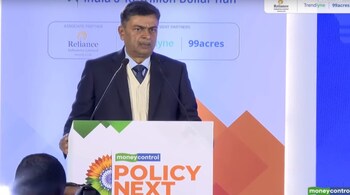
What is the one distinctive feature that separates a developing country from a developed country? I'll tell you that the one major distinguishing feature is this –- that in a developed country, you don't have load-shedding; the power does not go out. No country can develop, no country can industrialise if it does not have sufficient power, because it is electricity that powers the industry; it is electricity that powers everything. And no development is possible without electricity. Though infrastructure is necessary and important, I believe, and I do not think I am being biased, that electricity/power is the most important infrastructure, which is a sine qua non for development.
When our government came into office in 2014, you had a power shortage, which was around 4.5 percent. Prior to 2014, the shortage was 10-12 percent. Today, the shortage has been wiped out to about 0.1 to 0.2 percent. We have also emerged as a country that is at the forefront of energy transition. Simultaneously, we have done both.
We have emerged as a country that has ensured universal access. And ensuring universal access was a huge task. You have to connect 29 million homes. We connected 29 million homes and we connected 29 million homes in 19 months, in what the International Energy Agency (IEA) called the largest and fastest expansion of access ever in the history of the power sector. What happened was that we added about 194,000 megawatts (MW) of power generation capacity, out of which about 107,000 MW is in renewable. What happened was that we constructed 193,000 circuit kilometres of transmission lines, and all this was in the past seven to eight years. These were transmission lines that connected the whole country to one grid, running on one frequency, making this the largest single-integrated grid in the world. We increased the transfer capacity from 36,000 MW to 117,000 MW today. That, I think, is a jump of about four times or five times, that's what we did. What we did was that we added 3,000 substations, we upgraded 4,000 substations, we added almost about 5.5 lakh circuit kilometres of LT lines, 2.5 lakh circuit kilometers of HT lines, about 7.5 lakh transformers, and sundry other equipments. That's what we did.
So as a result of all this, because we added the generation capacity, because we increased the transmission capacity, and because we strengthened the distribution systems, we were able to bring up the availability of power in rural areas from over 12.5 hours in 2015 to about 21 hours to 22 hours today. Last year, it was for 22 hours. Now, it has dipped a bit, it has gone down to 21 hours. That's the average, national average in rural areas. In urban areas, it is 23.8 hours. The generator is fast disappearing; the days of generators are gone. We have made 24x7 into a right. We have promulgated rules that say that no distribution company can do gratuitous load shedding, and if you do that, you must compensate your consumers. And we have put in place mechanisms for oversight, and a couple of inquiries are going on. Any discom, which does gratuitous load shedding will be penalised, and the consumer will be compensated.
At the same time, we have also ensured we emerge as a leader in energy transition. Our rate of capacity addition to renewable energy capacity has been one of the fastest in the world in the past five, six years. Even, you know, I think, leave out China, I do not think any other country would match us in our rate of capacity addition. Today, I have 180,000 MW of renewable energy capacity. We had pledged that by 2030, we will have 40 percent of our capacity coming from non-fossils. Today, our non-fossil capacity is 44 percent. That means we are way beyond the target, and we still have seven years to go. Hence, we have upped our ambition. By 2030, we will have 50 percent of our capacity coming in from non-fossils. But actually, 65 percent of our capacity will come in from non-fossils.
Now because you are called Moneycontrol, I will tell you the monetary side of it. The total investments made is about Rs 70 lakh crores, and the capacities under construction are a further Rs 17.5 lakh crores. That is the investments that we have brought in and the investments that are going on. This is the capacity that has already been constructed. We are adding about 99,000 MW of renewable energy capacity; that's under construction.
We have under construction about 27,000 MW of thermal capacity. In addition, we have bid out 12,000 MW more of thermal capacity and have a further 21,000 MW of thermal capacity under survey and investigation, and about 22,000 MW more under initial stages. We have identified the land, so 80,000 MW, actually 87,000 MW of thermal capacity are being added, while 99,000 MW are under construction, which is non-fossil. And I have another about 32,000 MW under bid, that's renewable energy. We shall be bidding out almost 40-50,000 MW every year in renewable energy. That is the rate of growth which we plan, which we are doing.
When I joined, our hydro capacity was in doldrums. It was probably moribund as you'd call it. There was no growth. We restarted it. And now I have 47,000 MW installed hydro capacity. Another 18,000 MW of hydro is under construction and 13,000 MW is under various survey and investigation. I am going to double India’s hydropower capacity. I will make it about 90,000 to 100,000 MW of hydro capacity. Everything I'm going to double or triple.
Each of my companies is actually doubling or tripling in size. That's what we have done. We have transformed the power sector. And that was necessary because if we had not done that, we would have been like Sri Lanka. We have not only transformed India’s power sector, we have upgraded it. We have not only increased the size; we have made it viable. The AT&C losses have been brought down by nearly 12 percent, from 27 percent to 15.41 percent. Yet I'm not happy with it. I want to bring it down to 10-12 percent. We had a meeting of all the states today. And we'll continue the meeting tomorrow. And I've said that AT&C losses will have to come down further to about 12 percent. Nobody could have imagined that to be possible. Nobody thought that this could be done. Why? Because we are a democracy. Why? Because you know, we are a federal system. And because electricity is the concurrent list. Now, despite all that, we've done it.
Electricity falls under the concurrent list. Now, concurrent does not mean that the state and the Centre have equal powers. It means the state has the predominant power. If I make a law that prevails, if the state government wants to make a law, they can do so. But if at any point, the state law conflicts with the central government's law, then to an extent the state law is invalid. If we make a rule, that applies throughout the country. So we are making rules, and we are making sure that people follow them. I have made it very clear that anybody who violates the rules, whether it pertains to availability of power, or whether it pertains to fair tariffs, they will be prosecuted. And, everybody understands that I do not have any hesitation in taking action where action is warranted. So, things are happening.
Now, why was this timely? Just one figure will tell you this. In 2014, the peak demand was in the region of about 130-131,000 MW. Today, the peak demand is in the region of 243,000 MW. Demand has increased by 80 percent. Now imagine what would have happened if we had not added the capacity. In between, I also felt that probably I am adding too much. But you know, we had exports. We are exporting to Bangladesh, Nepal, among others. But I mean, whatever capacity I added has been lapped up and now I am having to add more capacity at a rapid pace.
Now, this is great news because it means that our economy is growing rapidly. One reason why, of course, the demand increased is because we connected 29 million homes. And you know, I go around in my constituency. I contest elections. I won twice. The second time with enhanced margin. Now the third time, I will win with a higher margin, I will tell you that. But I see that even in poor homes, now you see television sets, now you see refrigerators. When I first started going around in my constituency, I was offered tea. But now, I also am offered cold drinks. I also see air conditioners at homes in the villages, mind you, in the villages. In towns, one could see that. In the villages of Bihar, now you see air conditioners. That is one of the reasons why our power demand is galloping.
As I said, 80 percent increase in power demand from 130 GW to 243 GW. And by 2030, my officers tell me that the demand will be 366,000 MW. I believe that is an underestimation. I think the power demand is likely to go up to 400,000 MW. We are the fastest-growing large economy, and if any thermometer were to be an indicator of this, electricity is the thermometer. If the power demand is growing at that speed, that means your country is growing and our country is growing. And we will continue to grow at this rate for the next three decades. So imagine, you know, the huge burden, which is there on me to make sure that I add enough capacity to meet that demand. And that we shall. We shall add power generation capacity. As I said, adding about 193,000 circuit kilometres is huge. I am having to add transmission capacity, and every month I approve thousands of new circuits and kilometres of transmission capacity because I am running out of connectivity.
We had said that we will have 500,000 MW of renewables by 2030, I think we will cross that because, you know, for one million tonnes of hydrogen, you will need 25,000 MW of renewable energy. And I already have 7.8 million tonnes of green hydrogen manufacturing lined up. Incidentally, we are emerging as one of the biggest manufacturers of green hydrogen and green ammonia in the world. And we are the most competitive, because my cost of making renewable energy is the cheapest in the world. You know, 1 MW of solar energy is $600,000. That's cheaper than anywhere else. So nobody can compete with me, despite the fact that developed countries are adopting protectionist measures, I am still competitive. You know, one country is giving a subsidy of $3 per kilogram of green hydrogen. Now, that's the price of making a kilogram of green. They're giving a huge subsidy on their entire value chain of renewables, but still we shall be competitive. And not only that, we are adding capacity as well.
The quantum of storage, which we are adding, again, I think this is something, which is going to lead to wide eyes because now more and more bids are for round-the-clock renewable energy, more and more bids are for dispatchable renewable energy, which requires solar-wind hybrid with storage. I have about 35,000 MW of pump storage lined up under various clearances, etc. About 3,000 MW is already constructed; another 3,000-4,000 is under construction.
Battery storage is very expensive. Why? Because the West kept talking about how necessary it was to fight global warming and how everybody needs to take steps, but they actually took no steps, and therefore, did not construct energy storage capacity. Whatever storage capacity is there, about 90 percent or 95 percent is in China. The West has no storage capacity under construction. So we are also constructing battery storage capacity, which is very expensive.
Right now, it is Rs 10 per kilowatt hour. For making one unit of solar, I need Rs 2.5. For storing it for one hour, Rs 10 is the price. So unless and until you have volumes, the price won't come down. But I am bringing the volumes. We are leading the change. We are the lowest emitters in the world. Our per capita emissions are 1/3rd of the global average. We had pledged that we will reduce our emissions intensity by 33 percent by 2030, we achieved that in 2019. We have some programmes of energy efficiency, which are world leaders. The ‘Perform, Achieve and Trade’ programme is a world-leading programme, where we set targets for specific energy consumption and specific emissions for industries, and if any industry achieves that, they get Energy Savings Certificates. Now that will be translated into carbon credits.
And if they underachieve, they either buy Energy Savings Certificates or pay a penalty. That has resulted in a reduction of CO2 emissions, mind you, on a per annum basis of about 107 million tonnes per annum, just one programme. Our LED program has resulted in emissions reduction of 113 million tonnes of CO2 per annum. That's the quantum of CO2 emissions reduced by another program. We are also running a programme of star rating of appliances. Five-star ACs and so on have resulted in the reduction of CO2 emissions of 57 million tonnes per annum. We have a programme of energy efficiency for construction - the ECO Niwas Samhita for residential buildings and the ECBC for commercial buildings. So the entire gamut of emissions reduction we've carried out, achieved our target about 11 years in advance for emissions reduction, achieved our target of renewable capacity addition nine years in advance. We will achieve the next NDC target also well in advance.
We are growing rapidly. We are different. And, we have changed the rules and regulations and made it totally business-friendly, eco-friendly. For example, in transmission, I have introduced the General Network Access. Now, this is not even there in United States or anywhere else. Here, if a developer applies for connectivity, she/he will get it. The allotment will happen straight away and initially you would have gotten it within about 30 days. Now, because of so much of capacity coming, it will take you maybe three to four months, but you will get it. You are connected to the whole country and connected to the nearest ISTS load, maybe 20 kilometres away or something, and you get connected to the whole country. Today you sell to Guwahati, tomorrow you buy from Mumbai, day after tomorrow you sell to Baroda or whatever. You can generate power anywhere, sell anywhere. We have provided enough transmission capacity. I mean, buy power anywhere, sell anywhere, generate anywhere – it is one country. That is what we have done. No other country has this General Network Access. And the connectivity part has also been de-licensed. You do not need a transmission licence to get connected to the ISTS. If it is within 20-25 km. You just get connected!
We have promulgated rules for green open access that you can set up capacity anywhere in the country, and we will give you free transmission to wherever your factory is. Just set it up, and you will have open access. The rules guarantee that you will get open access within 15 days. That means it is not incumbent upon you to buy electricity only from your distribution company. No. You can buy it from anyone you want across the country.
We have also come out with bids for offshore wind and transformed the sector. We are different.
And for all this power generation capacity addition, I have not had to put in money, I get investments. For one bid, you have 7-10 companies competing. That's where we are. Every major fund is invested. And you know, we will continue to be one of the fastest-growing capacities in the world. Why? Because we are huge and we are growing, and no other country is growing as rapidly as us. That is the opportunity before us.
We will double, we will triple. As I said, I think my demand is going to double by about 2030 and we will triple, again, in seven years after that. No other big country is going to be able to double or triple. Other large economies are growing at 2 to 2.5 percent, I am growing at 7.5 percent, and I will continue growing at 7.5 percent. And in the case of power, I grew at 9 percent last year. This year, I am growing at 10 percent. In three months, I grew at 20 percent. On a daily basis, my demand is 8,000 to 10,000 MW more than the same day in the previous year. This is the rate at which I'll continue growing.
There's no other market as big as us, there's no other market growing as fast as us, and there's no other market which has so much ease of doing business as we've provided. We are different. Be with us, and you will grow. All my companies have grown three times, four times. One of my companies, NTPC has tripled in value. Its share prices have gone up three times. Share prices of PGCIL have gone up 2.5 times, REC has gone up about 3.5-4 times, and PFC’s share price is up four times or five times. So if you haven't invested, you've missed out.
Discover the latest Business News, Sensex, and Nifty updates. Obtain Personal Finance insights, tax queries, and expert opinions on Moneycontrol or download the Moneycontrol App to stay updated!





