

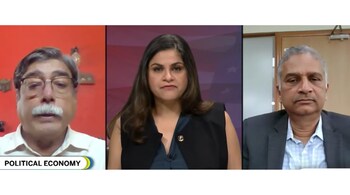
US President Donald Trump’s 50 per cent tariffs on India is a negotiating tactic. Even as India readies a negotiation strategy, two foremost economists, Madan Sabnavis of Bank of Baroda and Prof Biswajit Dhar, Distinguished Professor, Council for Social Development say that India should decouple from the US, China has done that successfully and extend support to the Indian SME sector. Having said that, India might find itself in a logjam on agriculture, US pushed China into opening its markets during US President Donald Trump’s first term. Moreover the American farm lobby is very strong and 77 per cent of the agricultural counties had voted for Mr Trump and they are actually demanding a payback. Edited excerpts from a conversation with Shweta Punj of Moneycontrol.
The 21 days that President Trump has given India before the additional penalty 25% tariffs kick in, what are our options?
Madan Sabnavis: The idea is to give us 21 days' time to negotiate. So it's a kind of an ultimatum being given that, look, we have been talking for the last three, four months, and now we better come and strike a deal. So to keep the sort of democracies hanging, he said that, look, there's going to be this 25% additional tariff on account of importing Russian oil—very, very illogical to my mind. But yes, that’s the way it’s been presented by Mr. Trump. And now it’s left for the Indian government to get back to the table and start discussing, trying to negotiate with the US what could be the best possibility.
So that’s why I look at 21 days. It’s not that he has said, "I’m going to do it immediately from tomorrow onwards." It’s more a case of saying that there is a window of opportunity, which is there—a window for negotiation. And now it depends upon what are the best possible terms on which we are able to negotiate. Because we should remember that there are two sets of tricky issues out here. One is purely economic, where America would like to have more of the agricultural and dairy products enter into India. We do have our reservations out there. We need to protect this particular segment.
And the second is slightly more political. When you’re talking of saying we should not be importing oil from Russia—this was something which was done earlier. A number of countries, including the European Union, have been importing gas from Russia. So it’s a slight shocker. But I would think that’s the way in which Mr. Trump would like India to work fast and come to an agreement with his set of provisions.
India is well within the WTO rules in the kind of tariffs that it imposes. So one, the "tariff king" argument does not really work for India. Our tariffs are fairly competitive and at par with the other countries. So I want to ask you: are you looking at this as a negotiation tactic? Or is he serious about the 50% tariffs he has levied on India?
Prof. Biswajit Dhar: No, I think it’s a negotiating tactic. And of course, he also wants what Mr. Sabnavis has said—that he wants India’s agriculture and dairy markets. Now, look at the way he has actually defined his "America First" trade policy. This, he says, is a mechanism to reduce trade deficits that the U.S. is running vis-à-vis major trade partners. Now, if that was to happen, then it’s only logical that the U.S. would be pushing agriculture and dairy products into its partner countries, like India, where there is a large deficit. And let me also remind you that when China did a deal with the Trump administration—the first Trump administration in 2020—agriculture and dairy products was an important part of that trade deal because it forced these products down the throat of the Chinese and got that deal done.
Now, of course, for India, it’s a no. And we have made it very clear that agriculture and dairy—are our red lines. We haven’t put these issues, these sectors on the negotiating table in any of our FTA negotiations. And even in the WTO, we’ve taken a very strong kind of a position there. So it was completely out, and everyone knows it, that this is India’s position. We have been battling in the WTO as well, where I’ve seen this play going on.
Let me also say a little thing about the WTO. When you talked about the WTO compliance, you know, it turns the whole WTO—you know, the structure—on its head, because the WTO provides special and differential treatment to developing countries. And there is a clause of non-reciprocity—that developing countries are not expected to make the same level of tariff cuts or same level of liberalization as compared to the developed countries. Now, what Trump has now done is that he is seeking special and differential treatment for himself now.
See, until yesterday, we wanted the GSP to be restored. Now, what Trump is doing is that he is seeking duty-free access to all countries, including the developing countries, while he has put tariffs—which are now 18.3%, the average tariffs after what he has done on 31st of July has gone up to 18.3%—which is among the highest in the world now. So he can’t complain that India has highest tariffs; he is the one who has actually put highest tariffs in the world.
That’s right. Even agriculture—US agriculture has been so protected. It’s been one of the most protected industries, and the kind of tariffs that the US imposes on agricultural imports range from anywhere from double digits to triple digits—the highest is about 200%.
Prof. Biswajit Dhar: The problem is agriculture—US agriculture subsidies. And this has been the battle that we have been fighting in the WTO, because the US has always been telling us to drop our tariffs. And our point has been: "You drop your tariffs; you drop your subsidies—we’ll drop our tariffs." And the subsidies that the US has given—you know, and this is officially recorded in the WTO—has gone from about $61 billion in 1995 to almost $230 billion now.
So it’s kept increasing. So how can you compete with a country which is giving so much of subsidies? And American agribusiness sells around the world their products below cost—in fact, dumping. And they have written about it that the cost of production in the US is much higher than the price they sell. So there can’t be a fair deal at all when it comes to agricultural trade.
So, Mr. Sabnavis, the 21 days that are there for us to negotiate—how hopeful are you? And what are the levers that India can really press on? The Prime Minister has categorically said that agri and dairy are the two red lines that India will not cross. The US President has called us out on the use of Russian oil. So where do you see the negotiations going? What are the levers that India can really press on as they go back to the United States, maybe with another offer?
Mr. Madan Sabnavis: So in fact, both the issues which you have stated are things on which I don’t see any reason why India needs to negotiate. So it will clearly have to be outside these two issues that there could be negotiation. And just like what we have seen countries like Japan have done—maybe there could be a promise to a pledge or a promise to invest more money in the US. That is something which we can do. And we’ve already seen that there are several Indian companies which are investing overseas. So that is something which we could do.
And if we’re talking of non-agricultural goods—just like what we have done with the FTA with Britain—we could probably be allowing more goods to come at favorable tariff rates or maybe zero tariff rates. I’m sure the ministry would be best equipped to choose those particular products. I think that would be a way in which you could probably placate the US and make sure that we don’t give up our sovereignty or in terms of any kind of a compromise on agriculture. Because oil is a very tricky issue—not just for India, but I think for the rest of the world too. But let’s assume that theoretically or hypothetically: Russia should not be supplying oil to anyone in the world. We can actually see that the overall price of oil is going to really increase for each and every country. Because Russia actually accounts for around 10 to 11% of overall oil supply. So if they’re not allowed to sell to the world, intuitively we can see that the entire world is going to suffer. It’s not just the case of India. We have other countries also which are importing from Russia. So overall supplies are going to get affected.
Professor Dhar, your thoughts in here on what are India’s options at this point? What can we go back to them with? Something that will pacify the US administration and India does not end up giving away too much.
Prof. Biswajit Dhar: No, that’s the problem now because I think all those—what we would call low-hanging fruits—those would have been plucked during the negotiation.
I think these options have been exhausted already because we’ve already been talking about the low-hanging fruits. For instance, there are a range of horticulture products, nuts and others. We’re already giving market access to American companies here, and those could be increased. And we could actually give lower tariffs on a range of manufacturing products, including automobiles, which the US has been talking about.
Now, all those options were already on the table before the 25% tariffs were imposed. So now we are in a situation that US just wants agriculture if it wants to balance its books. And that is the main objective—that I was saying—that it is very clear that he would like, President Trump would like the tariff, the trade deficit vis-à-vis India to come down. The only way that can happen is by increasing agricultural exports to India.
So in a way, I think that you’ve got into a kind of a logjam. And as I said, that there’s a tremendous lobby pressure—American, the farm lobby is really putting a whole lot of pressure because, you know, of the agricultural counties in the US—I was just looking at these numbers—77% of these counties had actually voted for President Trump. So you can understand the amount of support he has from the agribusiness, and they are actually demanding a payback. And that’s where we got stuck.
Mr. Sabnavis, the whole argument about Russian oil—is that something that India can scale back on? How should India be treading this?
Madan Sabnavis: See, I think sovereignty is a very important issue for any country, especially for us here in India. And therefore, there can be no compromise out here because, see, today you’re saying that we should not be importing oil from Russia. Maybe tomorrow they could say that you’re not supposed to have any defense relation with Russia. So therefore, this particular goalpost can keep getting shifted. So that’s one reason I think we should not negotiate on this particular issue.
But let’s again speak hypothetically: that suppose Russian oil was not available in 2022, we were managing our oil by importing from various sets of countries, primarily in the Middle East. So therefore, it was not really a major challenge to procure oil because only after the Ukraine war—when the price of crude oil went up to $120, $140 per barrel—that we were able to negotiate good deals with Russia and get it at a discounted price. So even today, for example, if you look at which country is actually providing oil at the lowest price to India—we’re not talking of the quantity—Russia still has the major chunk of around one-third of it. It’s actually Iraq. Iraq is actually providing at a marginally lower price than Russia. We also have Kuwaiti oil, which could be coming at comparable prices.
So therefore, it is possible for India to manage this thing. But it’s just a case of saying that: why should we give up our sovereignty just to make one person happy? I think that’s going to be the bone of contention. But as I told you, hypothetically, in case Russia goes out for some reason, we can still manage it. But the cost will definitely go up. Because as I mentioned earlier, if you’re talking of 10 million barrels per day being withdrawn from the overall global supply, I don’t think OPEC is in a position to supply that kind of quantity. Or they would also like to profit from it. There will definitely be a case of international price also going up. So to that extent, there will be more domestic problems for India. So there’s no reason why we should negotiate.
So that could be inflationary for India. But if India were to face the 50% tariffs, which would really make the United States completely closed for trade—at 50%, our businesses will not be able to compete at those tariff rates. Let me bring in Professor Dhar, what’s your assessment of this? We’ve really been pushed to a wall at the moment. So what, according to you, would be a more economically sound, you know, option for India right now to go back to the United States with?
Prof. Biswajit Dhar: As far as the tariffs are concerned—50% tariffs—there are two sectors which are exempt, which is mobile phones and pharmaceuticals; they’re exempt at the moment. Of course, there is this sort of Damocles sword hanging on pharma. President Trump is talking about increasing tariffs on pharma.
But at the moment, these are out, you know, they are not going to be hit. And these two sectors have almost 25% of our export business to the US. So 25% is just these two. And then there is, of course, clothing, which is again, 7–8%. And then the gems and jewelry, which is about 11%. Now, gems and jewelry , you know, there is—it has inelastic demand. And of course, the NRIs won’t care if the prices are going up; they will be buying—they don’t have any option; they would have to come to India.
So I think the only substantive sector which is going to be hit, you know, is clothing, garments—where of course, we have been having problems in the global market. We’ve been losing our share to Vietnam in any case. And so that’s the situation which faces us. And rest of the sectors have very little exposure to the US. And so I would, I would think that we should actually wait and watch what happens. And what we have seen in the past—and this is the Chinese that have done it—that once a country stands up to the pressures, Trump comes down and starts negotiating. So the only country which has been left out of this thing is China; they’ve been given a 90-day kind of a period to come and negotiate.
You know, we should also understand that he also has his own compulsions
But talking about MAGA and the way he’s going about it—"Making America Great Again," getting businesses back to the United States—I want to bring in Mr. Sabnavis here. Mr. Sabnavis, is Mr. Trump talking about a model, an economic model for America, which is maybe a decade too late?
Madan Sabnavis: In fact, what "Make America Great Again" stands for is quite antithetical to what economic theory says. So economic theory says that every country produces goods in which it has a comparative advantage. So this is how it has been over the last few decades, where countries have actually outsourced it, or they have been importing goods. They have not been unnecessarily putting in resources to produce things where they’re not able to do it in an economical manner.
Now today, when you’re saying that "I’m imposing tariffs," the basic idea is that they would like all these goods to be produced in America so that more jobs are created. And therefore, America becomes great again. But let’s look at it this way: if it was possible for them to produce ready-made garments in the past, why didn’t they do it? They didn’t do it because it was not economical.
Why is it that most of their activities have been outsourced? They’ve been producing in China because it did not make economic sense. So therefore, I think it’s just a matter of time when Mr. Trump will realize that you’re actually pushing up your own cost of production. And that’s what Professor Dhar mentioned earlier.
But also talking in terms of possible recession, which you could get into—because when your prices go up, your demand is going to fall, and everything is going to work against them. It’s one thing to say that you can sack the person in charge of your data to say that the data is all wrong. But you cannot do it forever.
I think when people are unemployed, people not buying goods—I think that’s when it’s really going to hurt. So even at 10 or 15%, to my mind—forget about the 25, 50% which we are facing—this thing will not really work in America’s favor. And it’s just a matter of time—once everything is in place, the 10–15% duties—that US will feel the heat, and you will see demand coming down on account of high inflation.
What is the economic cost of this uncertainty that India is paying right now, and that the world will also eventually end up paying—because if US economy slows down, it will have a ripple effect across the world, whether we like it or not.
Prof. Biswajit Dhar: No, absolutely. I think the US has already started paying the price. And the unemployment number that Mr. Sabnavis just mentioned—the unemployment numbers were the first signs that the American businesses are feeling shaky. So they’re not actually providing more jobs. They don’t know what’s going to happen tomorrow.
So the first country that is being hit by Trump’s, you know, these kinds of policies—and rightly mentioned that his right hand doesn’t know what the left is doing—is putting his own business into a tailspin. And therefore, like you said, that if the largest economy gets into this problem, then of course the rest of the world also suffers. Now, let me also mention here that the Trump tariffs haven’t actually kicked in. They will now kick in. They’re going to be kicking in from tomorrow. So if one has to, you know, we have to start seeing from the day after tomorrow what kind of a thing happens. And within a month, one can see what will happen. And I’m sure many countries will decrease their exposure to the US—and China has already done it.
And as you know, that prior to being attacked in the first term, China used to export almost 19% or more than 19% of its total exports to the US. This year in the first six months is down to below 12%—it’s 11.8% or something. So China has moved away from the US. And this is really bad news for the US. And I would say that many countries, including India, should be looking at this strategy. Because in any case, this kind of exposure to a single country is not good. And especially when the country is the US being, you know, led by Donald Trump. So I think it would be better for India and many other countries to play the same bet.
There are many markets in Africa and other places which are waiting to be exploited. That’s the way to go—and reduce your exposure. Like we used to say earlier that they should be decoupling from China earlier. I think now is the time to decouple from the US, you know? And that’s the way forward in my view.
Mr. Sabnavis—are you factoring in the tariff uncertainty in your projections for the year? Whether it’s inflation, whether it’s growth rate? Because the RBI policy has not really factored in the Trump uncertainty in their projections for growth. But what’s the view that you are taking?
Madan Sabnavis: So in fact, until yesterday evening, we had factored in a possible drop of 0.2% in our GDP growth estimate. So we had a range of 6.4–6.6%. So it would be 6.4% prior to yesterday 8 p.m. And I got to know of this particular news. We haven’t really worked out the fresh number, but it would probably be a certain kind of a downside depending upon what exactly we do negotiate.
I would just like to second what Professor Dhar was talking about in terms of the global dependence on America. See, America is the largest importer of goods. So that’s a major advantage or a disadvantage for the world economy today. And as we in the banking parlance normally talk of concentration risk—I think lots of these large economies, if you talk of even looking at India, China, and then we’re talking Mexico, Canada, European Union—I think there’s a lot of this concentration risk on account of being too dependent on exports, because that was a large market and a sure market. And one always felt that this is something which will only grow because the American economy is the biggest economy which will grow.
Now, I’m quite sure that all countries will start looking at alternative markets. This kind of search has already been on. And to my mind, the larger companies will find it easier. But I think where I’m really concerned is about the SMEs. Because when you’re talking of things like ready-made garments, you’re talking of precious stones—they’re largely coming from the SME sector. So this is where I think the government—I’m quite sure—is working on some kind of a package: monetary, tax—to ensure that they’re able to tide through this rough weather, assuming that even if it’s not 50%, it may be above 25%—even 25% itself is going to harm them more than probably the larger companies.
Professor Dhar, in terms of what can the Indian government do to support the MSMEs at this point
Prof. Biswajit Dhar: You know, this thing—support for the MSMEs in a big way, in a structured manner—was needed whether this happened or not. And we all know that this is a sector which is contributing considerably to our exports. But when it comes to facing problems, MSME sector faces the most. So I think there are a lot of handholding has to be done by the government. And in consultation with the MSMEs, where the shoe is pinching for them has to be identified.
And in a very concrete manner, support has to be provided. Now, this happened in other Southeast Asian countries, the Asian countries as well, where the government and the business work in sync. And many of those countries in Southeast Asia, East Asia—they’re actually dependent on the SME. I wouldn’t say M—M is really out of the game—the small enterprises. And I think we should take a cue from what they had done in the past. And we should go in a very systematic manner to ensure that these sectors are—they don’t face the kind of a problem that we are anticipating. This is a high time the government did it.
Madan Sabnavis: In fact, I have a couple of points out here. And this is actually not anything new. These are programs which are already running—or are being run by the government—or they have been used in the past in certain specific time periods. For example, we have the PLI scheme, which is running for around 14 to 15 sectors. It can be extended to the exporting companies.
So it can be specifically targeting the export-oriented units, where you’re giving a kind of a subsidy in the form of 4 to 6%—which was the average in case of the PLI scheme. That’s number one.
Two: there could also be certain tax breaks which should be provided. It could be based on your past performance; you get to know which are the units who have been exporting to America. Again, the government will have to take a call—but it has to be only for units affected to US exports? Or exports in general? It has to be generalized, I think—but that’s a call which the government can take. But this can be for a kind of stopgap measures.
Third: we could also be seeing some kind of interest rate subventions which could be brought about—where maybe 1% to 2% subvention where the government actually pays from the budget.
You could also have a credit guarantee scheme for the SMEs. This has been done in the past; we had the ECLGS during COVID. And I think the situation today is no different from COVID. Last time, it was a health issue; here it’s a political issue which has come through.
So we can have a TLTRO, where we are talking of certain funds being given to banks at a discounted rate—maybe at a repo rate, less than the repo rate—which could be used for the export-oriented units. So I think there are these schemes which could be run the moment the government thinks that, "Look, we are not able to move too much ahead with this 50%—it’s remaining at 50 or somewhere between 25 to 50%." I think the MSMEs do require this—or export-oriented units do require this. And this is support which could be provided by the government; it has been done in the past in different circumstances. But I think this is as critical as the earlier circumstances were. So I think this could help a lot.
Watch full video: Trump’s 50% tariffs will close United States as a market for India
So is this a , "moment of reckoning," and second, is it valid for us to be getting sleepless nights over the 50% tariffs that have been slapped on India?
Mr. Madan Sabnavis: I think it is a worrisome situation, given the fact that it is affecting several units at a micro level—which also has employment consequences. Now, is it a moment of reckoning? No, I think there have been a plethora of reforms which the government has been bringing in, and they have done it in the best possible way because you do not bring reforms all at one particular point of time—which we did in 1991. We are definitely not in that kind of crisis-like situation. And we should remember that all this is all because of one particular man in the United States of America—probably the most powerful man today in the world—who has managed to create this kind of disruption across the world.
So I do not think it is a kind of a moment for reckoning. But definitely, it is a time when we could at least reorient our entire export strategy by removing the concentration risk. I think that is what Professor Dhar had said—which I feel is very pertinent—and that is the way to actually go about it. Provide all the support—because I think in the next three years, whatever support you provide to exporters will be—I do not think WTO or anything is going to come in the way; we will be justified in doing whatever we do because at the end of it, we need to protect our own turf and our own agriculture—which I am sure the government is going to do.
Prof. Biswajit Dhar: As the cliché goes, every challenge has its opportunities—and I think that is where we are today. And many of the things that Mr. Sabnavis said, I completely agree with him. Now, the thing is—he was mentioning about the PLI scheme—now we know the PLI scheme was not going anywhere, and I think—and we will be hearing about review of the PLI scheme every now and then—but it has not actually happened. So I think all these things that the government has been talking about—and we have been pointing out where the problems are—I think we have to take these problems by the scruff of their neck, and then they have to be resolved as soon as possible.
Now, you cannot be—even otherwise, the Trump threat notwithstanding—you could not be in a position where you remain a laggard. You know, 20 years back, I remember we used to do papers after papers comparing India and China, and we used to say that it is a kind of a sibling rivalry and this and that. Today, we have stopped doing that because we know that we have missed the bus.
We should tighten our belts; do what is required to invest in competitiveness—just not in manufacturing. Agriculture is a failing sector; it is a sector in crisis with no investments whatsoever—and we do need to get the agriculture sector up and running. I think there are a lot of tasks before the government. And the government really has to now take center stage and then—in consultation with the industry—I keep mentioning this: that decisions cannot come from the top. You cannot be sort of para-dropping all these policies on to people. You know, policies have to be bottom-up. And that is where the government needs to do: engage more with the business, engage more with people who matter, and then tailor-make programs which suit them. That is what they need, and that is what is the way forward, you know, for me.
My last question is: where is WTO in all of this? How is President Trump being able to get away by doing this? Where is the World Trade Organization?
Madan Sabnavis: I think the WTO is virtually non-existent. When we keep saying that "it will be WTO compliant," it is basically the best practices which have been advocated by WTO is something which we will be following. Otherwise, for all practical purposes, I think the WTO became defunct quite some time back. The moment we had more bilateral, multilateral trade agreements being forged by different countries—that itself was indicative of the view that the WTO has failed to do what it was supposed to do, and countries were going to work on their own in terms of drawing mutual benefit from other countries.
Prof. Biswajit Dhar: Yeah, I think in a way—with WTO becoming more and more irrelevant today—the danger is that people like Donald Trump have got opportunities to pick and choose. That is the danger. Because we always pointed out that multilateralism makes good economic sense in more ways than one. The moment we abandon multilateralism and come to bilateralism, then you are in the hands of these big guys who can then manipulate in whatever way they like. So my view is that, you know, see—the countries like Brazil, India, South Africa—the emerging economies—were actually shaping up the narrative in the WTO at the turn of the millennium. Now, it went on until the Great Recession hit us in 2007–8. And after that, everything fell away.
I think it is—again, I think this is the time of reckoning for these countries to get their acts together. Maybe we should start from the BRICS—start coordinating a position from the BRICS—and then take it to the WTO. And there is a need—serious need—to revive multilateralism, because the demise of multilateralism has been extremely expensive for the global economy—not just economically, but also politically. And I think this is the time for influential countries and their leaders in the emerging economies to take stock of where they are and to really make a serious change in the narrative and the dynamics of the global economy and policy.
On Prime Minister’s visit to China?
Madan Sabnavis: Against the background of BRICS, which China is already a part, and India is a part of that particular group—I think this is a good way to forge more economic relations with China. And I’m quite sure the PM will be talking on economic issues as well, besides political part. And this is something which can actually be good. Because today, I think there is a case of saying that: how do we actually counter USA? We obviously need to have better economic relations with other countries—and it needs to be larger countries. So therefore, I think China actually fits the bill out here.
Prof. Biswajit Dhar: Yeah, I think it makes good sense. And it’s actually a good thing happening now. Because the timing of India-China relations improving couldn’t have been better. Because it comes at an opportune moment for us to show some kind of solidarity. Because both these countries have been bracketed. And we have been targeted by Trump. And if China and India could draw common or joint strategies—like I mentioned, the WTO and elsewhere—that really could give a lot of hope to many of the developing countries who have been slapped huge tariffs. And they don’t deserve being hit in this manner. They can’t fight the US.
And just because they’re running these trade deficits, they’re being hit by the Trump administration. So I think India-China working together, along with Brazil, South Africa that I mentioned, and other countries—the newer countries, like Indonesia—we are coming to the BRICS. I think that they should make a real good beginning from now on and really provide the basis for, like I said a new beginning to take place.
Discover the latest Business News, Sensex, and Nifty updates. Obtain Personal Finance insights, tax queries, and expert opinions on Moneycontrol or download the Moneycontrol App to stay updated!





