

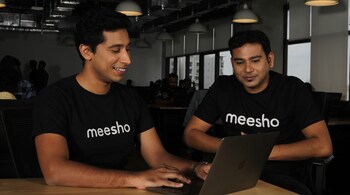
Barely a decade after struggling to convince investors of a WhatsApp-led reseller model, Vidit Aatrey and Sanjeev Barnwal now find themselves steering one of India’s fastest-growing internet companies into the public markets. Meesho — once dismissed as a small-town experiment — is today processing more daily orders than Flipkart or Amazon India, and is set to list on December 3 with a price band of Rs 105-111 per share, valuing the company at around Rs 50,000 crore (around $5.8 billion).
It marks the culmination of years of rapid pivots, cost discipline, and a relentless focus on affordability that helped Meesho carve out a mass-market consumer base largely overlooked by incumbents.
In an interview with Moneycontrol, Meesho’s founders — CEO Vidit Aatrey and CTO Sanjeev Barnwal — along with CFO Dhiresh Bansal, spoke about the significance of the IPO milestone, the thinking behind the valuation, their long-term strategy, and what changes (and doesn’t) now that Meesho is preparing to go public.
Edited excerpts:
The IPO is happening after a decade of pivots, near-misses and moments when your model was questioned. You’ve gone from Fashnear to resellers to a consumer marketplace, and are now processing more orders than Amazon and Flipkart. What does crossing the IPO threshold mean for you personally?
Vidit: For the last 10 years we've been very consistent with our mission: how do we really democratize e-commerce in India for everyone? “Everyone” includes consumers, businesses, and people in the logistics ecosystem. Everything we've done — from building for WhatsApp users when everyone else forced app downloads, to zero-commission onboarding, to Valmo bringing new people into logistics — has been aligned to our mission. Nothing changes after going public. We will continue to make progress because there’s still a large number of people who are not served very well.
Meesho will be India’s first horizontal e-commerce platform to go public — ahead of players like Amazon and Flipkart that entered much earlier. What does that milestone signify for you?
Vidit: It's hard for me to kind of comment on any other company. Different companies have different contexts. In our case, we’ve spent 10 years laying the foundation. Over the last few years, we’ve improved cash flows and continue to grow at a very good pace — our H1FY26 NMV grew 44 percent, orders grew over 50 percent. We’ve been cash-flow positive for two years. Because we built Meesho as a pure marketplace, asset-light model, we believe we are ready. This is the right time to go public.
Was there a moment when you felt Meesho had stopped being the underdog and broken into mainstream e-commerce?
Vidit: We don’t think like that. We believe there's so much to do. The day-one attitude — that we’re just getting started — continues. Feeling that you’ve arrived makes you think you’ve reached your peak. Our numbers reflect this: we’re still growing very strong with maybe the highest cash flow among listed e-commerce companies. So no, we never feel we’ve arrived. That startup attitude, or feeling that we should continue to move fast and take big bets, continues to be there.
ALSO READ: How Vidit Aatrey, Meesho’s marathon man, turned pivots and discipline into an IPO-ready company
Your IPO valuation of ~Rs 50,000 crore (around $5.8 billion) is lower than earlier targets of $10–11 billion. Did you recalibrate based on investor feedback? Are you confident in the price band?
Vidit: Our principle is simple: take a valuation attractive enough that long-term shareholders come on board and feel confident they’ll make money over time. People are optimistic about our future; we’re growing very strong with a lot yet to be solved. So the goal was: get the right kind of shareholders on board.
The IPO fundraise stays the same but the OFS size has been reduced. Why?
Dhiresh: The plan was always a 10 percent float — the minimum regulatory requirement. Shareholders only wanted to sell enough to reach that mark. Many believe long-term value will accrue, so they preferred to continue holding.
Was reduction in OFS influenced by criticism that new-age IPOs are used as exit events?
Dhiresh: Even earlier, the selling portion was a very small part of their holding — 3 to 7 percent. The idea was always to sell only what was required for the float.
Did the recent performance of new-age listings affect your timing?
Vidit: We never tried to time the market. It’s about doing the right thing for the long term. The business is predictable, with enough data for people to trust it. That’s how we decided the time was right — not based on market timing.
Dhiresh: Yes. We definitely didn’t know markets would hit an all-time high yesterday. We were just lucky with that.
Your IPO valuation is close to your last private valuation. Was there concern about leaving money on the table? What was the banker feedback?
Dhiresh: A large part of the IPO is primary, not OFS. Investors and we as a company want a high-quality long-term shareholding base, and a valuation comfortable for domestic, foreign and sovereign investors. Based on that feedback, bankers presented a range to the board. That’s how we arrived at the valuation.
How much did the Flipkart comparison come up in conversations with bankers, considering you’re listing much earlier than them?
Vidit: Benchmarking against others was never the focus. We’re very differentiated — in mission and in who we’re building for. People evaluated us based on our performance and vision, not in comparison to someone else.
Quick commerce is growing fast and eating into horizontal e-commerce. Will the dominance of value-commerce continue?
Vidit: In all large emerging markets, value commerce captures most of the market because affordability matters more than convenience. India won’t be different. Even as quick commerce scaled, we continued to grow faster — which shows our value proposition is strong. We’ll stay focused on affordability. We believe majority of India's population cares about that a lot more than anything else.
What is the timeline you are working with in terms of turning profitable at a PAT level?
Vidit: I don't think we comment on timelines. The metric we optimise most is free cash flow, and that’s been our focus for the last two years. Any company is valued on the free cash flow it will generate over its lifetime, which is why we prioritise it. We've been in positive territory for two years and will continue optimising for that — all great businesses eventually care most about free cash flow.
Your ad business is roughly $250 million and feeds directly into the bottom line. Will this help cushion your growth ambitions?
Vidit: In large emerging markets — China, Southeast Asia, Latin America — most profit pools are in logistics and advertising. Those opportunities are strong with us. We believe we can create substantial long-run profits from both. There’s a lot of juice in these profit pools.
Will Meesho explore M&A to enter new segments?
Dhiresh: We’ve said in the RHP that we’ll look at inorganic opportunities. Historically growth has been organic, but we’ll explore anything aligned to our mission. Nothing imminent, but we’re open.
Will AI be a major margin lever going forward?
Vidit: Yes. Automating support operations has already saved costs — most chat and much of voice support is now AI. We’re also using AI in recommendations and ad products with good results. We’re building chat and voice AI agents for less tech-savvy users, and improving local-language translation. There are many opportunities ahead in both margin and growth.
Discover the latest Business News, Sensex, and Nifty updates. Obtain Personal Finance insights, tax queries, and expert opinions on Moneycontrol or download the Moneycontrol App to stay updated!





