

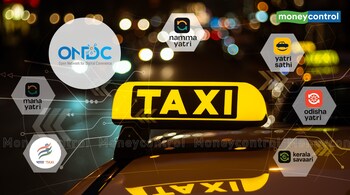
When Namma Yatri launched in Bengaluru in November 2022, it capitalised on drivers’ resentment against Ola-Uber duopoly, shrinking incentives, and the Karnataka transport department’s temporary ban on auto services offered by Ola, Uber and Rapido due to high fares.
The combination pushed both drivers and passengers toward Namma Yatri, built on the Open Network for Digital Commerce (ONDC) protocol.
But Bengaluru's success could not be replicated elsewhere.
With competitors like Rapido and even Uber rolling out zero-commission models in several categories, Namma Yatri’s early edge has eroded. To stay competitive, Moving Tech Innovations - the parent company - has increasingly started leveraging government-backed mobility platforms to enter new markets.
Also read: Auto Rickshaw Drivers Union in Bengaluru breaks up with Namma Yatri
Central push: Bharat Taxi built on Namma Yatri tech
The latest example is Bharat Taxi, a cooperative ride-hailing platform launched by the Union Ministry of Cooperation and National e-Governance Division (NeGD) in December. Pilot runs are underway in Delhi and Gujarat.
According to sources, Moving Tech Innovations is the backend technology partner for Bharat Taxi. “Moving Tech is behind this initiative and plans to expand it nationwide through this government-led model,” a senior official told Moneycontrol.
Also Read: Government set to launch Bharat Taxi, a new ride-hailing mobility app
"We are proud to be the Technology Service Provider (TSP) for Bharat Taxi, which is currently under trial in two states. We are building and maintaining a cost-efficient, high-quality infrastructure for the driver cooperative. To achieve scale cost-effectively without compromising quality, we use a multi-tenant server architecture, similar to leading technology infrastructure providers across the globe," Shan MS, co-founder and COO of Namma Yatri told Moneycontrol.
Unfair practice, says mobility startup founder
Anmol Sharma, founder of Naviget (formerly Oji), a platform that compares fares across multiple aggregators, said: “In our dynamic analysis, we found that Bharat Taxi is not using a dedicated server. The app’s server address points to api.moving.tech.”
“This raises broader concerns. User data and ride requests are routed through Namma Yatri’s servers, which means there is no data isolation and the team may have access to it," Sharma said.
According to the founder, there is also no 'kill switch' for third-party access, which means even if Bharat Taxi partnered with Namma Yatri’s parent company to build its systems, the app does not run on dedicated servers.
"In the future, Bharat Taxi cannot stop Namma Yatri from accessing this data, which could become an unfair advantage," he added.
Also read: Now, oJi app helps commuters compare fares across multiple ride-hailing firms
However, Shan of Namma Yatri said that data isolation and privacy are fully ensured in this partnership.
"While the system is built for scale, speed and efficiency, data isolation and privacy are fully ensured. All Personally Identifiable Information (PII) is fully encrypted, and each partner’s data is well-protected. We follow industry-standard best practices for access control and audits," he added.
Shan also said that the information security practices are independently audited and certified under ISO/IEC 27001:2022, and our systems undergo regular audits by CERT-In (Computer Emergency Response Team) empanelled cybersecurity firms.
"Our focus is to provide software, infrastructure and services, not to own data or the brand. Our objective is to enable community-led, government-backed mobility platforms to succeed," he added.
State-level partnerships: Bengal, Odisha, Kerala
Moving Tech Innovations began experimenting with government-led rollouts in 2023, starting with a tie-up with West Bengal government for the launch of Yatri Sathi under Department of Information Technology & Electronics. According to the platform’s website, “West Bengal government manages our app, which assures a secure ecosystem for drivers and improved consumer experiences.”
In Odisha, the company partnered with state’s Capital Region Urban Transport (CRUT) to launch Odisha Yatri in January 2025. This was followed by the rollout of Kerala Savaari in November 2025 in collaboration with Kerala labour department.
Also read: Spotlight on zero-commission models after Namma Yatri, auto union break tie-up
In all three states, Moving Tech Innovations was brought in through short-term tenders or proof-of-concept arrangements.
A mobility industry insider said governments prefer this model as it allows them to test the concept before awarding long-term contracts. “If drivers and citizens respond well - as has been the case - they extend the service,” the person said.
Shan added that Moving Tech’s role is to build and power mobility platforms while states retain ownership and control.
“In Kerala, we are the technology partner for Kerala Savaari 2.0, relaunched as a zero-commission, multimodal ‘super app’ for autos, cabs, metro, water metro, and buses. In all these states, the government owns the app, brand, data and policy, while Moving Tech provides the open-source, ONDC-compliant multimodal mobility platform and builds and improves product features.”
Wound up operations in Delhi
In Delhi, Namma Yatri launched in August 2024 but quietly withdrew as it lacked government or union support. In Telangana, it launched Mana Yatri, but with no state partnership, ride numbers remain minimal.
In Tamil Nadu, however, Namma Yatri gained traction without government support by partnering with several auto unions frustrated with Ola-Uber commissions. The company has also stopped releasing state-wise ride numbers on its website, despite earlier promises of an open data policy. It now only provides combined data for all cities in one category while Bengaluru (Namma Yatri) and rest of Karnataka (Namma Yatri) in two separate categories.
Why government partnerships matter
Industry officials say policy winds are shifting. “A lot of states want their own ride-hailing service because they’re unhappy with existing Uber-Ola aggregator model,” one source said. “ONDC is gaining prominence. Moving Tech already proved itself in Bengaluru and Kochi, so governments see them as a safe bet.”
Another source said that switching vendors is costly for governments: “If a successful service is shut down, the public backlash is huge. So, once a state launches a service, it always prefer continuity. Moving Tech becomes the natural choice during subsequent tenders.”
Also, read: Bengaluru: Ola Uber challenger Namma Yatri app to charge subscription fee from drivers
A third industry executive highlighted technology maturity: “Most government-run tech platforms are clunky. Moving Tech has a strong tech team. They deliver reliable apps - which governments cannot build internally.”
“Our aim is to be the digital public infrastructure layer for states and communities. We help them build superior open-source alternatives on ONDC, instead of relying on private closed platforms. Our platform already powers multiple mobility apps, Namma Yatri in Karnataka, Yatri Sathi in West Bengal, Odisha Yatri in Odisha, Kerala Savaari in Kerala, and Chennai One in Tamil Nadu, which brings metro, buses, trains, and ONDC autos and cabs together," Namma Yatri's Shan said,
He said more states are showing interest, but prefers they make their own announcements.
"The response has been very encouraging. These are designed as long-term, multi-year partnerships. Our pricing is very affordable, fully variable and can be sustained through driver subscriptions. It is similar to a pay-as-you-go model used by cloud and technology providers. This makes it a big win for governments and communities, because they get a proven platform without any large upfront investment" according to Namma Yatri.
Changing market: Zero-commission spreads beyond Namma Yatri
The ride-hailing market has also shifted significantly. “Ola is no longer aggressive in mobility; their focus is EVs (electric vehicles) now,” an industry official said. Uber and Rapido have emerged as the primary competitors. Rapido, in particular, has surged: “Rapido has become very strong. They began with bikes, expanded into autos and now four-wheelers. And they’ve already launched zero-commission services across India.”
Also Read: Spotlight on zero-commission models after Namma Yatri, auto union break tie-up
This has blunted Namma Yatri’s ability to win drivers in new markets. “Earlier, zero commission was unique to Namma Yatri. Today, drivers say: ‘Rapido already gives me zero commission. What else are you offering?’”
“We pioneered the zero-commission model: drivers keep the full fare, and we charge a small subscription for tech and services. Government or cooperative brands like Yatri Sathi, Odisha Yatri, Kerala Savaari and Bharat Taxi follow the same idea. The projects are sustained through driver subscriptions, while brand owners choose how much to invest in marketing and community development," told Shan.
Also read: Uber CEO says Rapido, not Ola, is its top rival in India
Why government channels help expansion
Another mobility startup founder explained: “Entering a new city as a private player makes you just another competitor. But if you enter as a government-backed platform, thousands of drivers come to you instead of you chasing them.”
Read more: How Namma Yatri works: Can it break Ola and Uber's duopoly?
Driver onboarding cost is a major factor: “While private players spend Rs 200-400 per driver (staff cost), government-backed apps reduce this drastically as drivers voluntarily enrol through one kiosk at a bus stand or airport, and it brings in hundreds of drivers at a much lesser cost. The onboarding becomes frictionless.”
The insider added: “Moving Tech is using the government route because it gives legitimacy and solves acquisition. In cities like Hyderabad or Delhi, where they entered alone, they couldn’t replicate Bengaluru’s success story.”
Namma Yatri's Shan added that community-led mobility apps collaborate on ONDC to empower drivers, and the real competition, however, is with closed, high-commission private platforms.
“Across states, these community-first mobility apps, Bharat Taxi, Kerala Savaari, Yatri Sathi, Odisha Yatri, Namma Yatri and others, are on the same side. They empower drivers by democratising ownership and improving service quality. All of them work together on the open ONDC network to solve problems for drivers and customers. The real competition is with closed, high-commission private platforms, not between open, community-led apps".
Also read: Namma Yatri mends partnership with Bengaluru autorickshaw drivers union
Discover the latest Business News, Sensex, and Nifty updates. Obtain Personal Finance insights, tax queries, and expert opinions on Moneycontrol or download the Moneycontrol App to stay updated!





