

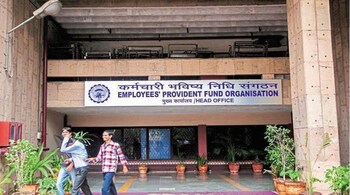
Retirement fund body EPFO has allowed its over five crore subscribers to avail the second COVID-19 advance in view of the second wave of the coronavirus infections in the country.
Earlier last year, the Employees' Provident Fund Organisation (EPFO) had allowed its members to withdraw COVID-19 advance to meet exigencies due to the pandemic.
The members were allowed to withdraw three months basic wages (basic pay + dearness allowance) or up to 75 percent of amount standing to their credit in their provident fund account, whichever is less.
"To support its subscribers during the second wave of COVID-19 pandemic, the EPFO has now allowed its members to avail second non-refundable COVID-19 advance," a labour ministry statement said.
Here's all you need to know
-The provision for special withdrawal to meet the financial need of members during the pandemic was introduced in March 2020, under Pradhan Mantri Garib Kalyan Yojana (PMGKY).
-An amendment to this effect was made by the Ministry of Labour & Employment in Employees' Provident Funds Scheme, 1952 by inserting therein sub-para (3) under paragraph 68L, through notification in the Official Gazette.
-Under this provision, non-refundable withdrawal to the extent of the basic pay and dearness allowances (which forms basic wages) for three months or up to 75 percent of the amount standing to member's credit in the EPF account, whichever is less, is provided.
-Members can apply for lesser amount also.
-The COVID-19 advance has been a great help to the EPF members during the pandemic, especially for those having monthly wages of less than Rs 15,000.
-The EPFO has settled more than 76.31 lakh COVID-19 advance claims thereby disbursing a total of Rs 18,698.15 crore as on date.
-Members who have already availed the first COVID-19 advance can now opt for a second advance also.
-The provision and process for withdrawal of second COVID-19 advance is same as in the case of first advance.
-It has been decided to accord top priority to COVID-19 claims
-The EPFO is committed to settle these claims within three days of their receipt. For this, the EPFO has deployed a system driven auto-claim settlement process in respect of all such members whose KYC requirements is complete in all respects.
-Auto-mode of settlement enables EPFO to reduce the claim settlement cycle to just 3 days as against the statutory requirement to settle the claims within 20 days.
Discover the latest Business News, Sensex, and Nifty updates. Obtain Personal Finance insights, tax queries, and expert opinions on Moneycontrol or download the Moneycontrol App to stay updated!





