

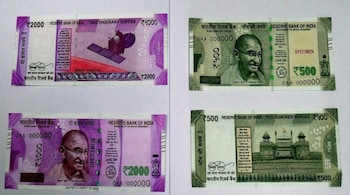
Six years since demonetisation, a lot has changed, with digital payments now increasingly a way of life across different sections of society. Another interesting trend is that the Rs 2,000 currency notes, introduced for remonetisation, in late 2016, are seen less and less frequently. So what has happened to those pink notes? Here’s an explainer.
To begin with, when were the Rs 2,000 notes introduced by the RBI?
On November 8, 2016, Prime Minister Narendra Modi said that all Rs 500 and Rs 1,000 notes would become invalid. The aim of the exercise was to curtail black money, eradicate fake currency notes, and create a cashless economy by pushing digital transactions. To replace these notes, the RBI introduced a new Rs 500 note and the mega Rs 2,000 note.
At present, the RBI issues banknotes in the denominations of Rs 2, Rs 5, Rs 10, Rs 20, Rs 50, Rs 100, Rs 200, Rs 500, and Rs 2,000.
What purpose did the Rs 2,000 notes serve?
It was meant to help the RBI replace the value of the demonetised notes at a faster pace because of the higher value of the Rs 2,000 notes.
Simply put, the RBI wanted to remonetise the economy quickly. At the time demonetistion was announced, the banned Rs 500 and Rs 1,000 currency notes accounted for more than 80 percent of the value of notes in circulation. To replace such a large number almost overnight was not possible, even with the RBI’s currency presses working non-stop.
As such, not only were limits initially placed on how much cash a person could withdraw from his account, but the higher denomination of the Rs 2,000 note helped make up the numbers with fewer notes. In fact, the Rs 2,000 notes made up 50.2 percent of the value of currency in circulation, as on March 31, 2017.
Have Rs 2,000 notes disappeared from circulation?
No, but their circulation has reduced significantly, primarily because the RBI did not print a single one of these notes in FY20, FY21 and FY22, according to the central bank’s latest annual report.
As a result, these notes made up only 13.8 percent of all currency notes in circulation, in value terms, as on March 31, 2022.
The RBI has also started to withdraw these notes, with the number of these notes steadily declining over the years. From 274 crores as at the end of FY20, the number of Rs 2,000 currency notes had fallen to 214 crores at the end of FY22.
Why has the RBI stopped printing Rs 2,000 notes?
The introduction of the Rs 2,000 notes had left people puzzled as it seemed counter-intuitive, given the government’s reasons for demonetisation. Since high-value notes are more of a store value, they can be hoarded more easily.
However, the fall in the number of these notes shows the central bank does not view them as a long-term option.
“There has been a conscious effort to reduce the share of Rs 2,000 notes, which is reflected in the steady decline since FY19 in absolute terms,” said Gaura Sen Gupta, India economist at IDFC FIRST Bank. “This could be a reflection of difficulty in using the notes to make small denomination payments and also to discourage the creation of black money.”
An official at a cash management firm said on condition of anonymity that banks have also realised that the demand for Rs 2,000 notes is very low.
“The public prefer to withdraw lower denomination currency notes over Rs 2,000 notes, and hence, some banks are recalibrating their ATMs.”
Sonal Badhan, an economist at Bank of Baroda, had a similar view.
“It is possible that banks are facing greater requests for exchanging higher denomination notes for smaller ones. Thus, they are even making a conscious decision to provide smaller denomination notes via ATMs, so as to provide more convenience to the public,” said Badhan.
Will Rs 2,000 notes go out of circulation soon?
Given that the RBI has not printed Rs 2,000 notes starting FY20, experts see no reason for the regulator to start printing them again, especially as instances of black money seizures continue.
In August, the Income-Tax Department said it detected black money worth more than Rs 150 crore after it raided several business groups which run hospitals in Haryana and Delhi-NCR, according to a report by the Press Trust of India. Similarly, the department detected undisclosed income of more than Rs 250 crore during searches against two business groups running a silk saree trade and a chit fund in Tamil Nadu, another PTI report showed. There are several such instances across the country.
Also, counterfeit currency in this denomination is high, with the central bank detecting a 55 percent rise in fake notes of Rs 2,000 denomination in FY22.
As such, while these notes have not disappeared, they are likely to keep diminishing in number and we may see fewer of their kind.
Discover the latest Business News, Sensex, and Nifty updates. Obtain Personal Finance insights, tax queries, and expert opinions on Moneycontrol or download the Moneycontrol App to stay updated!





