

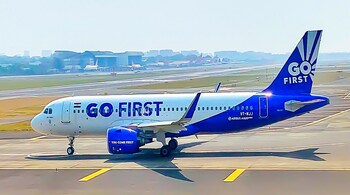
Wadia group-owned Go First has once again deferred its initial public offering (IPO) to raise Rs 3,600 crore till November on weak consumer sentiment surrounding aviation stocks.
"Go First has been advised to wait for the new ATF pricing mechanism to kick in before launching its IPO. The new ATF pricing mechanism is expected to boost sentiment in the aviation sector," a person aware of the airline’s plans said.
ALSO READ: Price war in the sky: Airfares tumble after government lifts fare caps
The airline had planned to come out with its delayed IPO in the second quarter of this financial year, but will now wait for a couple of months before considering a launch.
Another person said that while Go First was optimistic about its IPO on the back of a recovery in domestic and overseas air travel, a weak April-June quarter, accompanied by rising costs of aviation turbine fuel, have caused the airline to delay its IPO plans once again.
Go First's Draft Red Herring Prospectus has expired on August 26 and the airline will need to refile its IPO papers with the Securities and Exchange Board of India (SEBI).
A public issue or rights issue needs to be opened within 12 months of the date of issuance of observations, according to SEBI regulations. This period was extended by six months during the pandemic, but no longer.
This is the third time Go First has delayed its IPO plans since last year. The airline had received approval from the market regulator for its IPO last year but had held back the share sale plan first in August 2021 after SEBI called the promoters, the Wadias, for a pending inquiry, and then in December 2021, Go First further delayed the offering due to the outbreak of the Omicron wave.
The Russia-Ukraine war, which started in February, and the mega IPO of Life Insurance Corporation (LIC) also delayed the airline's IPO plans.
Go First has been planning a listing since at least 2015 when it was known as GoAir.
The IPO market has slowed this year after record funds were raised in FY22. Indian companies sold shares worth $995 million in the January-March quarter of 2022, compared to $2.57 billion during Q1 of 2021, according to EY Global IPO Trends. That was a decline of 60 percent in proceeds raised.
The mega Rs 21,000-crore IPO of LIC made a tepid debut on the stock exchanges, listing at a discount to the issue price.
Jet fuel
Aviation turbine fuel (ATF) prices have shot up almost 120 percent since May 2021, peaking at Rs 141,232.87 per kl in June.
In order to reduce ATF prices in India, the government had asked oil marketing companies (OMCs) to switch to the MOPAG (Mean of Platts Arab Gulf)-based pricing system instead of the prevailing dual pricing mechanism to determine ATF prices.
The new mechanism is expected to help airlines predict ATF price movements based on international prices and help them be better prepared in case global crude prices rise.
Fuel costs now account for 50 percent of overall airline expenses for domestic airlines in India. Airlines in India had to find a way around rising ATF prices even as the industry was stepping up operations to cater to rising demand after two years of the COVID-19 pandemic and fare caps imposed by the government still in place.
Go First plans to use Rs 2,200 crore to be raised from the IPO to reduce debt and repay lessors. The remaining Rs 1,600 crore will be deployed to expand the airline’s operations in India and internationally, including adding flights to Indonesia, Malaysia, Singapore, Sri Lanka, and Nepal.
The airline expects domestic passenger traffic to surpass pre-COVID-19 levels by 5-10 percent by the second quarter of 2022-23 in the absence of a new wave of COVID-19.
The airline plans to convert its entire fleet of Airbus A320 Neos and Airbus A320 Ceos to Airbus A321 Neos. The airline currently has 52 A320 Neos and 6 A320 Ceos in its fleet. Go First plans to take deliveries of 10 aircraft per year until 2023-24 and another 72 aircraft will be delivered between 2023-24 and 2026-27.
Discover the latest Business News, Sensex, and Nifty updates. Obtain Personal Finance insights, tax queries, and expert opinions on Moneycontrol or download the Moneycontrol App to stay updated!





