

India and Russia are considering a semi-floating rupee–ruble exchange rate, potentially fixed on a monthly basis to facilitate bilateral trade. These efforts are aimed at reducing currency conversion costs and to revive momentum in bilateral commerce, according to sources aware of the developments.
Most trade between India and Russia is conducted in local currencies or a third currency like the dirham, given the pressure on dollar transactions due to Western sanctions. This has also been a key part of New Delhi’s efforts to internationalise the rupee.
A direct rupee–ruble exchange rate would help reduce foreign exchange costs, which can be 4–5 percent higher when using indirect currency conversions compared with direct settlement in local legal tenders, an industry source said.
Any such framework would involve coordination between the Reserve Bank of India and the Russian central bank and is part of the ongoing efforts to deepen local-currency trade.
A request for comment sent to the commerce ministry did not receive a response by the time of publication.
The discussions come amid tighter Western sanctions on Russia, which have complicated traditional dollar- and euro-based payment channels and sharpened the focus on local-currency settlement mechanisms.
In 2025, the West stepped up sanctions on Russia. The US placed curbs on Russian refiners Rosneft and Lukoil, which are likely to temporarily affect India’s crude imports. In October 2025, the European Union adopted its 19th sanctions package, banning transactions for banks in Central Asia, restricting EU operators from using key Russian payment systems, and sanctioning non‑EU companies, including third‑country buyers of Russian crude, that help Moscow generate revenue.
The rupee-ruble talk
India started exploring a rupee settlement mechanism with Russia soon after the invasion of Ukraine in February 2022, but this practice failed to pick up given the skewed trade balance between the two sides.
Especially for discounted Russian oil, payments are increasingly being de‑dollarised and routed through UAE dirhams, rupees, and yuan to work around sanctions.
However, given the lopsided trade profile, with significantly higher imports from Moscow than India’s exports, the rupee-ruble trade has yet to gain traction.
Efforts to fix a direct exchange rate also comes amid demands from traders to pay for Russian oil in Chinese yuan, as nearly $60 billion of rupee pile up in Vostro accounts each year due to the widening trade deficit in Moscow’s favour.
India and Russia intensified talks over establishing a direct exchange rate for their local currencies in 2024 when the central banks of the two nations started discussions on working out the modalities for the same.
The idea involves avoiding pegging the exchange rate with the dollar or any other third currency.
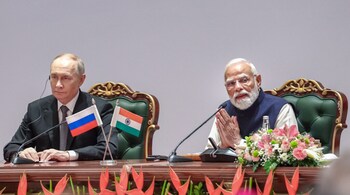
The push on trade and financial cooperation has gathered momentum following recent high-level engagements, including Russian President Vladimir Putin’s visit to New Delhi on December 4-5.
Export boost as trade imbalance widens
India is seeking to scale up exports to Russia and narrow a widening trade deficit, making local currency settlement a need of the hour. While some trade is already being facilitated through settlement in Indian rupees, a second government source said that the mechanism has scaled up only gradually.
The two nations pledged to increase bilateral trade to over $100 billion by 2030, during Prime Minister Narendra Modi's visit to Moscow in 2024.
Total merchandise trade between India and Russia was worth $68.7 billion in FY25, a growth of 5 percent on-year.
But trade between India and Russia remains heavily skewed, with Indian exports at less than $5 billion annually, while imports stand at around $64 billion, largely driven by New Delhi’s purchases of crude oil from Moscow.
An increase in Russian oil purchases, with New Delhi having little to offer in exports, has widened the trade gap.
“There are natural synergies where India can supply, given that Russia has a sizeable import basket of around $200 billion. The country imports a wide range of products, including automobiles, auto components and pharmaceuticals, which it currently sources from other markets. These are sectors where India can look to increase its exports,” the second source added.
This government source said that this forms part of the ongoing discussions and regulators are facilitating the pathway, while businesses now also need to step forward and assess what can be practically realised.
Strengthening rupee trade
The Reserve Bank of India has already taken steps to strengthen the ecosystem for rupee-based cross-border trade, including further simplifying operational rules for rupee settlement arrangements and expanding the permitted uses of accumulated rupee balances held with Indian banks as recently as October.
“These measures are aimed at ensuring that rupees received through trade can be gainfully deployed rather than remaining idle,” the second source said.
Back in September 2023, Russia's Foreign Minister Sergei Lavrov reiterated that Moscow has billions of rupees stored in Indian banks that "unfortunately cannot be used right now", but India had proposed some ways in which this money can be invested.
The first source pointed out that companies still face structural hurdles in using rupees for trade with Russia.
Russian banks continue to advise exporters to open a current account in Indian rupees to facilitate settlements, but operating these accounts for cross-border trade requires obtaining a No Objection Certificate (NoC) from the relevant authorities.
Sources say these procedures have slowed the scaling of rupee-based trade, even as recent RBI reforms aim to simplify procedures and make local-currency settlements more viable.
In November, EEPC India said Indian exporters were facing payment delays due to sanctions on Russian banks. It noted that the rupee–ruble trade mechanism has not functioned smoothly, with some multinational banks of Indian origin reportedly refusing to accept payments from Russia or issue electronic Bank Realisation Certificates (e-BRCs), citing concerns over potential loss of business in North America and Europe because of sanctions on Moscow.
There is a need to establish a robust and reliable direct rupee–ruble exchange mechanism for settling financial transactions between the two countries, EEPC India added.
Discover the latest Business News, Sensex, and Nifty updates. Obtain Personal Finance insights, tax queries, and expert opinions on Moneycontrol or download the Moneycontrol App to stay updated!





