

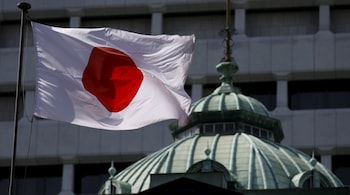
The world economy is caught in an inflation storm. Throughout 2021, most central banks refused to increase policy rates terming inflation as transitory; they remained focused on economic recovery. The Russia-Ukraine war, however, upset many a calculation and led to a jump in inflation. There were concerns that higher inflation will eventually lead to higher inflation expectations. If central banks ignored the spurt they would have lost credibility. Most advanced economy central banks have been pushed to tighten policy rates significantly. However, there is one exception: Bank of Japan.
The economy of Japan has gone through amazing turnaround of fortunes. The Japanese economy was destroyed in World War II but the people and economy picked themselves remarkably well. In 1960, Japan’s per capita GDP was around $8600, one third of the US’s. By 1988, Japanese per capital GDP had touched $35000, surpassing that of the US. During that period, average per capita growth in Japan was 5.2 percent, double that of US.
The Japanese economic miracle ended in 1989 starting with a stock market crash followed by a crisis in banks and non-bank financial instiutions, and a collapse of the overall economy. In 1998, the US economy overtook Japan in terms of per capita income and continued to widen the gap. US per capita income in 2018 was $55,000 compared to $49,000 for Japan.
The Asian economy’s average per capita GDP growth rate during 1998-2018 was 0.76 percent, half of the US average in the same period.
One of the major issues facing Japan’s economy is a low level of inflation since its crisis. Inflation in Japan averaged 2.5 percent in the 1980s and halved to 1.2 percent in the 1990s. Inflation turned into deflation in the 2000s, averaging -0.2 percent before becoming marginally positive to 0.5 percent in 2010-19. In the pandemic phase, inflation again turned negative.
Japan's inflation has remained low as economic activity has remained persistently weak. Japan's average growth since its crisis in 1989 has been 1.2 percent whereas the US grew at an average growth rate of 2.5 percent in the same period. The weak economic activity disincentivises future investments leading to a depressed economic outlook and prices.
Economists warn against both high inflation and deflation. High inflation leads people to bring forward their future consumption and investment. This leads to a vicious cycle—as people rush to buy goods and services, it leads to inflation spiralling higher. Deflation does the opposite. Under deflationary conditions, it is cheaper to buy tomorrow than today. Therefore, people will postpone current consumption and investment to tomorrow. This also leads to a vicious cycle as people defer their consumption and investment plans leading to slowing of the economy and even further rise in deflation.
The policy response is to avoid both high inflation and deflation. In case of inflation, central bank policies are targeted towards lowering aggregate prices. In case of deflation, the policies are targeted towards increasing aggregate prices. While both the set of policies look straight forward, it is not the case. Central banks can still bring inflation down but they have struggled to get out of deflation.
Bank of Japan is a perfect example of its constant struggle to get out of low inflation and deflationary conditions. The central bank tried everything from negative interest rates and large scale monetary stimulus but could not really come out of deflation/low inflationary conditions.
In this regard, it is interesting to see the recent rise in inflation in Japan. After remaining negative during the pandemic, inflation started to become positive in September 2021 and has gradually risen to 2.5 percent, a level last seen in 2008. While other central banks are sweating over high inflation, Japan is sweating whether inflation will go back to deflation levels! Japan had seen rise in inflation earlier too as was the case in 2008 but it was short-lived. Even in 2008, inflation rose on account of high prices of food and fuel items.
Bank of Japan is one of the few advanced economy central banks which has not increased its policy rates. Infact, it is doing the opposite and promising to continue to follow aggressive monetary easing. The short term policy rate remains at -0.1 percent, it has set a target to buy bonds and keep 10 year bond interest rates at zero percent.
Bank of Japan Governor Haruhiko Kuroda in a speech gave three reasons for this policy stance.
First, Japan is still recovering from the pandemic.
Second, while growth in Gross Domestic Product (GDP) in 2021 was 2.5 perent, the growth in terms of Gross National Product (GNP) was just 0.6 percent. GDP computes the income of a country produced within the domestic boundary of a country whereas GNP comprises incomes of all citizens of a country including those living abroad and excludes incomes of non-citizens living in the country. The Japan case seems to imply that GDP may have grown but incomes of citizens have barely grown requiring continuation of the stimulus.
Third, inflation has risen mainly on account of energy prices. If we estimate inflation excluding food and energy items, inflation remains low at 0.8 percent. Thus, the recent rise in inflation in Japan is mainly on account of supply factors whereas inflation in US has risen on account of both higher demand and lower supply. Ironically, Japan needs higher inflation on account of demand factors, something other economies want to avoid.
To sum up, Japan remains an outlier in the world economy. It is one of the few countries which continues to struggle with mostly deflationary economic conditions. There was a time when it was a pride for economies to be called the next Japan whereas today economies want to avoid being the next Japan.
Discover the latest Business News, Sensex, and Nifty updates. Obtain Personal Finance insights, tax queries, and expert opinions on Moneycontrol or download the Moneycontrol App to stay updated!





