

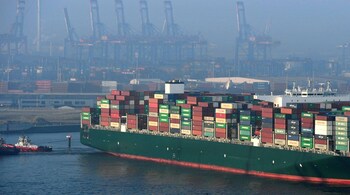
The political and economic uncertainties in Sri Lanka and congestion at Colombo Port, that country’s biggest and busiest, are expected to force more ships to turn to Indian ports in the first quarter of 2022-23, senior government officials said.
Officials said initial estimates suggest around 50,000 twenty-foot equivalent units (TEUs) of cargo are expected to expected to be diverted to Indian ports in April-June.
TEU is a measure of capacity of a container port.
“Our estimates suggest that Chennai Port, V.O. Chidambaranar Port (in Thoothukudi, Tamil Nadu) and Cochin Port will see increased traffic for at least the next three months. The initial study says that 50,000 TEU more cargo traffic will be diverted to these ports in the next three months,” a senior government official said.
Cochin Port started seeing the benefits of this diversion in March. According to data from the Cochin Port Trust, the transhipment volume at the International Container Transshipment Facility (ICTT) in Kochi rose to 13,609 TEUs in March 2022 compared with 8,394 TEUs in March 2021.
According to industry estimates, Colombo handles around 40 percent of Indian transhipment cargo and any disruptions there cause a ripple effect on Indian container trade, making it harder for cargo interests in the region to find other solutions, particularly when vessel capacity is so tight.
Transhipment is when cargo from a vessel is transferred to another for onward shipment.
“We have already started receiving updates from liners on delays and non-performance of shipment in Colombo Port. Port closure would definitely worsen the situation and will force ships into Indian ports,” a logistics pricing manager said.
Senior officials from the Jawaharlal Nehru Port Trust (JNPT), the country’s largest container port located in Navi Mumbai, and Nhava Sheva said they are in discussion with Maersk, the world’s largest shipping company, to divert export shipments from eastern ports in India like the Kolkata and Chennai to the western ports in order to avoid any delays in shipments.
“Around four block trains have been run between the inland container depot in Durgapur (West Bengal) and JNPT in the last two weeks,” a senior JNPT official told Moneycontrol.
Officials added that due to congestion at Colombo, Maersk has been facing delays in its ME2 service which connects countries in Europe with West Asia and South Asia.
The Container Shipping Lines Association (CSLA) expects global shipping lines to increasingly look at Indian ports both on the east and west coasts. Sunil Vaswani, executive director of CSLA, said that Chennai Port or Kamarajar Port (north of Chennai) could be viable alternatives to Colombo.
“Chennai or Ennore could possibly be options but again the issue of deviation could pose a problem, particularly since the mainliners are already struggling to keep to their schedules. Vallarpadam near Kochi (where the ICTT is located) could, therefore, possibly be another option, although all these options are still a work in progress,” Vaswani said.
Sanjay Bhatia, co-founder of digital forwarder Freightwalla, said that while there is an opportunity for Indian ports to increase incoming cargo, handling this increase will be a challenge.
“Colombo is a transhipment port and it will not be easy for shippers to opt for alternative routes as those may not be feasible for international trade,” Bhatia said.
Some experts have also said that an increase in incoming traffic at Indian ports can strengthen India’s case for an indigenous shipping line in the future.
A shipping line is a company that owns and operates fleets of ships to transport goods from the port of origin to the port of discharge. An indigenous shipping line from India can help tackle challenges ranging from severe congestion at key ports to equipment shortages and sky-high freight rates determined by foreign shipping companies that dominate maritime transport.
Senior officials from an import-export trade body said that if Indian ports can handle increased incoming traffic, this presents an opportunity for the government to establish an indigenous shipping line in 2022-23.
“The government should take this opportunity to realise the potential of Indian ports and in order to maintain high incoming traffic to Indian ports set up an Indian shipping company,” a senior official from the organisation said
“According to the World Trade Organisation, maritime transport accounts for nearly 90 percent of global trade. Therefore, an indigenous shipping line from India is crucial for the long-term growth of the country’s economy,” the official added.
The call for indigenous shipping lines has been growing since the outbreak of the COVID-19 pandemic to reduce dependency on large transporters like Mediterranean Shipping Company, Maersk and others for global trade.
Another long-felt need is for more deep-water ports that can handle larger vessels which have greater draughts. One way of achieving this is to use dredgers to deepen ports. Last month, Cochin Shipyard and Dredging Corporation of India signed an agreement to build the country’s first indigenous dredger. The vessel with a 12,000 cubic metre capacity, will cost around Rs 920 crore and is expected to be completed within 34 months.
Discover the latest Business News, Sensex, and Nifty updates. Obtain Personal Finance insights, tax queries, and expert opinions on Moneycontrol or download the Moneycontrol App to stay updated!





