

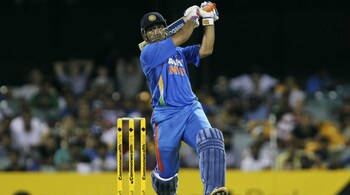
The debate about whether or not he was India's best ever captain will rage even after the world of cricket has dissected each and every moment of his 16-year-old eventful innings.
There is no doubt, though, on Mahendra Singh Dhoni’s enduring impact on life beyond 22-yards. The Ranchi-to-Chennai phenomenon taught India it is important to win but not obsess to win.
Outside of the aspiration arc fuelled by Dhoni’s dare-to-dream syndrome, his illustrious career showcased him as a leader par excellence.
It is important to examine what leadership lessons can India Inc draw from his enduring performance on and off the field.
Early on in his career, Dhoni created a marketing stir with Ernst &Young (E&Y) releasing a report on the rise of the small town hero.
The consultancy firm's report – ‘The Dhoni Effect-The Rise of Other India’ – said that from small-town Ranchi, the cricketer had turned a big-city icon. The report argued that Dhoni's rise epitomised the corresponding rise of small-town India.
That was in 2008! Dhoni today is leadership personified. Here are seven key takeaways for chief executives at corporate India:
1: Build on legacy; respect predecessors
Dhoni is the only captain to win all three limited-overs ICC titles: the ODI World Cup, the Champions Trophy and the T20 World Cup. Only Ricky Ponting has won more ICC titles as captain than Dhoni. He took over captaincy of the T20 team in 2007 ahead of the T20 tournament, and soon after led the country in other formats of the game.
Dhoni got a completely raw team for the 2007 T20 series and had world ranking stalwarts in his 2011 ODI triumph. He never publicly talked either about past captains or his team members. He never over estimated himself even as he was the epitome of confidence.
India Inc is ripe with instances of chief executives launching their innings with a preachy sermon that directly or indirectly paints the earlier leadership in poor light. In the ever-raging debate about the individual and the institution, individual does matter, but not at the cost of the institution.
Dhoni gave respect to the individual, and thus built the institution.
2: Dirty your hands!
Cricket is a game of glorious uncertainties. But what is most certain is that you are as good as your last performance. Stardom might give you an extra innings, but given the highly competitive nature of the game, leaders and laggards are differentiated by the performance on the ground for that particular game. Consistency matters.
Dhoni is rightly credited for being a great cricketing strategic mind, but he would have earned half the respect if he had not performed consistently, both, in front and behind the stumps.
Business leaders, whether promoters or professional chief executives, need to remember and learn from Dhoni that strategy is good to have, but so long as you do not excel yourself in one or more disciplines – operations, sales, alliances, human resources, finance, etc. – your leadership will ever be in doubt. Delegation is good so long as it does not render the business leader as a non-playing captain.
3: Lead from the front
Leading from the front, in case of Dhoni, meant being on top of his game as a wicket-keeper, batter (even with an undetermined slot), and as a captain being responsible for every action on the field.
The multi-tasking didn’t stop at being at your best in one format of the game. It meant being a top performer across various formats thus ever raising the bar. This means living in the moment and leading the charge in whatever the role demands.
Dhoni made virtue of the often debated core competency versus diversification challenge in the corporate world. He clearly saw value in diversifying the skill sets and defined core competency in rising to the challenge.
Chief executives need to learn from Dhoni, the art of taking ownership. Not everything Dhoni touched turned into gold. But he always appeared to be in total command, and didn’t not have to scurry around for mitigation in a difficult situation. The finisher status he deservingly got, showed his utmost capability to lead from the front, even as the asking rate often was beyond reach.
Business leaders have to learn the art to convert an initiative into finitiative.
4: Share credit; take blame
A leader is as good as his or her team. This applies to Dhoni as well, but he never over emphasized his own individual role and always gave credit to the team. His often repeated term in post-match winning conferences was “process”.
Process purity is a critical piece in a business organization. But purity can only be drawn from the top leader. Leader is the obvious pivot, but often leaders become the story rather than the organization or the product and services it offers to end consumers.
Remember Dhoni avoided the spotlight and would comfortably perch himself in a corner in post-match winner pictures. He had his moments of being in company of team members without any undue airs of being a champion captain.
Corporate India boasts of transparency and often well publicised town halls and GBMs define team play. However, it would not be erroneous to say that India Inc is yet to fully institutionalize the idea of giving credit where it is due. Often genuine contribution gets buried under the burden of overgrown layers, masked as hierarchies in the corporate ladder.
The Dhoni syndrome symbolised by his ability to garner global trophies shows that the ultimate winner was the team. A winner team is one that has no room for superstars but only consistent performers. This was first demonstrated by Kapil’s Devils in 1983. But truth be told that corporate generally tend to bloat and be top heavy with little room for recording genuine contributions at the grassroots.
5: Risk appetite
Indian cricket has often fallen prey to its inherent nature to be defensive. The talk here is not about undue aggression which can be counter-productive but about taking calculated risks. Dhoni exemplified this virtue. His decision to hand over the last over to Joginder Sharma created history. Sharma recently told media that Dhoni gave him full support spurring him to put in his best. Rest, as they say, is history!
To be able to take risks, you need a more than fair understanding of the game and the opposition. Dhoni had this great ability to read the game much better than his rivals, and it paid India rich dividends.
In the world of business today as in the past, risk taking capability has paid rich dividends. Companies that stay happy in the status quo situation have either been marginalized or just gone out of the radar.
In the Covid era, though, risk management is a bigger challenge than taking any undue risks. The Covid-enforced business continuity challenges will see the difference between laggards and leaders, and among the key differentiators will be the appetite for disruption. Think out of the box, even if it means taking a well-planned risk.
We have just seen that it is possible to conduct business (at peak Covid time) at a global scale if the leadership aims to make that difference.
6: Promote merit, not loyalty
Credit must be given where it is due. Saurav Ganguly laid the road map for a truly pan-India cricket eleven. Dhoni built on that legacy. As India got addicted to MSD, he expanded the rest of India paradigm bringing in and promoting talent from across the country. His IPL triumph further demonstrated his capability to identify and encourage talent across the world.
Dhoni might have his likes and dislikes but when it came to the playing XI, in whose selection he had a fair say, nothing mattered more than the talent.
His dressing down recently of a famed spinner when he went little astray showed he brooked no waywardness. His magical spell on his team members often showed outstanding results as he plotted batsmen failure behind the stump, engineering the perfect delivery from the bowler.
Corporate India has to learn the push for meritocracy from Dhoni. Personal loyalties must ever play second fiddle to talent and the ability to make a difference on the ground. Chief executives must remember that a true winner is one who boasts of hosting talent irrespective of place of origin.
7: Stay cool!
The ‘Captain Cool’ title will stay with Dhoni forever. It is unlikely that India will ever have a cooler captain that him. Does not going public with your emotions, especially with milling cameras, show you as being inhuman? Not really!
Containing one’s emotions in public is a must to stay focused in a highly competitive game like cricket. And when you are carrying the expectations of 130 crore cricket crazy Indians, the coolness will only yield positive dividends.
Emotion isn’t a bad sentiment. But often it tends to draw you down, especially in a crisis situation.
With several – known and unknown – risks facing Indian businesses today, the need to maintain cool and stay grounded could not have been more perfect.
Discover the latest Business News, Sensex, and Nifty updates. Obtain Personal Finance insights, tax queries, and expert opinions on Moneycontrol or download the Moneycontrol App to stay updated!





