

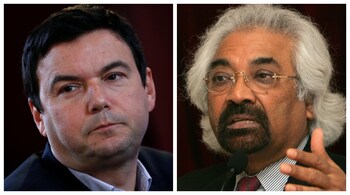
In this election season, income inequality and wealth redistribution has made a dramatic entry into India's political lexicon.
There were three entry points through which these have gained considerable currency over the last few weeks.
In March, a new working paper, titled "Income and Wealth Inequality in India, 1922-2023: The Rise of the Billionaire Raj", by the Paris-based World Inequality Lab has estimated that “inequality declined post-independence till the early 1980s, after which it began rising and has skyrocketed since the early 2000s” and is now more unequal than the British Colonial Raj.
The paper, which has been co-authored by Nitin Kumar Bharti, Lucas Chancel, Thomas Piketty, and Anmol Somanchi, combines data from national income accounts, wealth aggregates, tax tabulations, rich lists, and surveys on income, consumption, and wealth to arrive at the results.
In April, the Indian National Congress in its election manifesto said that it will "conduct a nationwide Socio-Economic and Caste Census to enumerate the castes and sub-castes and their socio-economic conditions. Based on the data, we will strengthen the agenda for affirmative action".
The manifesto also says that the party will "address the growing inequality of wealth and income through suitable changes in policies."
On April 24, senior Congress leader Sam Pitroda sparked off a row when he termed inheritance tax an "interesting idea". Pitroda cited a US example of inheritance tax law. "If a person has property worth US dollars 10 million, then after his death, 45 percent of the property goes to his children and 55 per cent of the property goes to the government," Pitroda told ANI.
Conceptual nuance and the policy clarity appears to have got lost in the din of political narrative that these have triggered. Here are five counters to why Piketty and Pitroda's arguments appear simplistic at best, fanciful at worst:
One, there is a need to distinguish between poverty and inequality. Poverty is an economic construct. Inequality is a socio-economic concept. Conflating the two can muddy analyses.
Also read: Who is Sam Pitroda and how his controversial remarks have put Congress in soup
Economists and policymakers set a poverty line to fix a threshold income to get a headcount of poor people in a country. Households earning below the threshold, or the poverty line, are considered poor. Different countries have different methods of defining the threshold income depending on local conditions.
Income inequality, on the other hand, is a measure to gauge the difference in income levels of high income earners and low income earners in a country. Metrics like the Gini coefficient and the Thiel index are commonly used inequality measures.
Two, inequality can be relatively lower in a comparatively poor society too. This holds true if one compares the Gini coefficient of Indian states. It measures inequality on a scale from 0 to 1, where higher values indicate higher inequality.
Also read: India's former inheritance tax explained
A paper 'Spatial disparities in household earnings in India' by S. Chandrasekhar of the Indira Gandhi Institute of Development Research, Karthikeya Naraparaju and Ajay Sharma of Indian Institute of Management Indore shows that within the eight poorest states, inequality as measured by the Gini coefficient, varies from 0.316 in Bihar to 0.476 in Chhattisgarh, while the estimate of the Gini coefficient is 0.378 in Tamil Nadu and 0.468 in Maharashtra. For India as a whole, Gini is estimated to be 0.446. Bihar’s inequality is lower than Maharashtra and Tamil Nadu, two of India’s richest states.
Three, just how many people have moved out of poverty is the key question that India needs to address. The answer to that question is critical. In 2013, during the erstwhile United Progressive Alliance (UPA) government the question was clouded by a controversy over how the all-important "poverty line" has been fixed.
According to a panel headed by C Rangarajan, the former chairman of the Prime Minister’s Economic Advisory Council, there were 363 million people, or 29.5 per cent of India's 1.2 billion people who lived in poverty in 2011-12. The Rangarajan panel considered people living on less than Rs. 32 a day in rural areas and Rs. 47 a day in urban areas as poor. In contrast, the official estimates using a different methodology suggested by a panel headed by late economist Suresh Tendulkar fixed the poverty line at an income threshold of Rs 27.2 a day in rural areas and Rs 33.3 in cities.
The million-dollar question, however, is: How does one define the poverty line in India, in which old yardsticks may not hold good, either in terms of the food that money can buy, or in terms of defining who the poor are. The multi-dimensional poverty index (MDPI), which the NITI Aayog has come out with, is, perhaps, a better way to measure poverty, instead of a standard poverty line approach. As an illustration, if the poverty line is defined at an income level of Rs 15,000, how would one define a person who earns Rs 15,001?
Four, counting the poor accurately is important for India given its population size and developmental goals rather than seeking to establish a more economically “equal” society. Lifting people out of absolute poverty through empowerment and opportunities remains one of the primary policy imperatives.
Moving millions moving out of poverty and the richer are getting even richer should not be seen as a binary trade off. The focus should be firmly on reducing the count of those defined as poor, rather than trying to bring down the numbers of wealthy to in a flawed quest to establish a more equal society by taking away wealth and assets from the prosperous and giving it away to the less affluent through an inheritance tax. A falling count of the poor would also mean that those previously counted as poor as getting better off.
Five, it is about time to capture evidence from proxy indicators to measure poverty reduction, and also lowering inequality. For instance, an interesting way to measure changes is how people travel. The flight status display board at an airport today makes for a fascinating sight. Tier-2 towns and cities now clearly outnumber the metro and state capital destinations as more Indians are taking to the skies. The data reinforces this. The commercial fleet strength in India has gone up from 395 in 2014 to 714 in 2023, vaulting by nearly 81 per cent, as millions criss-cross across the country's firmament.
Another piece of that shows that mofussils are increasingly getting integrated into the formal money economy. The Indian equity market added around 15.69 million investors in 2023, with Uttar Pradesh leading the pack with 2.31 million, outgrowing Maharashtra. Maharashtra, however, retains the largest investor base at 14.9 million, while Uttar Pradesh and Gujarat come next with 8.9 million and 7.7 million investors.
The heartland is getting financially savvy. Digitisation of financial systems and deeper bank penetration is transforming people's savings behaviour, from locking up money in physical assets such as gold or stocking up cash, to more return-yielding financial assets. This is a socio-economic change that is, perhaps, telling a story of change.
Discover the latest Business News, Sensex, and Nifty updates. Obtain Personal Finance insights, tax queries, and expert opinions on Moneycontrol or download the Moneycontrol App to stay updated!





